Why this component?
Inspect the relevant working facts and interpretation when reconciling an output or investigating an exception.
Connect industrial instruments to the decisions your attendance and payroll processes depend on. Follow the source, understand the conditions and inspect the reasoning behind the result.
Imminently Awards is available on its own, and it is included with Imminently Timesheets and with Imminently Rosters. With Timesheets and Rosters it is Imminently Attendance Management.
Interpret awards, agreements and policies, with a decision report that cites the clauses applied.
Follow one determinationDecision reportsPayroll, HR and industrial relations, and assurance teams can each examine the basis of a result.
See howPayroll, in every modePayroll manages approved, interpreted timesheets within each pay run, resolves errors and releases a run it has checked.
See howOn its ownYour existing timesheet stays in place, connected through a configured adapter. With TechnologyOne, work patterns and approved leave stream through the certified adapter.
See howStaff and managers, in every modeThe IFA module, part of Imminently Timesheets, is used to set out and approve arrangements, including with Awards on its own.
The IFA flowCapabilitiesInstruments, determinations, effective dating, pay code mapping, testing and change modelling.
See the detailThe strategic value is the connection between what the instrument says, what happened at work and why a particular treatment follows.
The instrument is ingested word for word. Rules are written in plain English beside it, each tagged to the paragraph it came from.
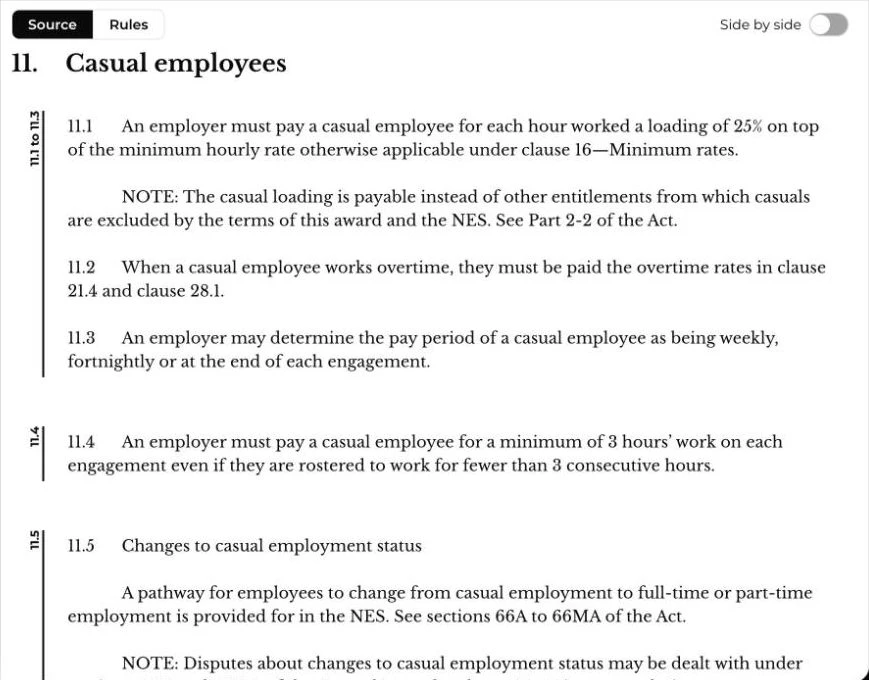
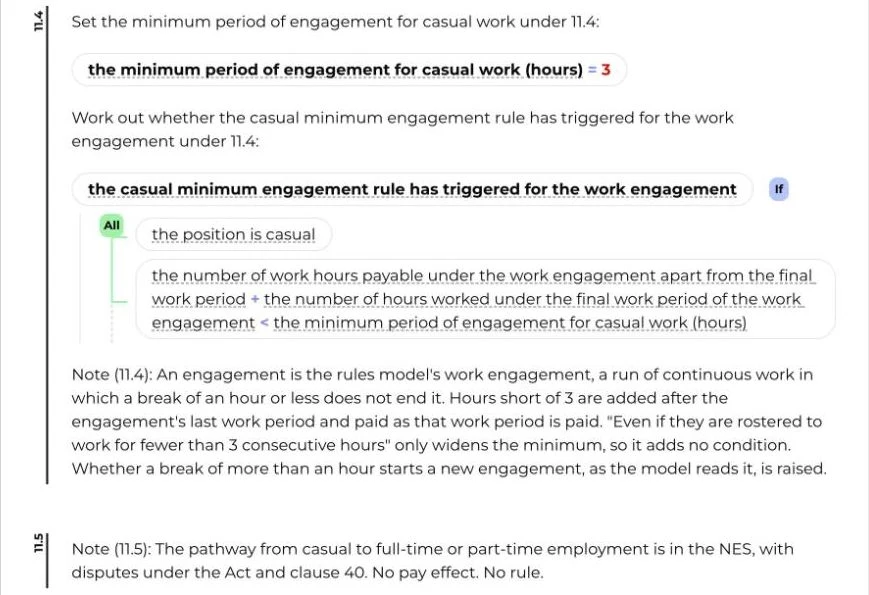
The rule graph shows how the working facts reach each outcome, and which conditions were met.
the employee is working full or part-time hours outside the ordinary for the positionSatisfied
Value:trueAward 13.1 · work period Wed 4.30 pm to 6.00 pm
AllNot satisfied
Value:falseOutside the spread of hours
the position is full or part-timeSatisfied
Value:trueInput
the employee is working for the positionSatisfied
Value:trueInput
Not (the employee is working within the spread of hours for the position)Not satisfied
Value:falseInterpretation
it is during the standard spread of ordinary hoursSatisfied
Value:trueAward 12.1
it is a weekdaySatisfied
Value:trueInput
it is between 6 am and 6 pmSatisfied
Value:trueAward 12.1
AllSatisfied
Value:truePast the daily maximum
the position is full or part-timeSatisfied
Value:trueInput
the employee is working past the daily maximum of ordinary hours for the positionSatisfied
Value:trueAward 13.1
the maximum number of ordinary hours on any day (hours) = 9
Value:9Award 12.2
the overtime rate for the work period
Value:1.5Award 13.3
A decision report shows each conclusion with its reasons and the clauses relied on, for every work period.
Effective 18 January 2027. Clause 12.1 varied.
Effective 3 March 2026. Applies to work on or after that date.
Effective 1 July 2025. Retained for earlier periods and back pay.
12.1 Ordinary hours are worked between 6.00 am and 6.00 pm 7.00 pm, Monday to Friday.
A variation is located by reference, retested and released with an effective date. Earlier periods keep the rules that applied.
The Legal Reasoning Platform’s own views, on one clause of an example award. Actual tests, rates and exceptions depend on the configured instrument.
Establish the applicable award or enterprise agreement, its effective version and the relevant organisational arrangements. Definitions, coverage and related provisions form part of the reasoning context.
Employment type, job, classification, actual time and period context can change the questions that need to be answered. The configured model applies the relevant conditions to those facts.
Decision reporting supports investigation of an outcome by exposing the relevant facts and configured reasoning. Reviewers can examine the basis rather than treating an output code as the explanation.
Use interpretation within Imminently Attendance Management or connect it to an existing front end through an agreed interface. Required facts, output components and exception ownership form part of that design.
Different teams approach the same determination with different questions. A useful explanation helps them focus their review.
Inspect the relevant working facts and interpretation when reconciling an output or investigating an exception.
Review the configured treatment in the context of the source instrument, related conditions and agreed arrangements.
Use the reasoning as part of scenario validation and change review. Establish the evidence and retention requirements for your organisation.
Pay Validation is where payroll teams manage approved, interpreted timesheets within each pay run, resolve errors and release a run they have checked. It is part of Imminently Attendance Management in every mode, including Awards on its own.
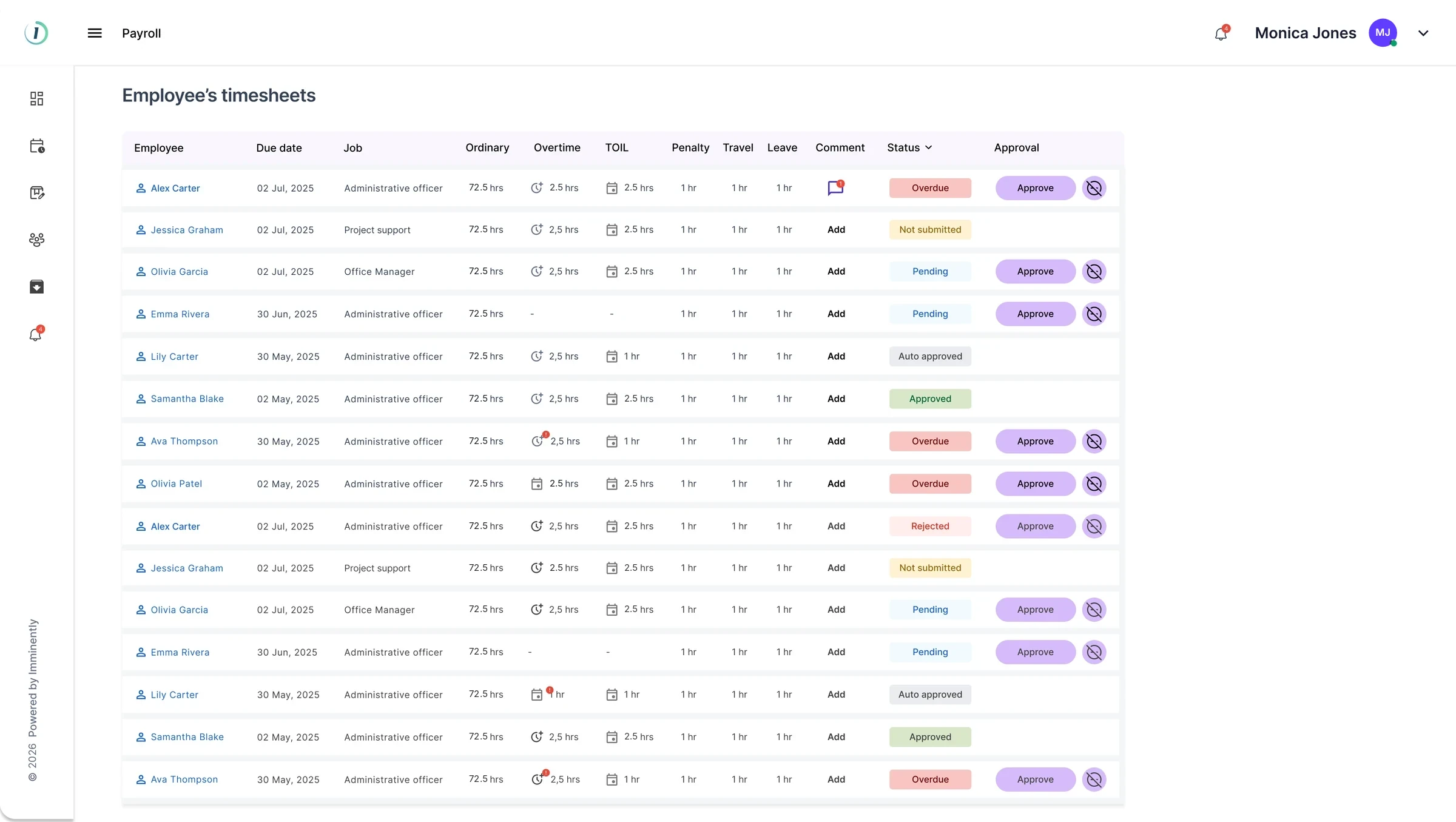
Every pay run moves through the same four stages, and payroll can see where each item is.
Approved timesheets add their interpreted pay items to the run for the period.
Payroll moves the run into review, checks the items and resolves any error.
The reviewed run produces the output your payroll system takes in.
Delivery is recorded and the run is closed.
Approved timesheets contribute interpreted items for the period. Employee, job and pay code travel with each outcome, so payroll can reconcile exactly what is being delivered.
Payroll reviews the run and its items. Each item carries the interpretation behind it, so an unexpected penalty or allowance can be traced to its clause before release.
An item in error is held and resolved before release. Late approvals and corrections go to another run for the same period, and cut-offs are agreed with you during implementation.
Payroll finalises the reviewed run, which produces its output for your payroll system. Delivery is recorded and the run is closed; your payroll system then runs its own processing.
Interprets attendance against your instruments, routes the working record for approval and validates the pay items in each run. We maintain the instrument model as your agreements change.
Runs payroll processing, holds payroll master data and makes payments. A configured adapter carries the run’s output to it. With TechnologyOne, the certified adapter carries it, using the standard TechnologyOne pay codes adjusted for your instruments.
Record accurate working facts and make approval decisions. Together we agree the cut-off calendar and how exceptions are handled.
Imminently Awards is available on its own, for organisations that keep their existing timesheet. Payroll still uses Pay Validation, and staff and managers still use the IFA module.
Imminently Awards works with your existing timesheet, payroll or ERP system through configured adapters. With TechnologyOne, staff record time in TechnologyOne, whose timesheets must be configured to use Record of Attendance entries rather than pay components, and TechnologyOne sends the approved timesheets for interpretation at the end of the pay period, or for one employee by exception. Work patterns and approved leave stream to Imminently through the certified adapter, separately from the timesheets. For a retrospective change, TechnologyOne reopens and resubmits the timesheets, and only the differences come back.
TechnologyOne AdapterOther systemsPayroll manages the approved, interpreted timesheets within each pay run, resolves errors and releases a run it has checked.
Pay ValidationStaff and managers use the IFA module, part of Imminently Timesheets, to set out and approve individual flexibility arrangements.
The IFA flowAwards can sit behind an existing front end through our APIs, or inside another timesheet or rostering product through the SDK. The interface supplies the facts and takes the results, with clear responsibility for exceptions.
APIs and SDKTime is interpreted as it is entered, rostered and approved, and the forms adjust to what the award needs. Retrospective changes, time off in lieu and flexitime are handled in our product.
Explore TimesheetsInstruments are digitised from their legal text and expressed in plain English, mirroring the form of the agreement, so rules stay maintainable by business experts rather than system specialists.
Modern and state awards, enterprise agreements, individual flexibility arrangements, policies and agreed interpretations. Enterprise agreements are configured as overlays, and an employee can work under several instruments at once.
Ordinary hours, overtime, weekend, shift and public holiday penalties, allowances, loadings, on-call and call-back, minimum engagement, higher duties, TOIL and travel time, travel outside span and working from home, as defined by the instrument.
Entitlements that depend on all of a person’s work, such as overtime across concurrent appointments, are determined holistically and paid by the job at the rate of the appointment being worked.
A legal determination report for every employee work period shows which clauses were applied, how they interacted and why the outcome is compliant.
The same facts and rule version produce the same outcome. Artificial intelligence is not used to interpret instruments; analytics can be applied to the engine’s outputs, for example to identify overtime or fatigue patterns.
Historical rule versions are retained, so retrospective changes and back pay are recalculated under the rules in force at the time, with an audit trail.
For staff paid standard hours automatically, only additional items (such as overtime, penalties, allowances and leave in lieu) are sent; all hours and units are sent for staff paid in arrears, so nothing is paid twice and nothing is missed.
Determinations are mapped to the customer’s pay codes, hours and units, with position and, where used, project or cost code, and the mapping is tested before go-live.
Automated scenario packs, including multiple positions and edge-case timesheets, compare outcomes with legacy systems, isolate root causes and provide regression testing for every release and agreement change.
The impact of proposed agreement changes, including bargaining outcomes, can be modelled before they are finalised.
Imminently scopes each instrument, builds and tests the rules, and applies ongoing award and agreement updates. Ongoing changes are included in support.
For NSW councils, the Local Government (State) Award 2026 and the Local Government (Electricians) (State) Award are digitised as a shared base, each rule traceable to its clause.
The rule model is an ongoing service responsibility within the agreed scope, not simply an implementation artefact.
Imminently provides and maintains the agreed instruments. Organisational variations, authoritative interpretation decisions and acceptance responsibilities are established with your team.
Assess the affected dates and scenarios when provisions or facts change. Instrument changes and retrospective corrections need explicit handling across interpretation, approval and payroll delivery.
Prove ordinary working periods and difficult exceptions against agreed expectations. Release governance connects source changes, regression scenarios and operational readiness.
No. It illustrates how source provisions, working facts and reasoning connect. Actual triggers, rates, exceptions and interactions depend on the applicable configured instrument.
No. The attendance determination uses configured deterministic reasoning. The relevant facts and rule version establish the basis for the result.
Yes. Each step in the journey includes an expandable product visual. These are representative views, not screenshots of one continuous overtime transaction.
An Awards-led scope can connect to an existing front end. The interface must provide the necessary facts and consume the agreed results, with clear responsibility for exceptions.
Employee identifiers, pay codes, hours or units and the relevant job or costing attributes. With TechnologyOne, the certified adapter delivers it; for other payroll systems, the layout and destination are set during implementation.
Once a run is in review, later approved items go to another run for the same period. We prove the cut-off, the movement of items and the downstream handling with you before go-live.
No. Pay Validation manages the interpreted hand-off to payroll. Your payroll system performs its own processing and payments.
We will walk from the relevant instrument through the working facts and configured reasoning to the payroll hand-off.