Impairment, care and capacity
Medical and functional criteria, care needs, work capacity, and the income and assets tests, with the links between payments for the person and for their carer.
The interview, from the lawPensions, allowances, concessions and compensation are set out in Acts, regulations, policy guides and operational procedures. Our top-down method turns all of it into source-linked rules with automatically generated tests, so the determinations in scope are automated, accurate and explained against the provisions they rely on.
The rules sit beside the systems you run today. That is what makes a move off legacy and mainframe platforms rapid and safe.
the person is qualified for an age pensionSatisfied
Value:trueQualification
the person has reached pension ageSatisfied
Value:truePension age
the person has 10 years qualifying residenceSatisfied
Value:trueQualifying residence
the person has been a resident for a continuous period of at least 10 yearsNot satisfied
Value:falseContinuous residence
the person has been a resident for periods totalling more than 10 years, one of at least 5 yearsSatisfied
Value:trueResidence in periods
the person has a qualifying residence exemption for an age pensionNot satisfied
Value:falseResidence exemption
Entitlement logic in legacy and mainframe platforms is often decades of code that few people can still read. Rewriting it line by line carries its errors forward. We take the law out instead: the rules are written again from the legislation and procedures, proved against the old system’s results, then put into service in stages.
Rules are written top down from the Acts, policy and procedures, so they carry the intent of the law rather than the old system’s workarounds.
A request and a response connect the rules to the system of record, and a parallel run compares every result. In our pension work, integrated calculations ran this way, and the comparison showed where the source data had gaps.
We move one benefit at a time from the old system to the rules, once its results have been proved. Because the rules can use data the old system does not hold, the law is no longer limited by what the old database can store.
From then on an amendment is a rules release with an effective date, not a change request to the core system. The core platform can be kept, modernised or replaced on its own timetable.
The same rules are applied consistently to every case in scope, with a clear explanation of each outcome. These are the measures that matter to an agency that pays entitlements.
Deterministic rules apply the law as written. The same facts and rule version always produce the same outcome, and each outcome is traced to its provision.
Every determination in scope is calculated by the rules from end to end, with no side calculations and no manual workarounds.
Every outcome returns a plain-English decision report: each conclusion, its value over time and the provision it relied on.
Most entitlement systems hold the law as code, written from someone’s reading of a specification. Change is slow, and no one can show which provision produced a payment. We start at the top: the Acts and regulations, then the policy guides, then the operational procedures, and every rule keeps a link to the words it came from.
Acts and regulations first, then the policy guides, then the operational procedures. Each is loaded with its structure and wording intact, and stays beside the rules for as long as they exist, so nothing is paraphrased away.
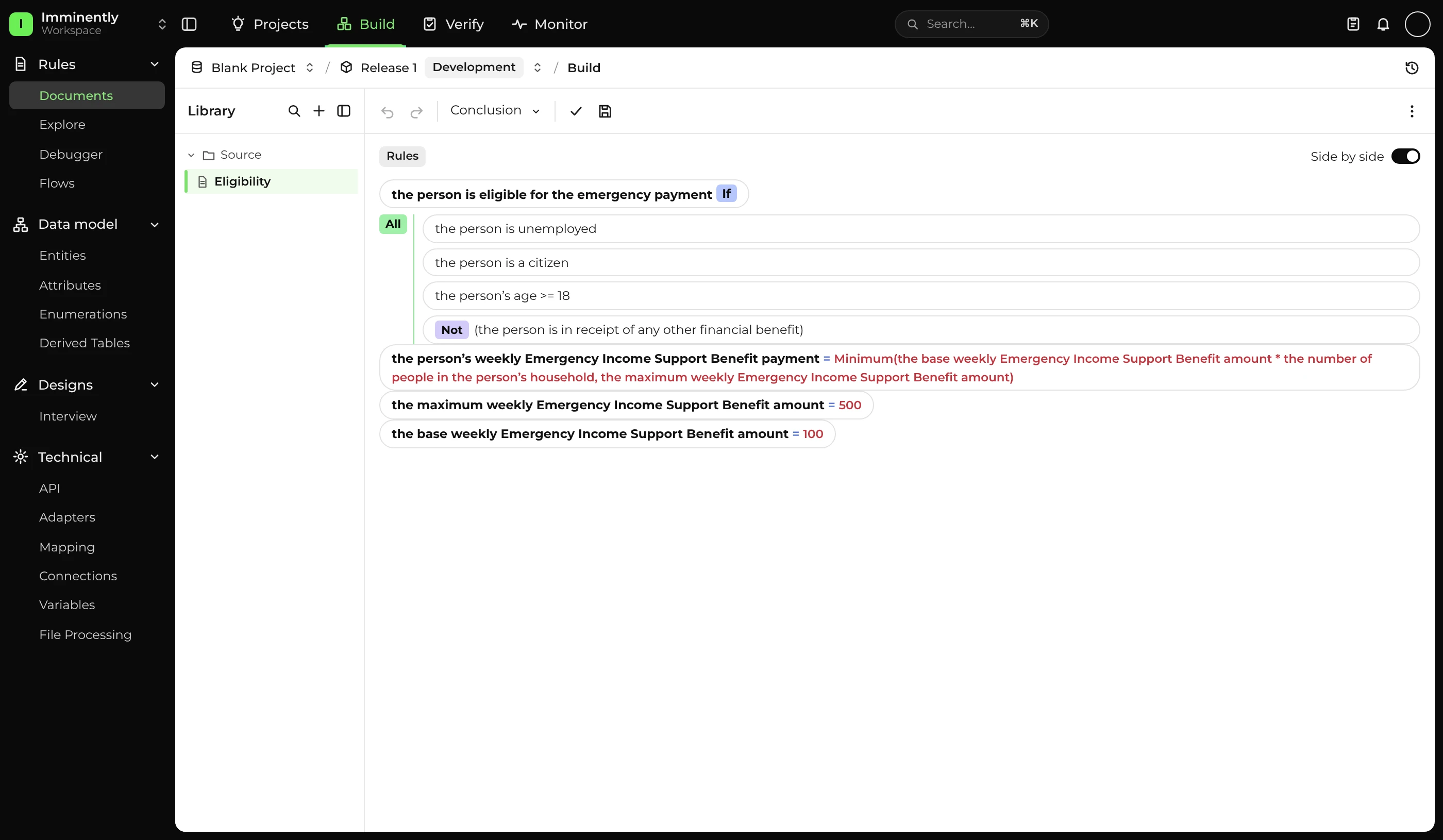
Rules are written in plain English that policy and legal specialists can read and check, inside the provision they come from. Here, the eligibility and payment rules of an example payment, with their All and Not conditions.
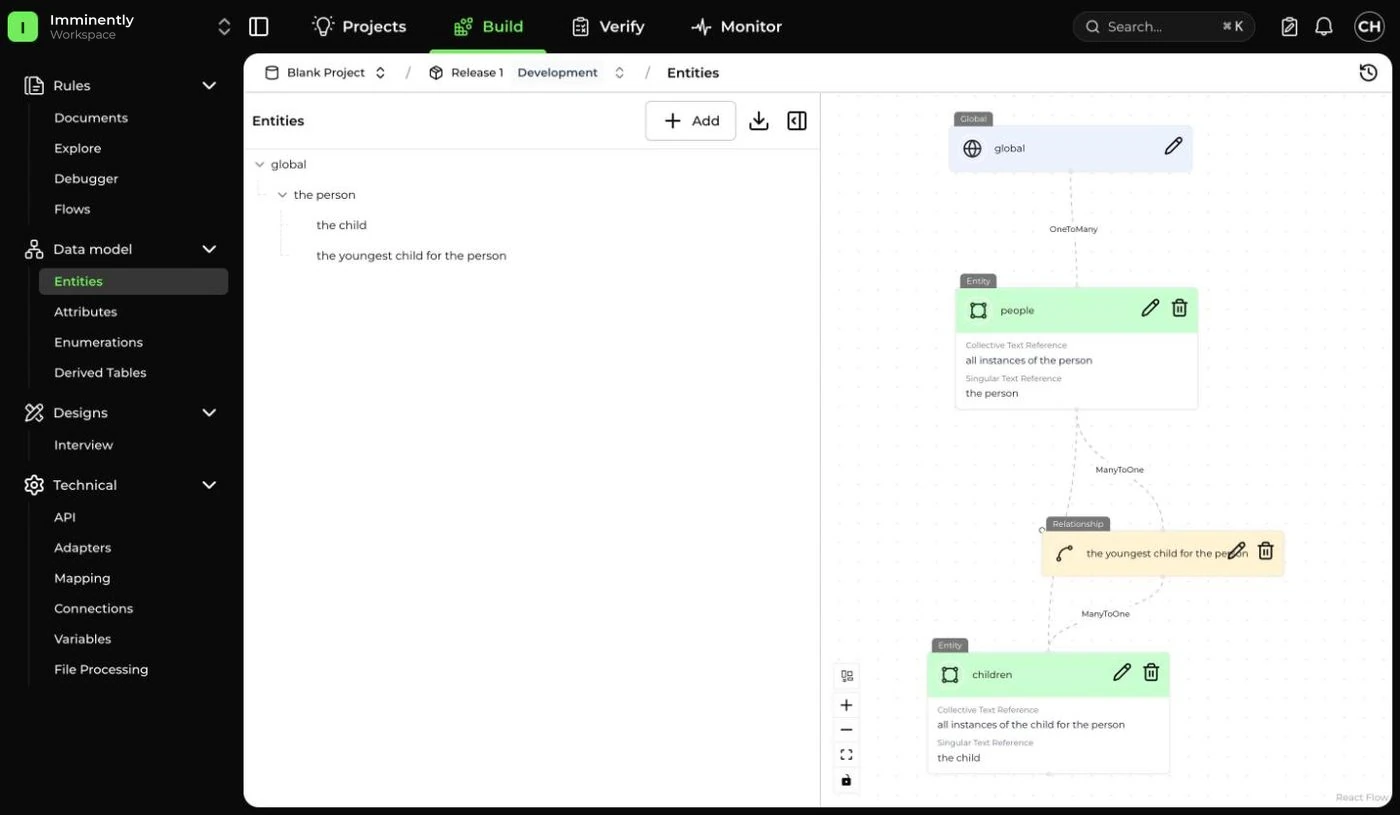
From the rules, our product generates a unit test for every rule, the data model, the rule graph and the Decision API. Business scenarios then confirm the outcomes policy owners expect. Here, the entities an example payment’s rules speak about: the person and their children.
| Case | Determination | Status | Outcome | Existing system |
|---|---|---|---|---|
| C-10482 | Age pension, new claim | Complete | True | Match |
| C-10483 | Age pension, change of income | Complete | True | Match |
| C-10484 | Disability support pension, review | Complete | False | Match |
| C-10485 | Age pension, assets revalued | Complete | True | Difference: data gap |
| C-10486 | Age pension, partner deceased | Complete | True | Match |
| C-10487 | Disability support pension, new claim | Complete | True | Match |
The rules run beside the system you have today. Each case goes to both, and the parallel run compares the results. Every difference is traced to its cause: a rule to refine, a gap in the data or a defect in the old logic. Each run is recorded with its outcome and processing time.
When a benefit’s results are proved, its determinations move to the rules while the existing platform keeps paying, recording and corresponding. Each benefit after the first starts sooner, because much of the model is reused.
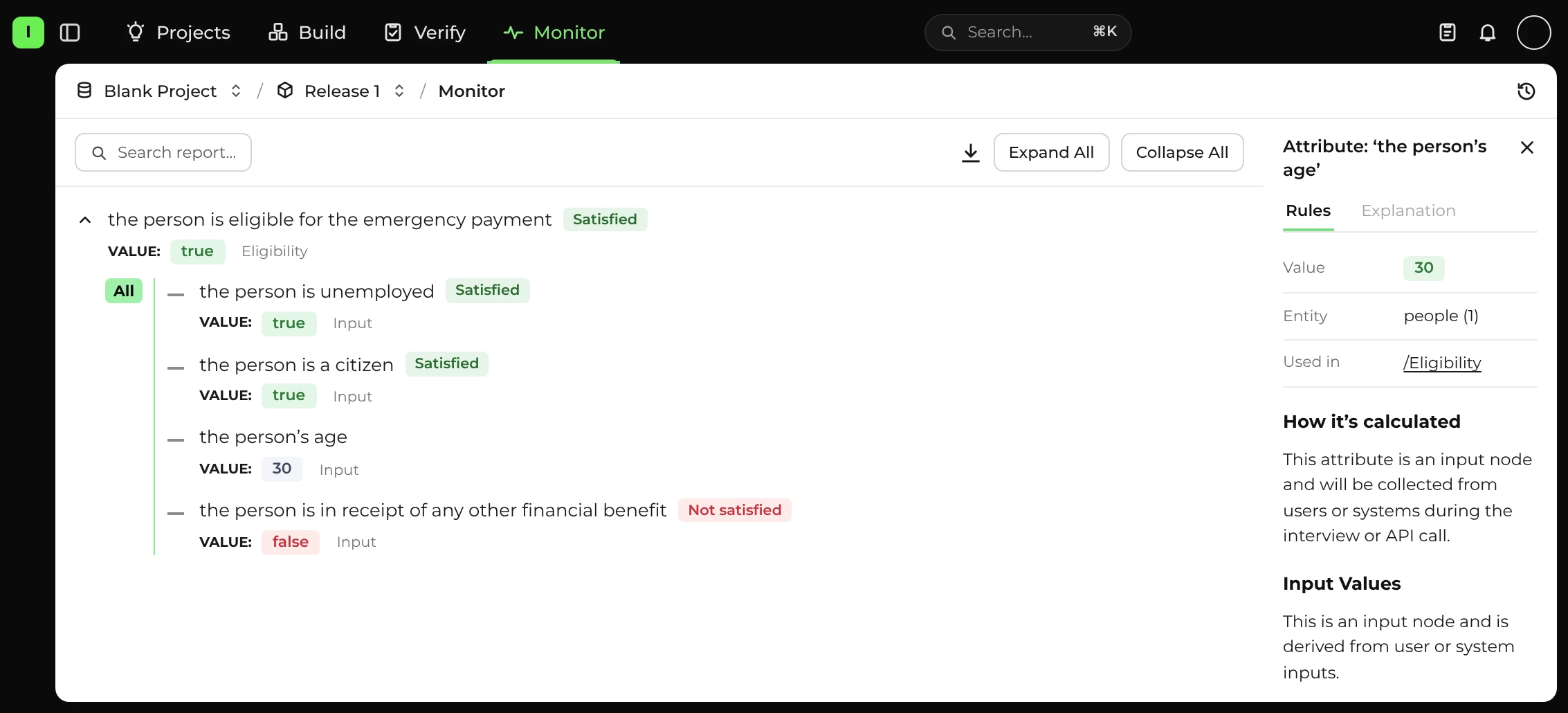
Every rule carries the section it came from and shows where it is used, so an amendment leads straight to the rules it affects. They are updated, retested and released with an effective date, and earlier periods stay under the law that applied at the time.
The screens show the Legal Reasoning Platform on an example payment.
Pensions are among the hardest entitlements to automate: qualification, residence, income and assets tests, rate calculators, supplements, payability and constant change of circumstances, all interacting over time.
Wherever an entitlement is set out in legislation, policy and procedure, the same method applies: the law in, source-linked rules and tests, and a decision report out.
Passports, visas, concession cards, carer support and grants are each set out in law, with conditions, exceptions and rules of evidence. Our product turns those rules into a guided experience: only the questions that apply, why each one is asked, and an answer that names the provision behind it.
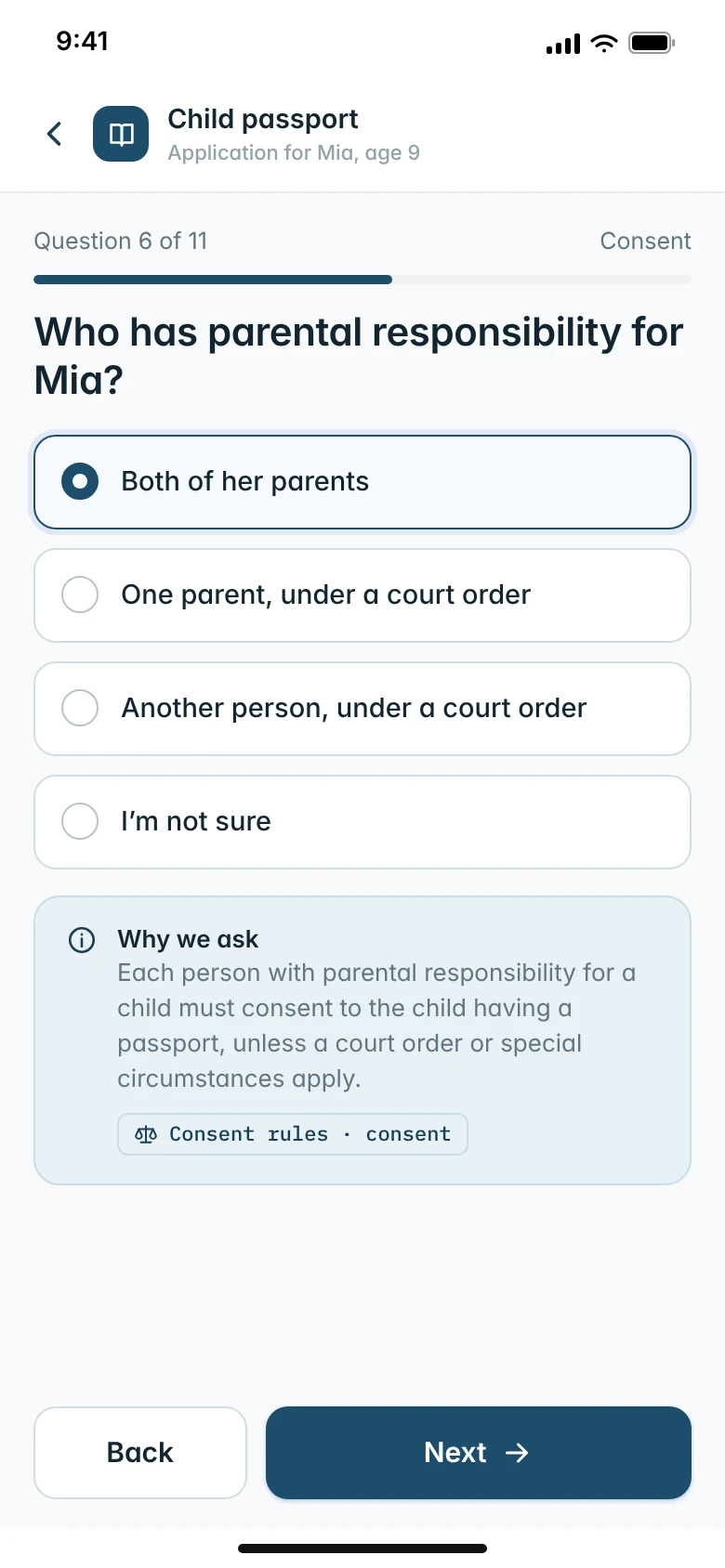
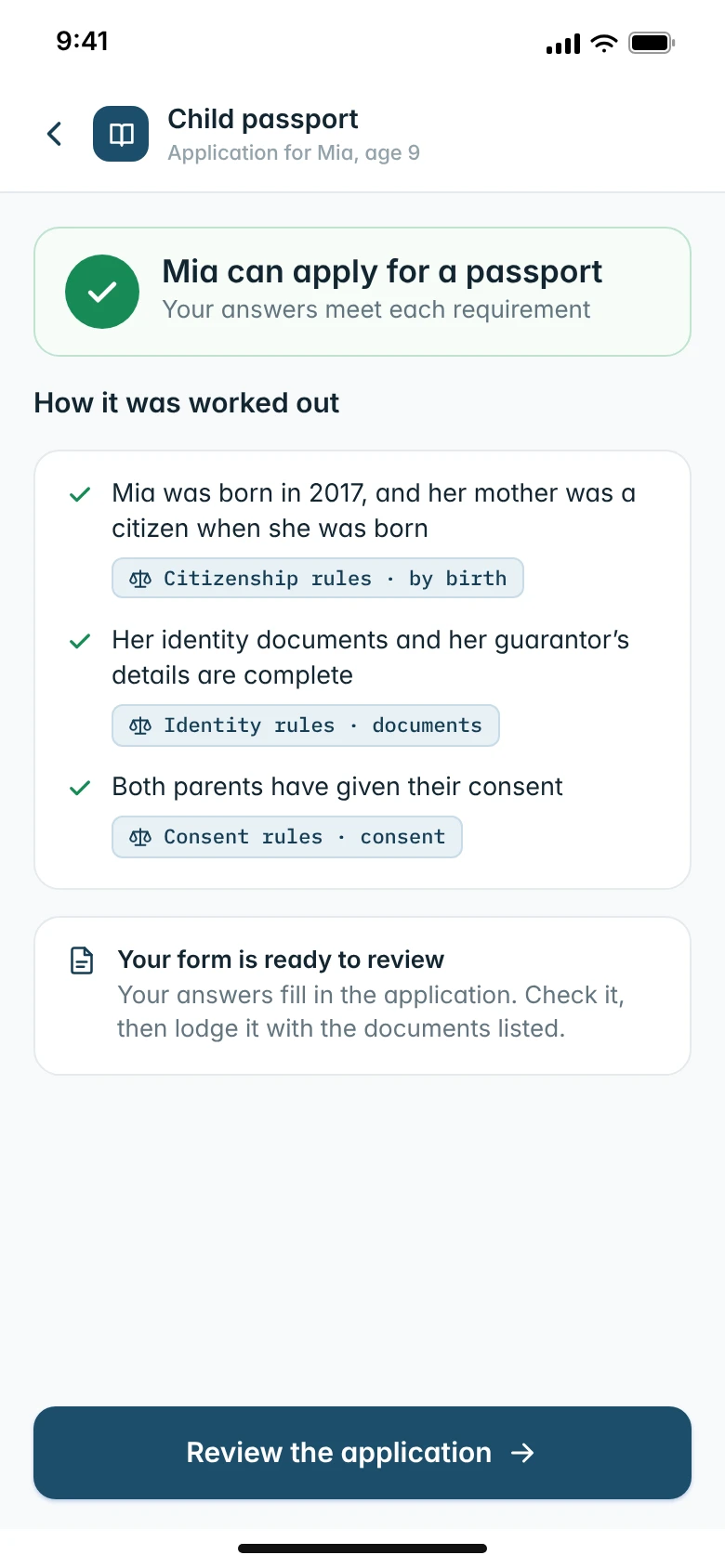
The parent is asked who has parental responsibility, because each of them must consent to a child having a passport unless a court order or special circumstances apply. The answer shows citizenship, identity and consent, each met.
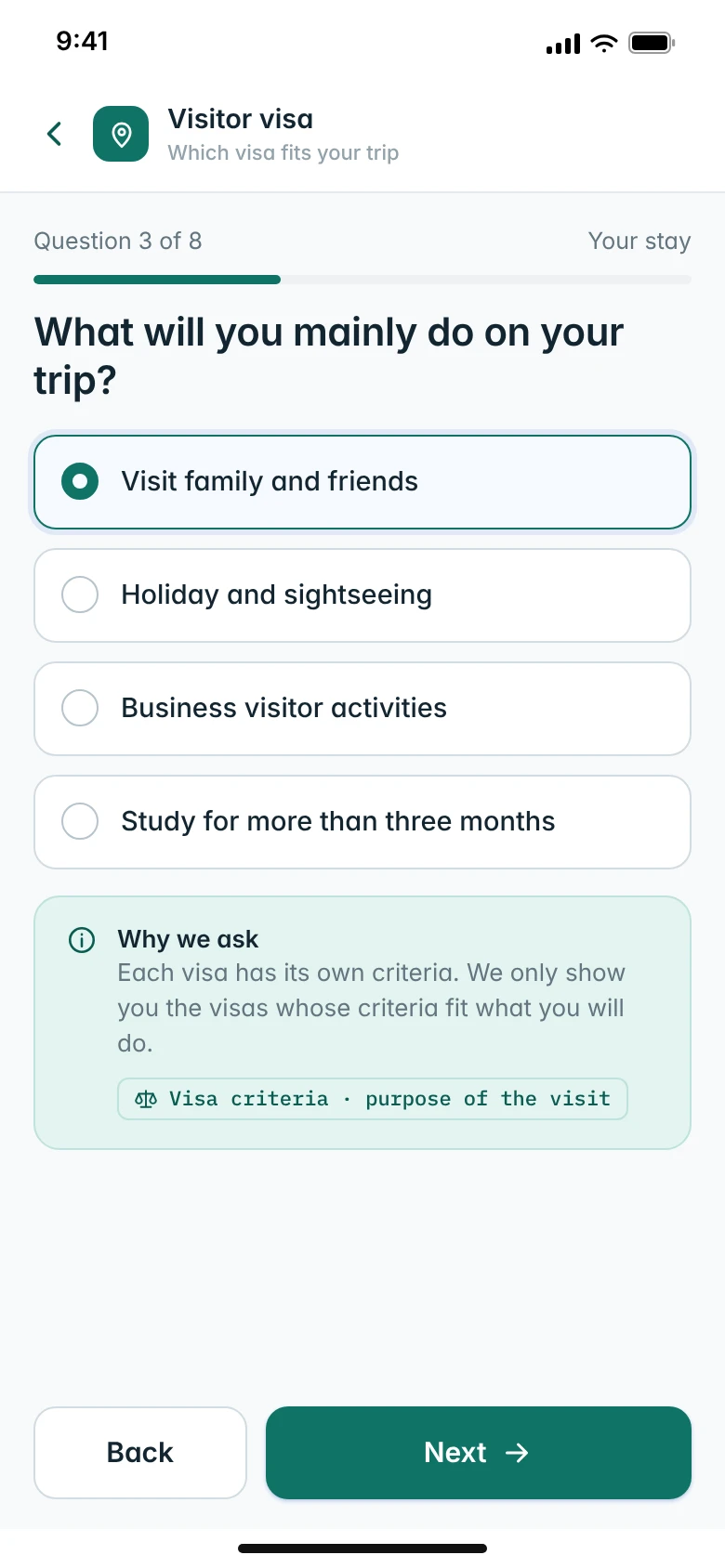
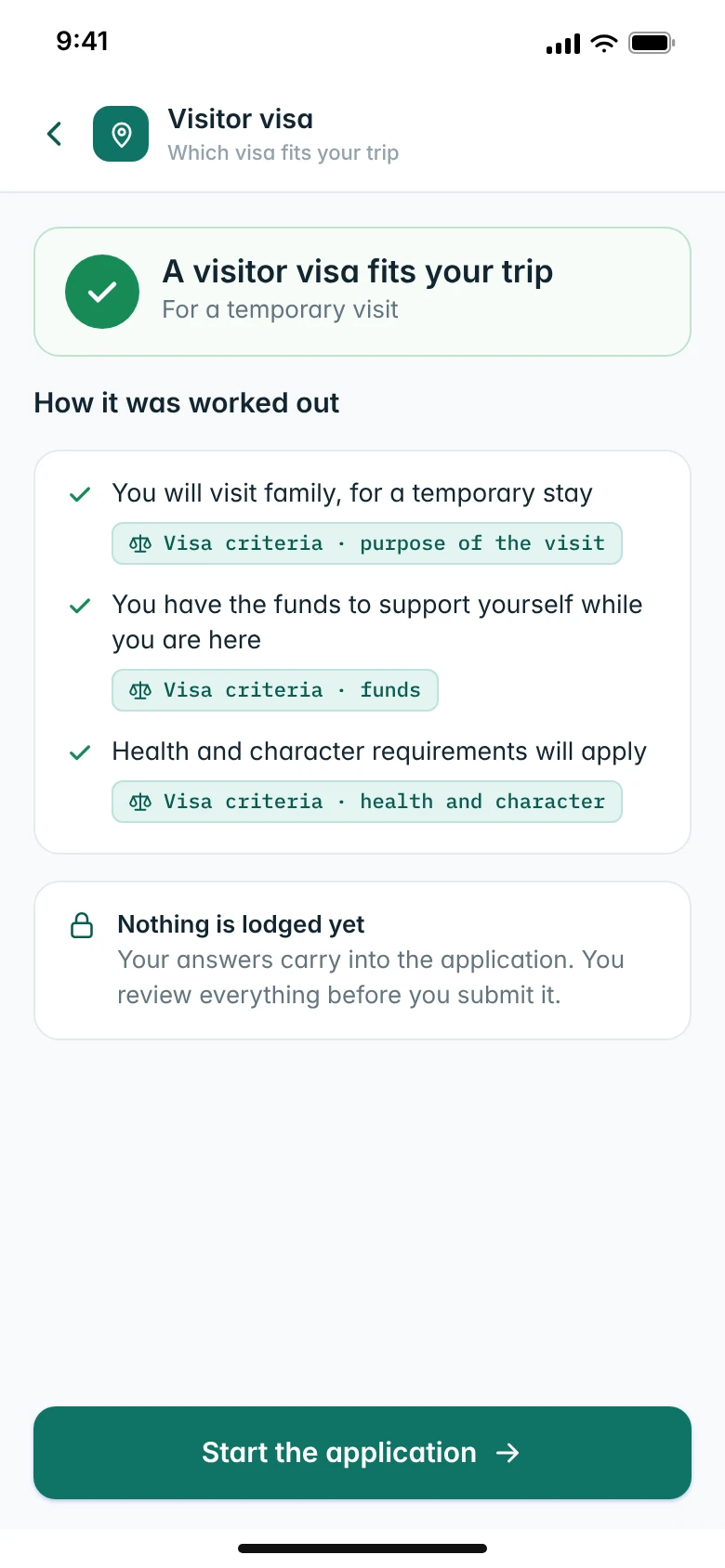
The visitor says what they will mainly do, and only the visas whose criteria fit are shown. Each visa has its own criteria, and health and character requirements apply to every application.
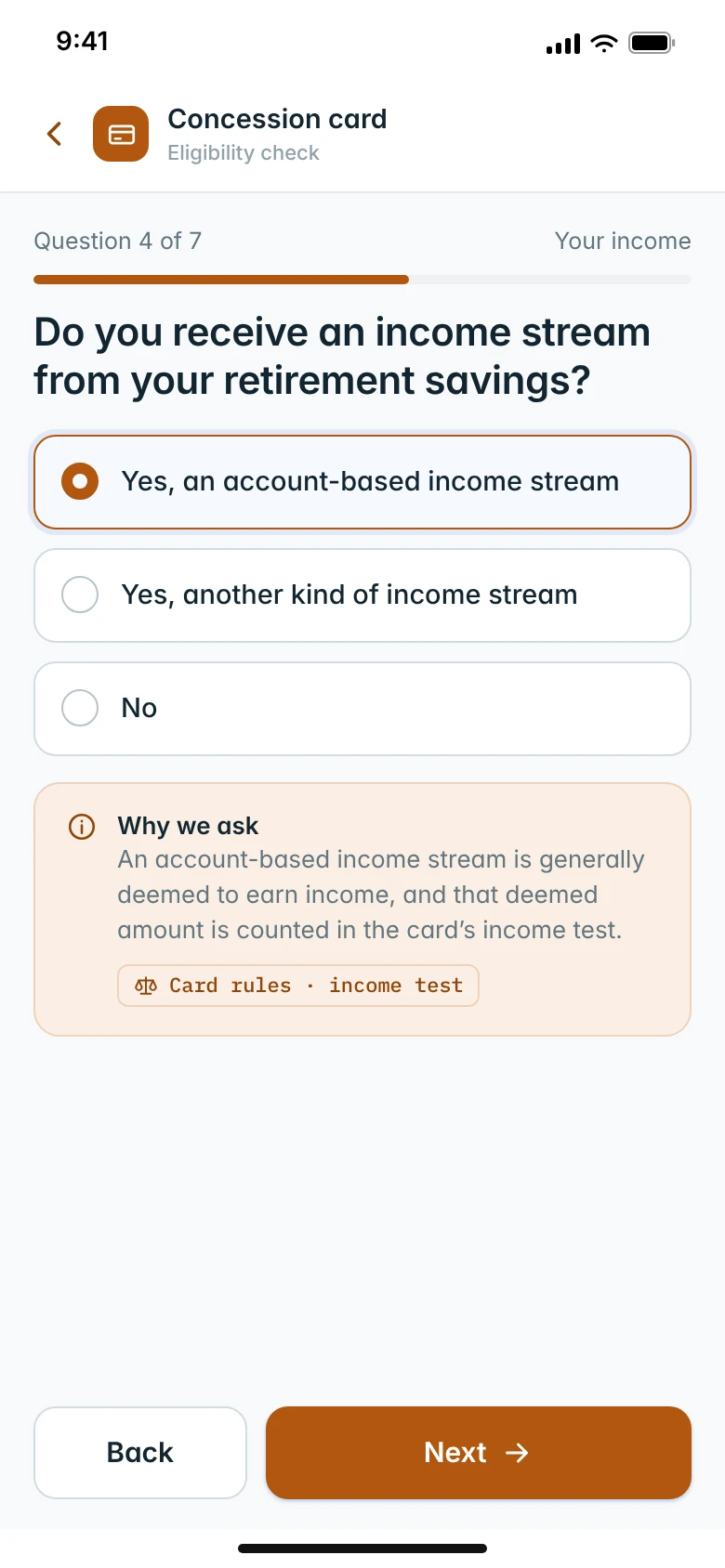
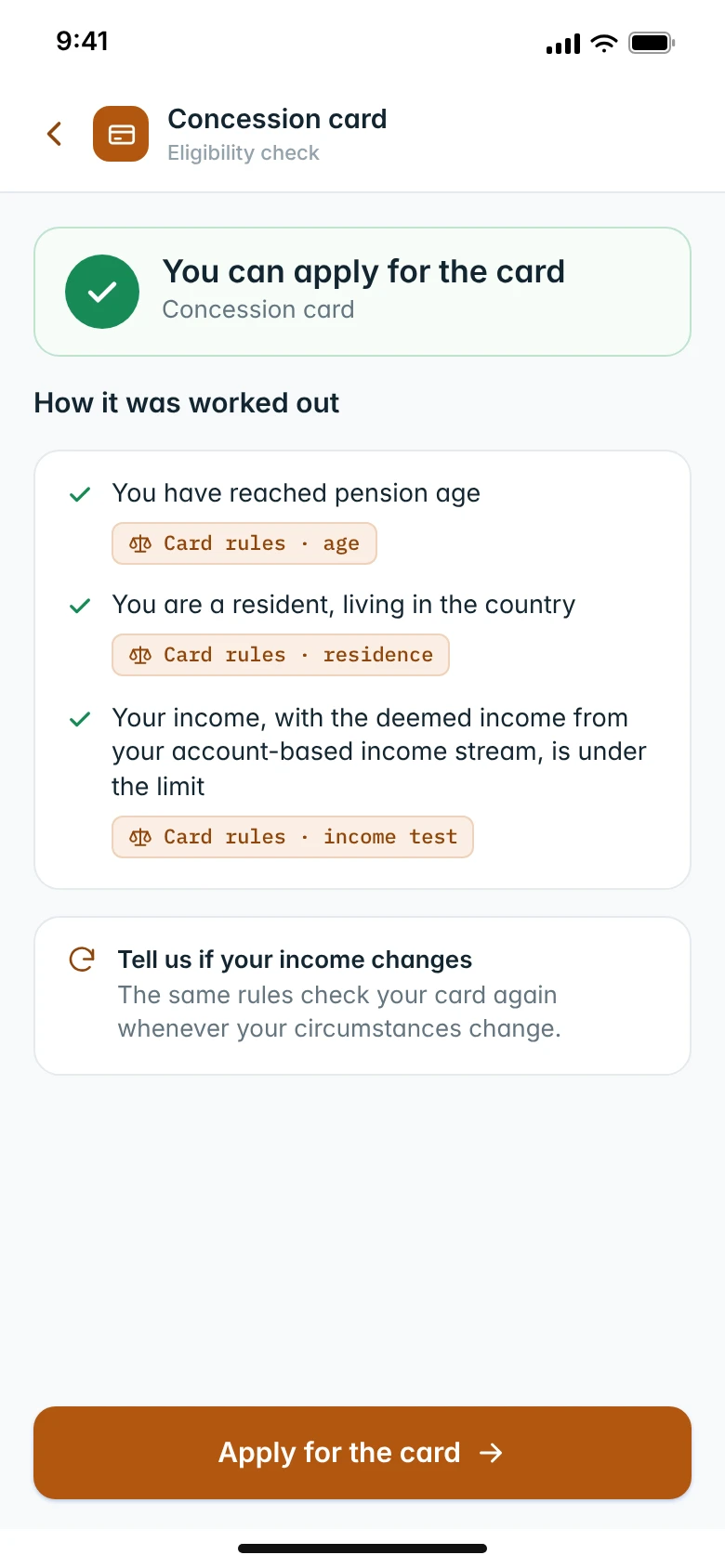
The person is asked about any income stream from their retirement savings, because it is generally deemed to earn income for the card’s income test. The answer sets out age, residence and the income test.
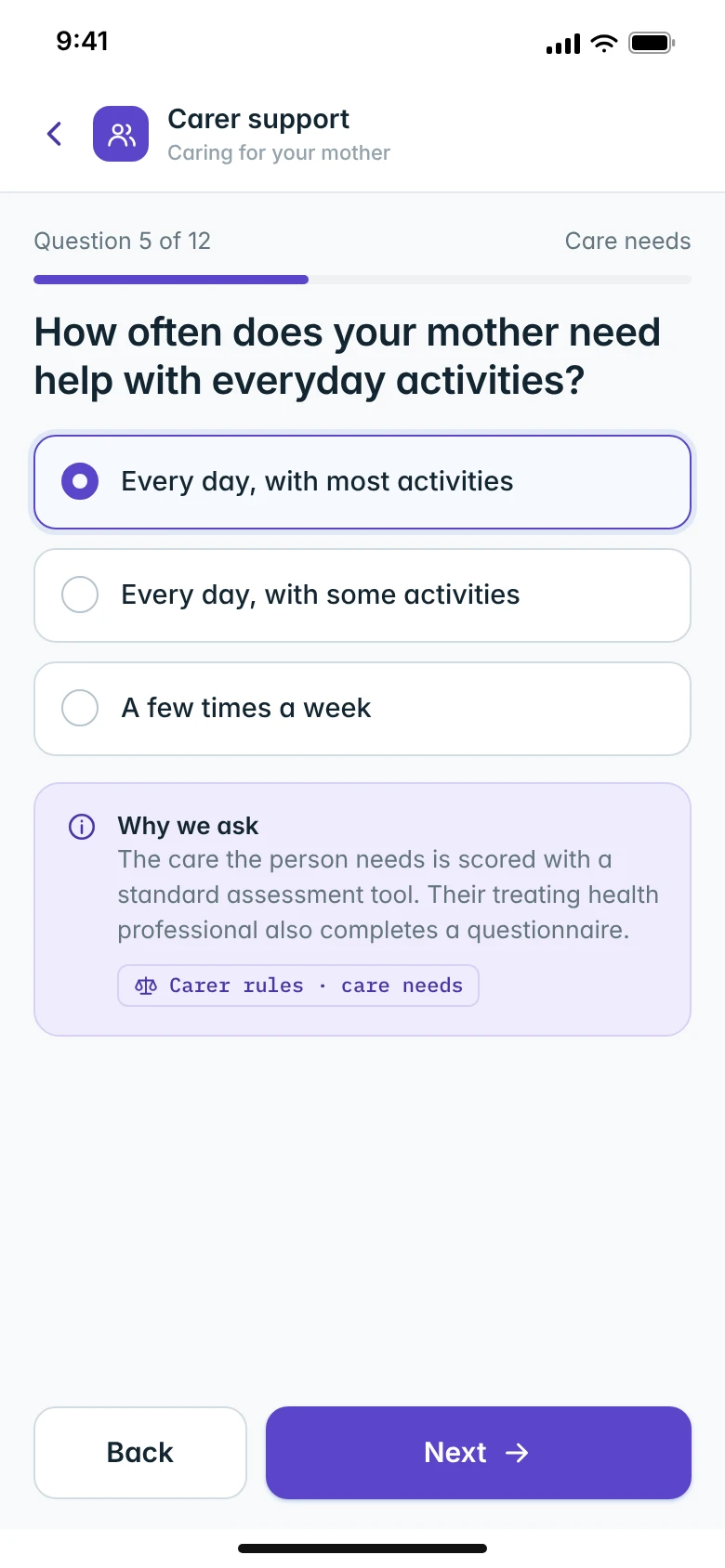
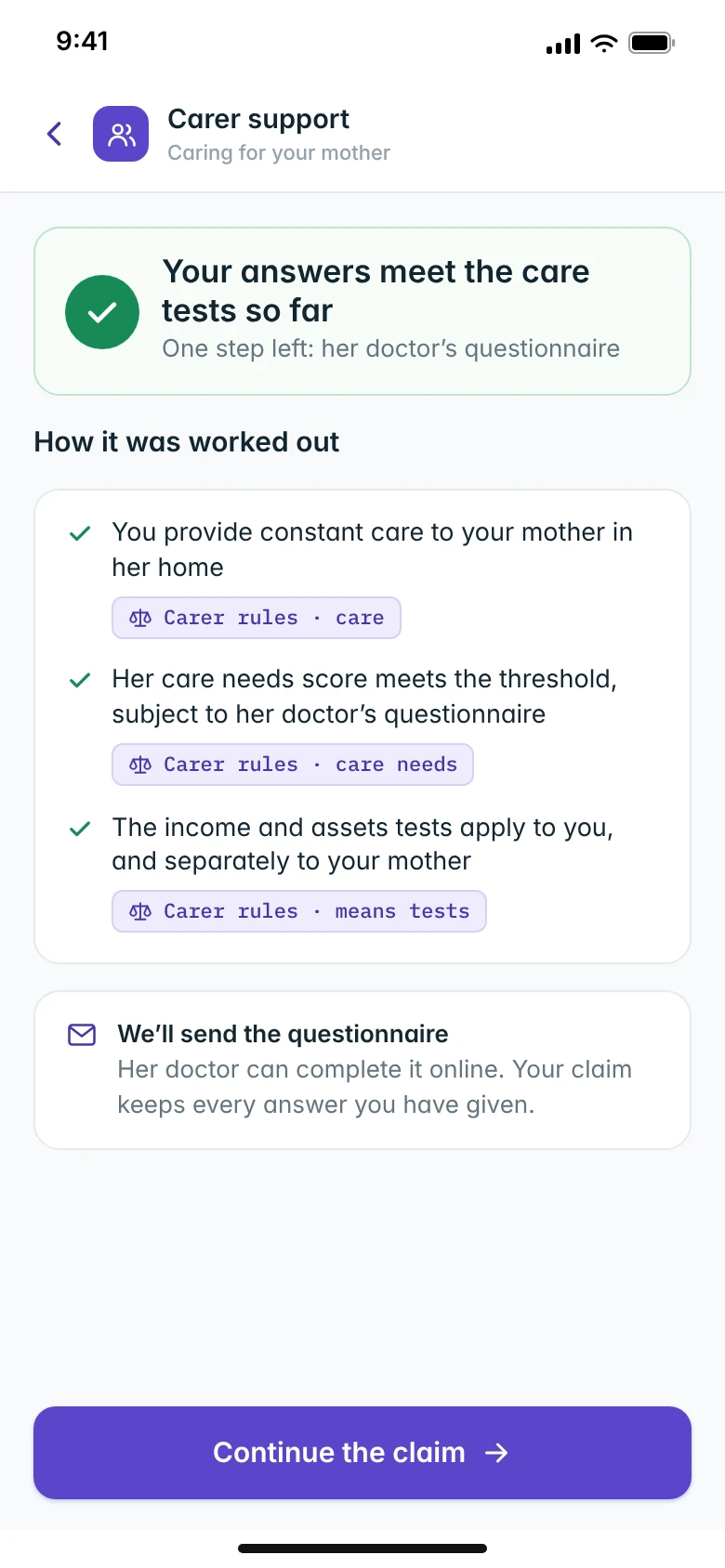
The carer describes the help their mother needs, which is scored with a standard assessment tool, and sees which tests are met and what is still needed: her doctor’s questionnaire. The income and assets tests apply to the carer and, separately, to the person cared for.
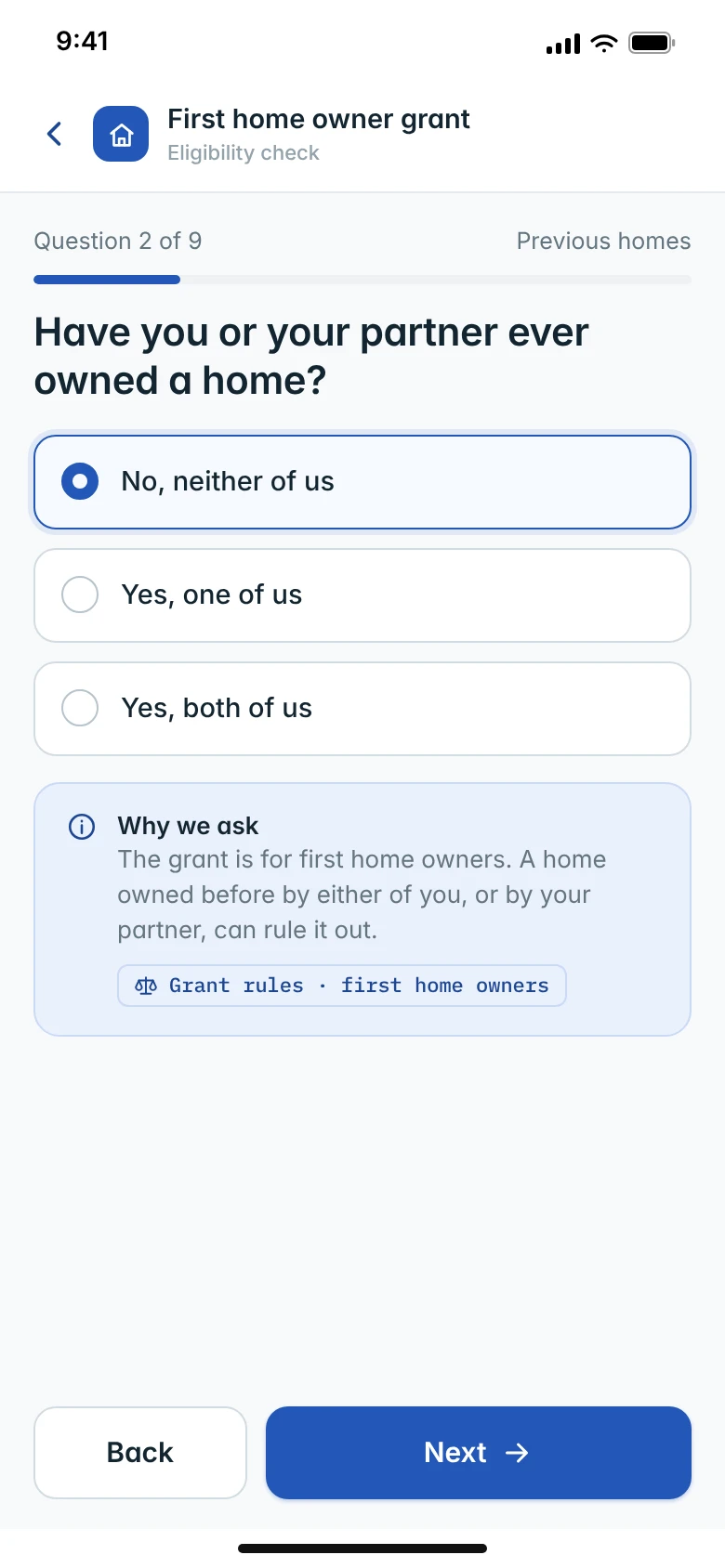
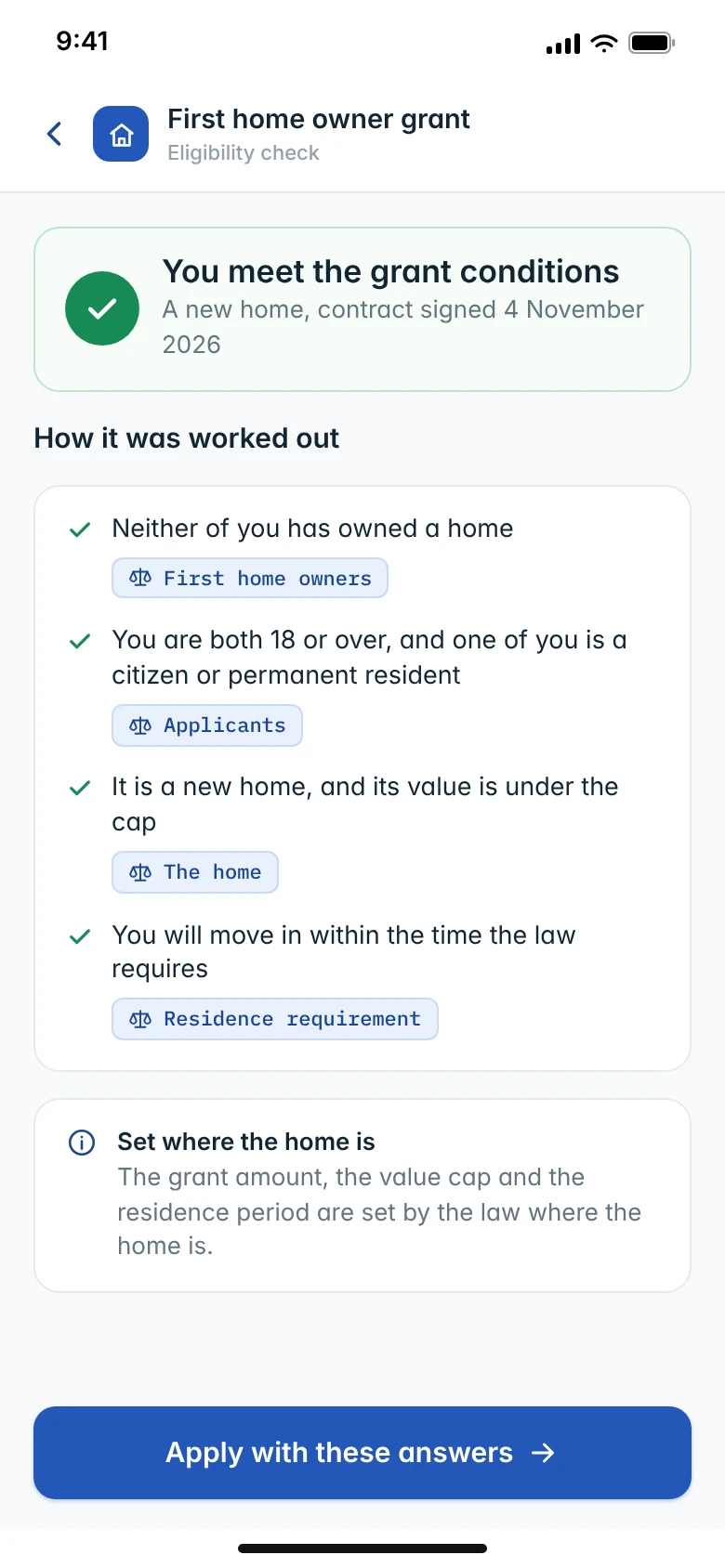
First home owner grants are set by the region where the home is. The buyers see each condition met: first home owners, age and citizenship or permanent residence, a new home under the value cap, and moving in within the time the law requires, with the amounts set by the law where the home is.
What our product makes possible wherever an entitlement is set out in law. The people and the amounts are an example.
Medical and functional criteria, care needs, work capacity, and the income and assets tests, with the links between payments for the person and for their carer.
The interview, from the lawFamily income tests, care arrangements, subsidised hours and rates, recalculated as income and care change, with checks that support payment integrity.
Concession cards, utility, transport and rates rebates, maintained once and used by every counter, portal and calculator that offers them.
Service pensions, and compensation for a service-related injury or illness, are decided under separate schemes that refer to each other. Each has its own tests and offsets. Our pension rules already draw on veterans’ legislation where the schemes interact.
Two schemes, one answerWeekly payments and their step-downs, medical and incapacity entitlements, and offsets against other income, each explained to the section.
Superannuation salary, birthday reviews, scheme rules and benefit calculations for defined benefit members, with the history that explains each figure.
Independence criteria, parental and personal income tests, and rates that change with study load and living arrangements.
Program guidelines, eligibility criteria, payment rates and means testing applied consistently, and explained to the applicant and the assessor.
The pension law sets out who is qualified for the disability pension: an impairment rated at a set level or more, a continuing inability to work or participation in a program of support, age, and residence. Our product turns those conditions into a guided interview: one question for each condition that needs an answer, in the provision’s order, each with the condition it comes from.
A higher-rate disability pension is a choice offered to a person with a service-related impairment under one scheme, and its maximum weekly amount is set by reference to the rate under another. Our product applies the eligibility criteria to the person’s facts and shows each one, with the condition it comes from.
When the criteria are met, the decision-maker must offer the choice in writing. The person has 12 months to choose and must first obtain financial advice.
the person is eligible to be offered the choice of a higher-rate disability pensionSatisfied
Value:trueEligibility
the person is receiving incapacity compensationSatisfied
Value:trueInput · Incapacity compensation
the impairment is likely to continue indefinitelySatisfied
Value:trueInput · Duration
the person is not pension age or olderSatisfied
Value:trueInput · Age
the impairment constitutes at least 50 impairment pointsSatisfied
Value:trueImpairment points
the person is unable to undertake remunerative work for more than 10 hours per weekSatisfied
Value:trueInput · Capacity to work
rehabilitation is unlikely to increase the person’s capacity to undertake remunerative workSatisfied
Value:trueInput · Capacity to work
the maximum weekly amount
Value:one half of the fortnightly rateMaximum weekly amount
As an example of what our product makes possible, the payroll officer starts from what needs attention, then works through the members due for review. Each review compares previous and current salary for superannuation, component by component, and keeps the history that explains it.
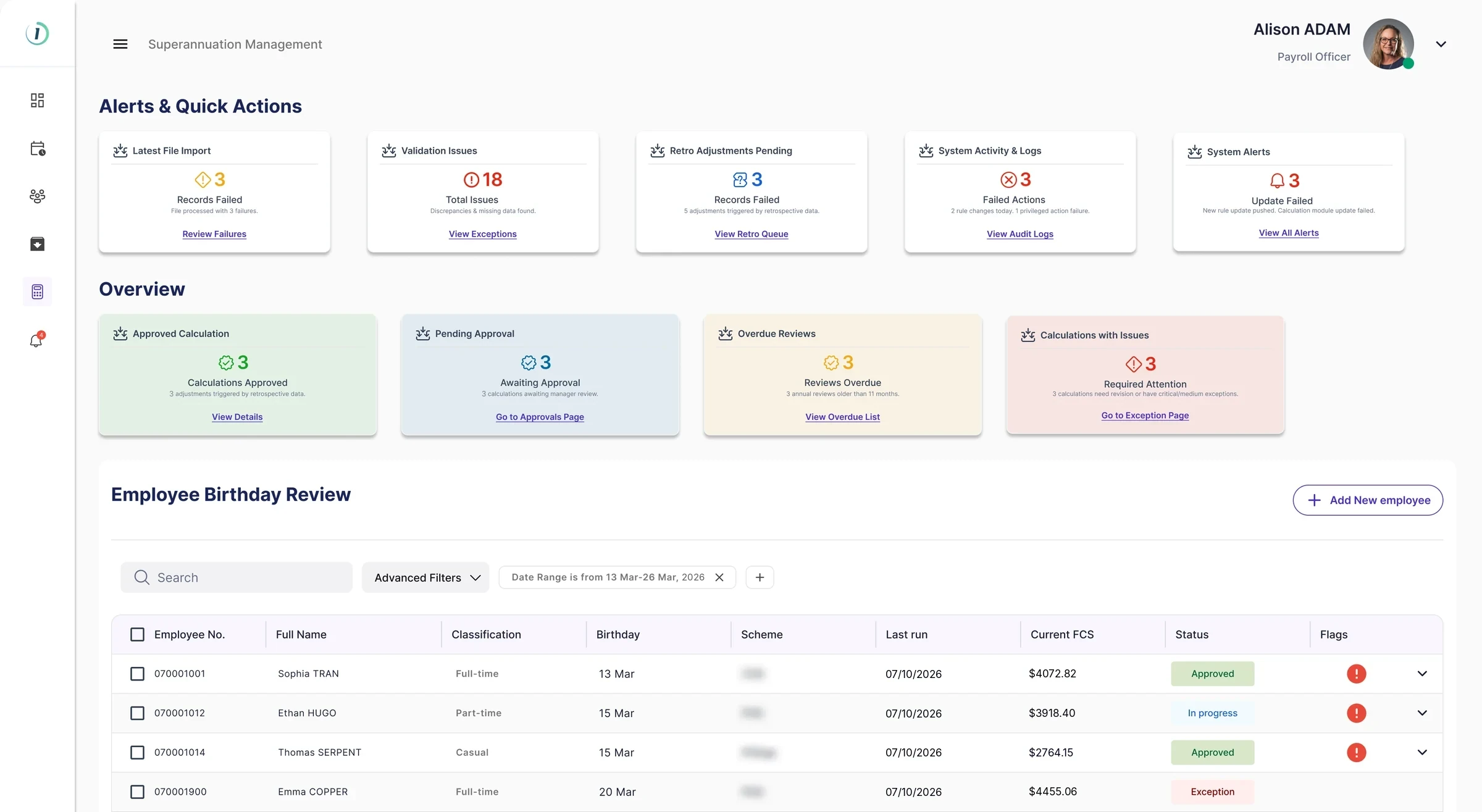
The rules are deterministic and written from the law itself. Interpretation is agreed and tested when the rules are authored. At run time the same facts and rule version always produce the same outcome, with the provisions relied on. If the data supplied is incomplete or wrong, the decision report shows which fact made the difference.
No. We write the rules from the legislation, policy and procedures, then prove them against your existing system’s results in a parallel run. Where the two differ, the decision report shows which provision decides the case.
Its role does not. It calls the Decision API, or the Batch API for bulk runs, supplies the facts and receives the determination with its report. Payments, records and correspondence stay where they are.
Yes. Rule versions carry effective dates, so each period is assessed under the law in force at the time, within a single determination.
No. Determinations come from the rules and the facts supplied. AI can help people author, test and question the rules; it does not decide the outcome.
Inside your environment. Our product is designed for customer-managed cloud, within your network and security boundary. Imminently holds ISO 27001 certification and a SOC 2 Type 2 report.
We deploy the top-down method for your entitlements, with your Acts and regulations, policy guides and operational procedures loaded as source-linked rules. When the law or the policy changes, the affected rules are found by their provision, updated, re-tested and released from commencement, as part of the service.
We will take one provision from the law to rules, tests, a decision report and an interface your systems can call.