Every assessment,
explained to the clause.

One governed rules layer for rates, land tax, duties, payroll tax and concessions. Officers see every liability with the law behind it, notice runs for the whole roll are reviewed before release, and ratepayers read why they pay what they pay.

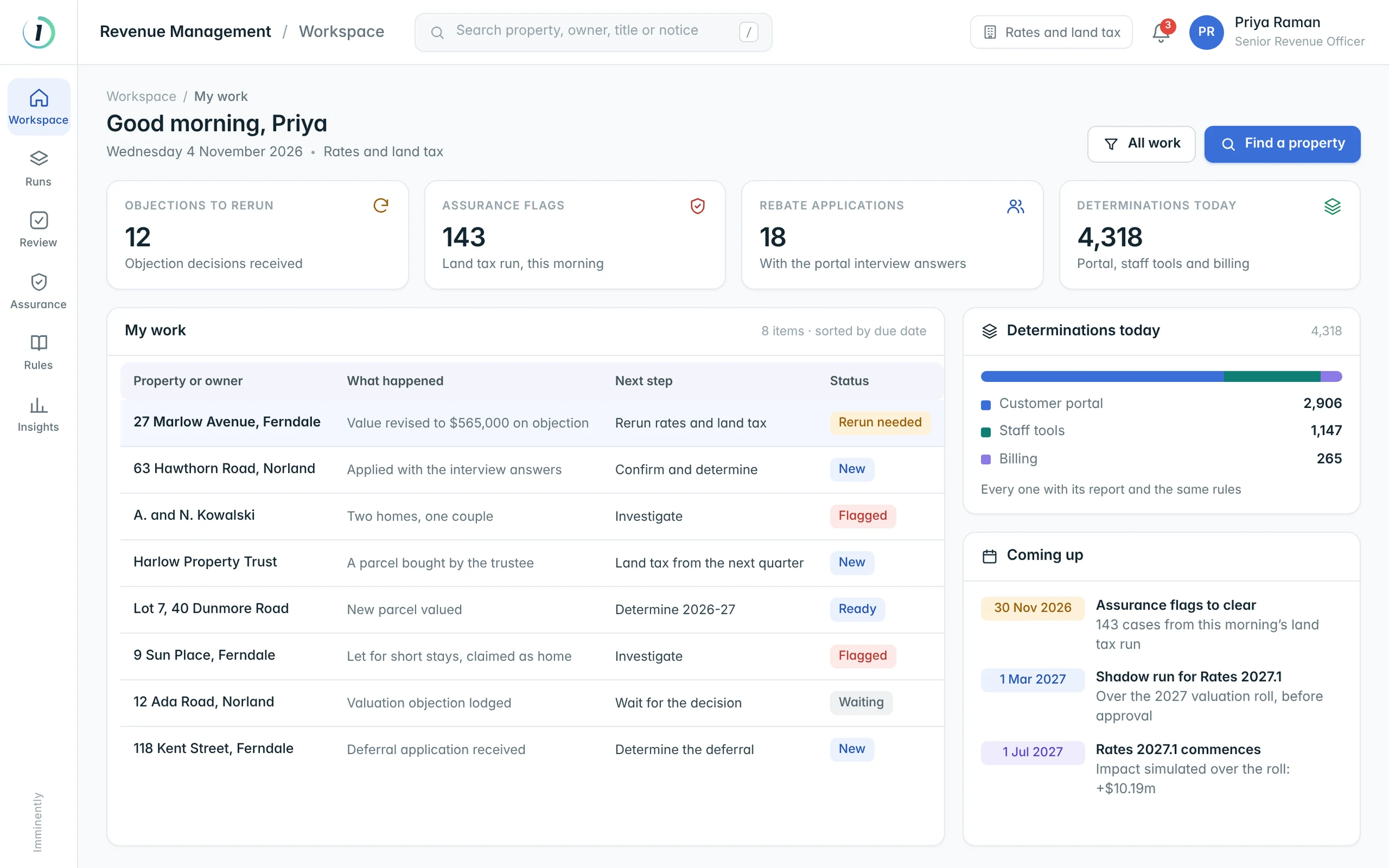
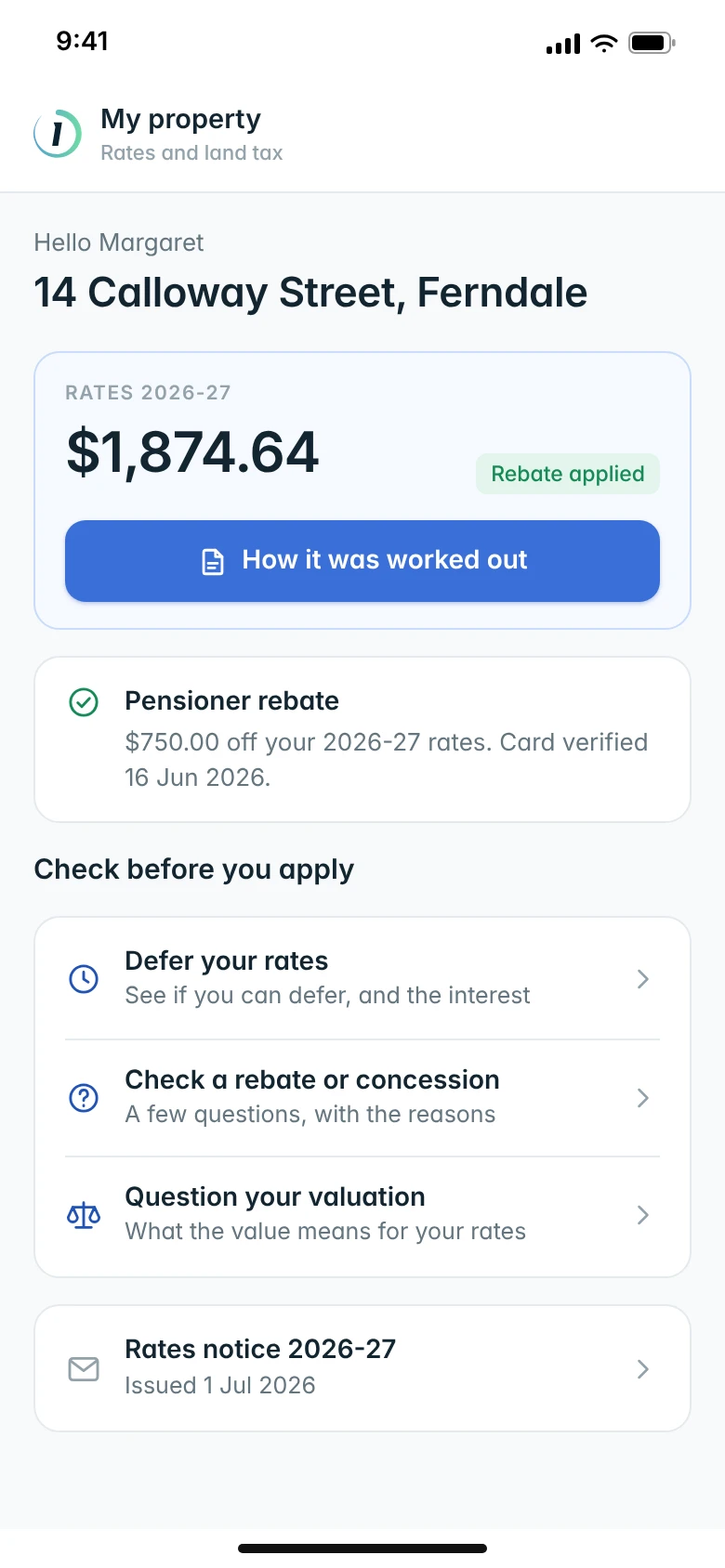
Revenue Management · my workThe revenue officer’s work for the day: objections to rerun, assurance flags, rebate applications and determinations made today across the portal, staff tools and billing, a list of work with what happened and the next step, and what is coming upThe ratepayer’s portal on the phone: rates of $1,874.64 for 2026-27 with the rebate applied, how it was worked out, the pensioner rebate, checks before applying and the rates notice
Revenue Management, on an example revenue office: an officer’s day and a ratepayer’s portal.
01 · The officer’s day

One property.
Every reason in view.

Rates and land tax, rebates and exemptions, objections and the timeline of assessments sit together, and every figure traces to the section that produced it.

Revenue officer

Four moments in an officer’s day.

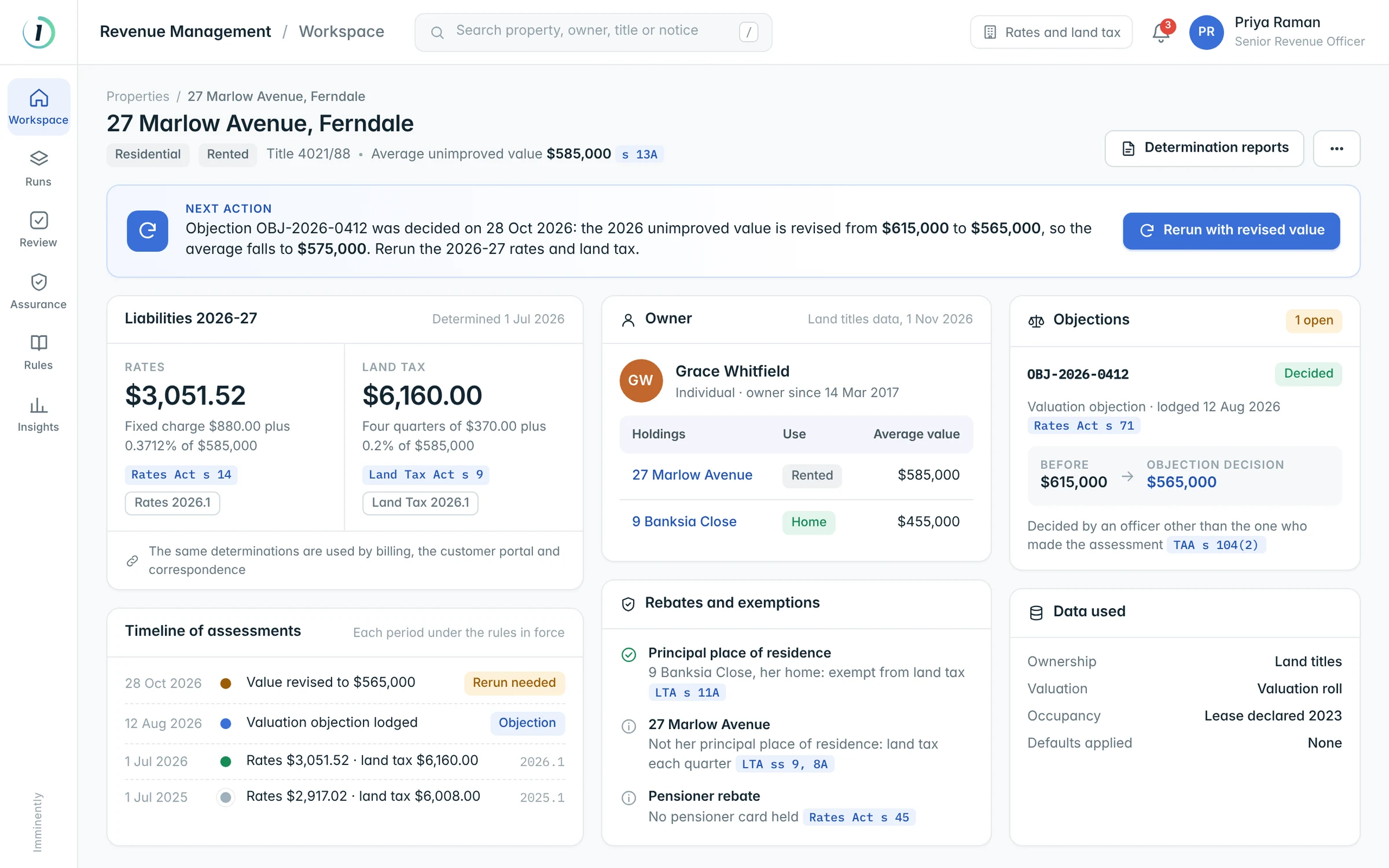
The officer opens a property and sees its owner, rates and land tax for the year, rebates and exemptions, objections, the timeline of assessments and the next action. Every figure opens to the clauses that produced it.

01 / 04
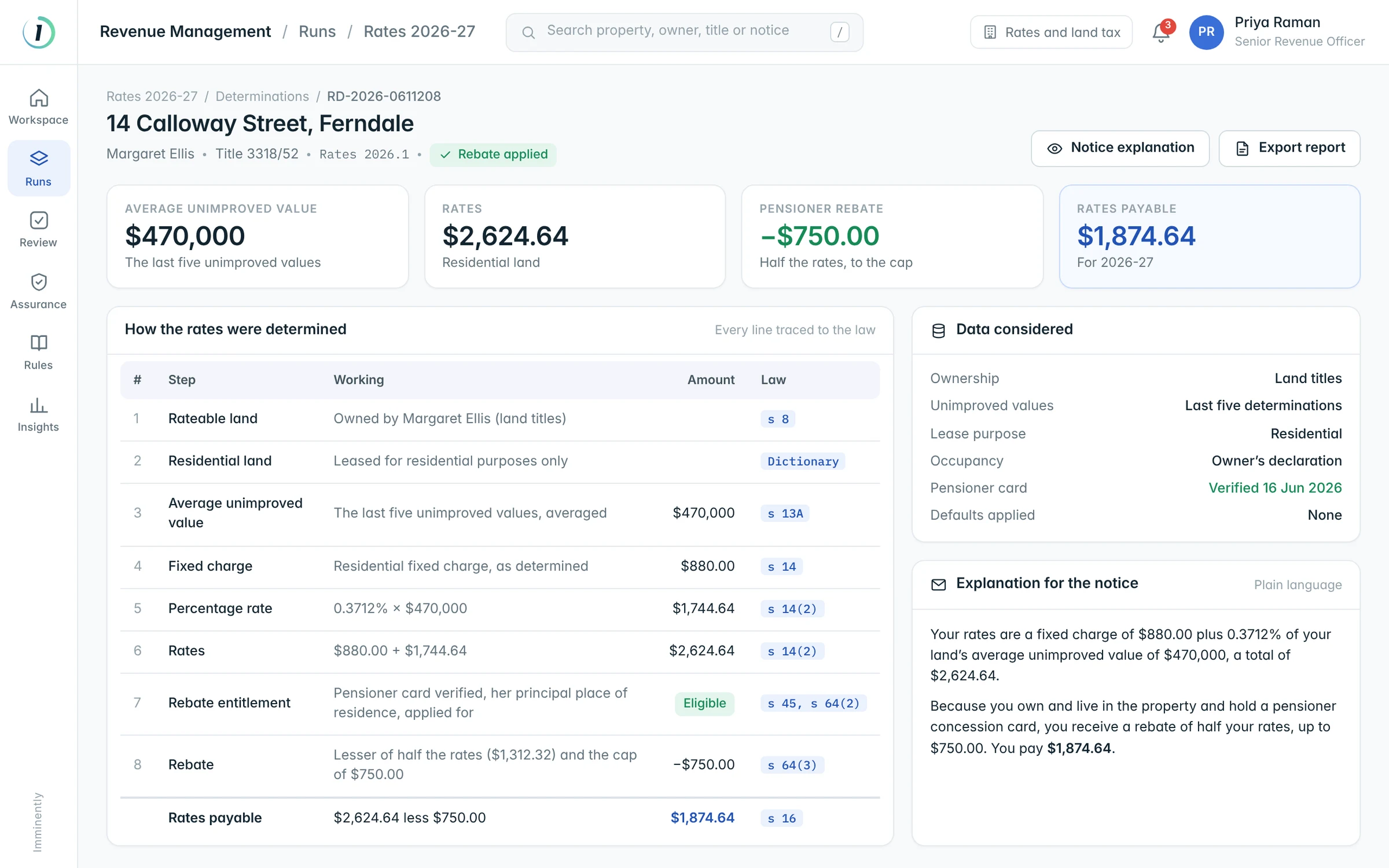
Revenue Management · property workspaceRevenue officer’s workspace for 27 Marlow Avenue: rates of $3,051.52 and land tax of $6,160.00 for 2026-27 with their sections and rule versions, the owner and her two holdings, the principal place of residence exemption on her home, a decided valuation objection, the timeline of assessments and the next action to rerun with the revised value
Step 01 of 04

The property and its owner in one view.

Rates and land tax for the year, each with the section and rule version that produced it. The owner’s holdings, the principal place of residence exemption on her home, an objection that has been decided, and the next action: rerun with the revised value.

Revenue Management, on the Rates Act 2004 and the Land Tax Act 2004 (ACT). People, properties and amounts are an example.

02 · The annual run

A new rating year,
entered once.

When the fixed charges and percentage rates are determined for a new year, the change is entered once with its effective date, tested against historical and projected data, and used by billing, portals and staff tools from commencement.

Rates team

From the valuation roll to one property’s rates.

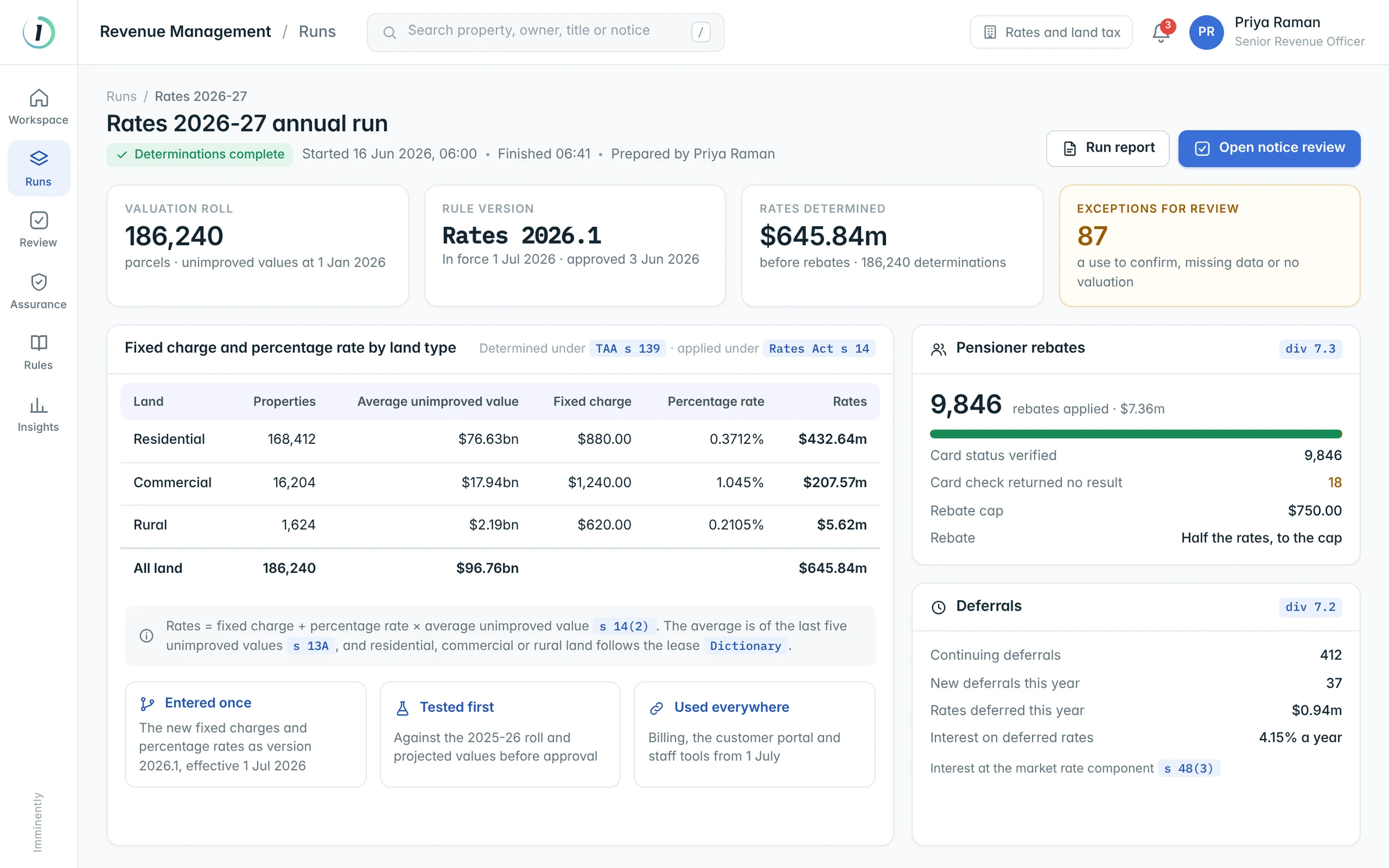
New fixed charges and percentage rates, determined under the Taxation Administration Act 1999, are entered once as a rule version with its effective date and tested before approval. The engine averages each parcel’s last five unimproved values, works out whether it is residential, commercial or rural land, applies the fixed charge and percentage rate as the Rates Act 2004 sets out, then rebates and deferrals, and returns a determination with its explanation for every parcel.

01 / 02
Revenue Management · annual rating runRates 2026-27 annual run: 186,240 parcels on the valuation roll, rule version Rates 2026.1, the fixed charge and percentage rate for residential, commercial and rural land with the rates each produces, pensioner rebates with card status verified, deferrals with interest and 87 exceptions for review
Step 01 of 02

Average unimproved values, fixed charges and rebates.

The fixed charge and percentage rate for each type of land with the rates they produce, pensioner rebates with card status verified, deferrals with interest, and the exceptions to review before any notice is issued.

Revenue Management, on the Rates Act 2004 and the Land Tax Act 2004 (ACT). People, properties and amounts are an example.

03 · Notices, reviewed and released

Bulk notices,
with government review.

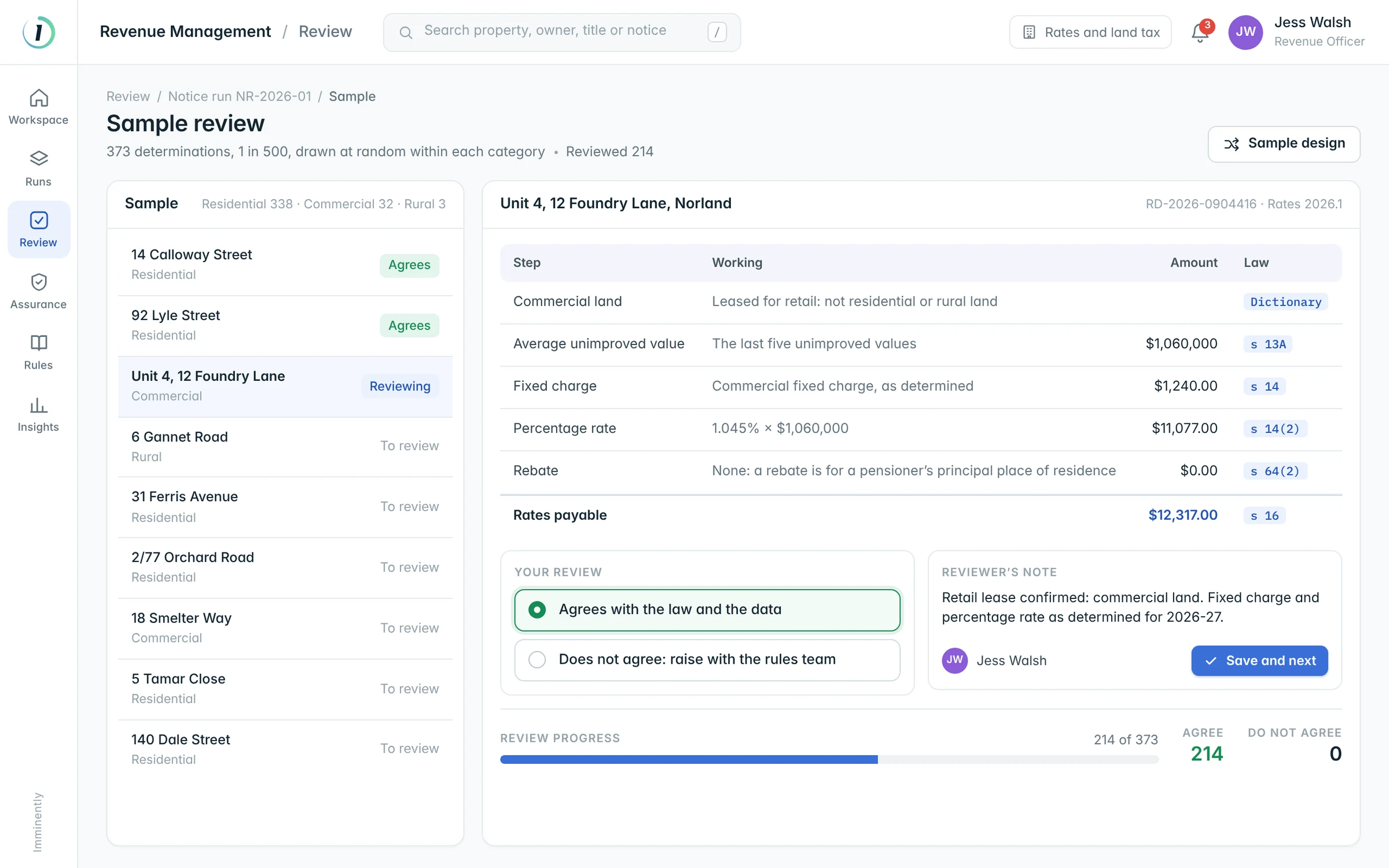
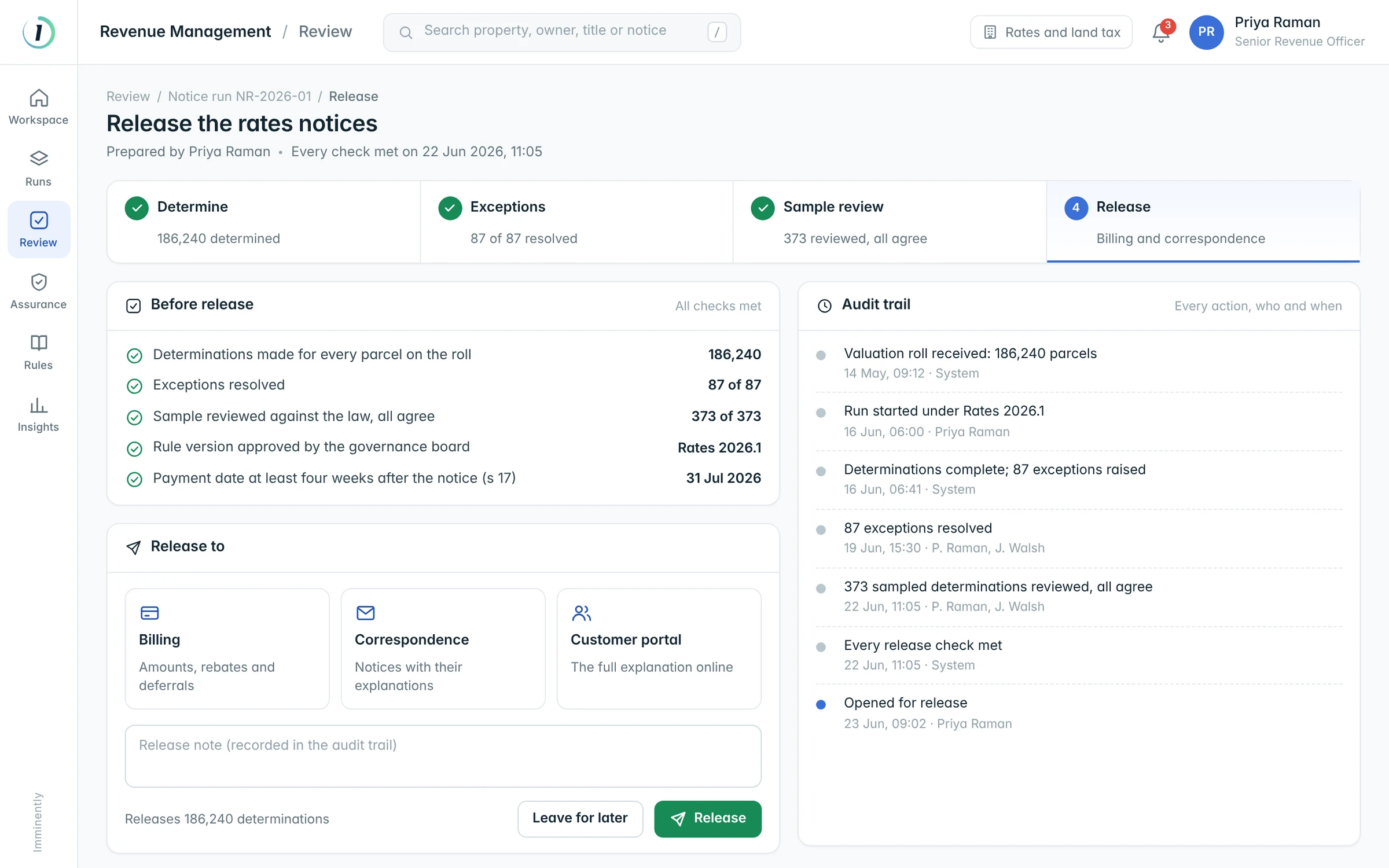
A whole roll determined in one run, with the exceptions resolved, a random sample checked against the law and an audit trail of every action before anything is released.

Revenue officers

Five steps from run to release.

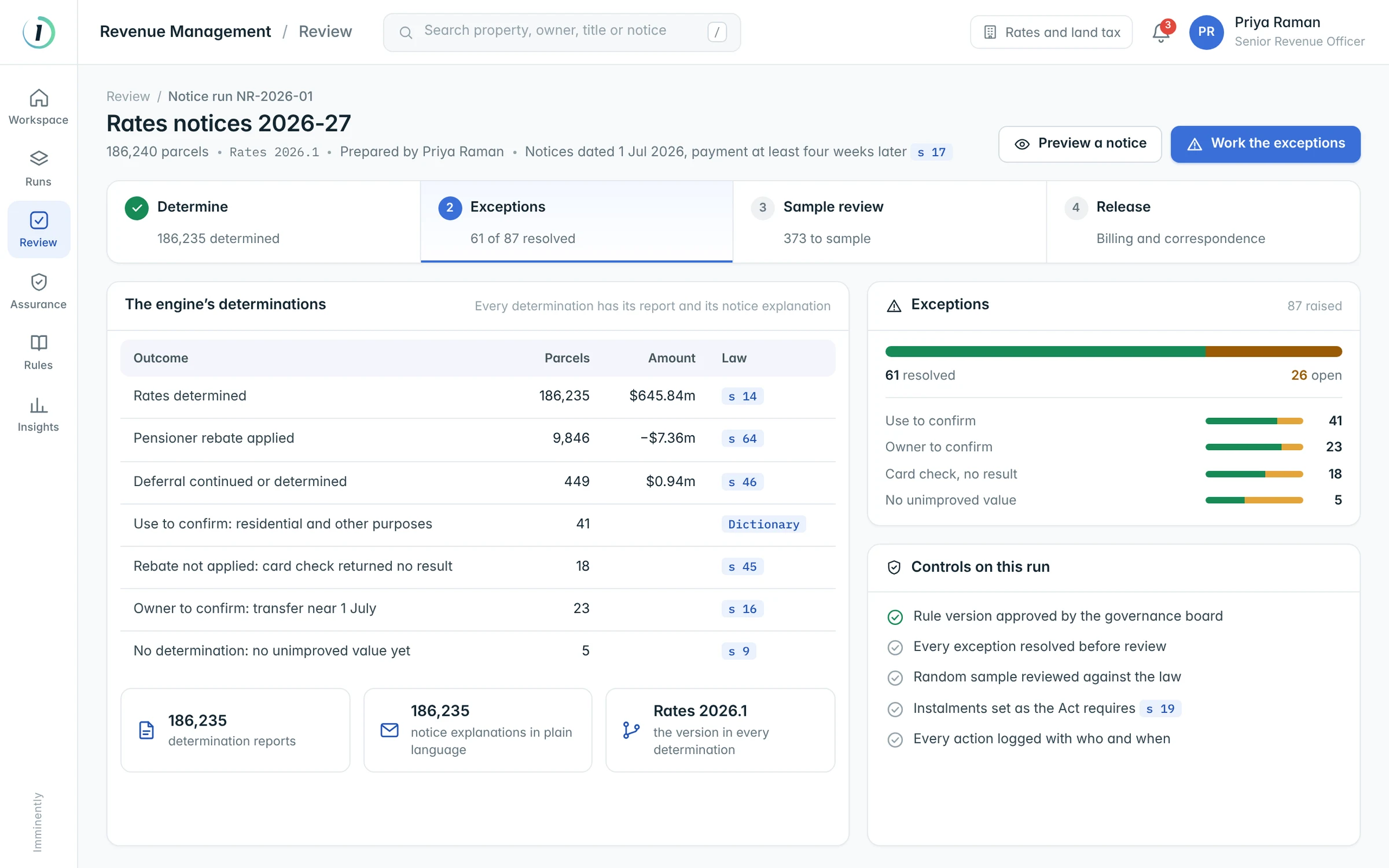
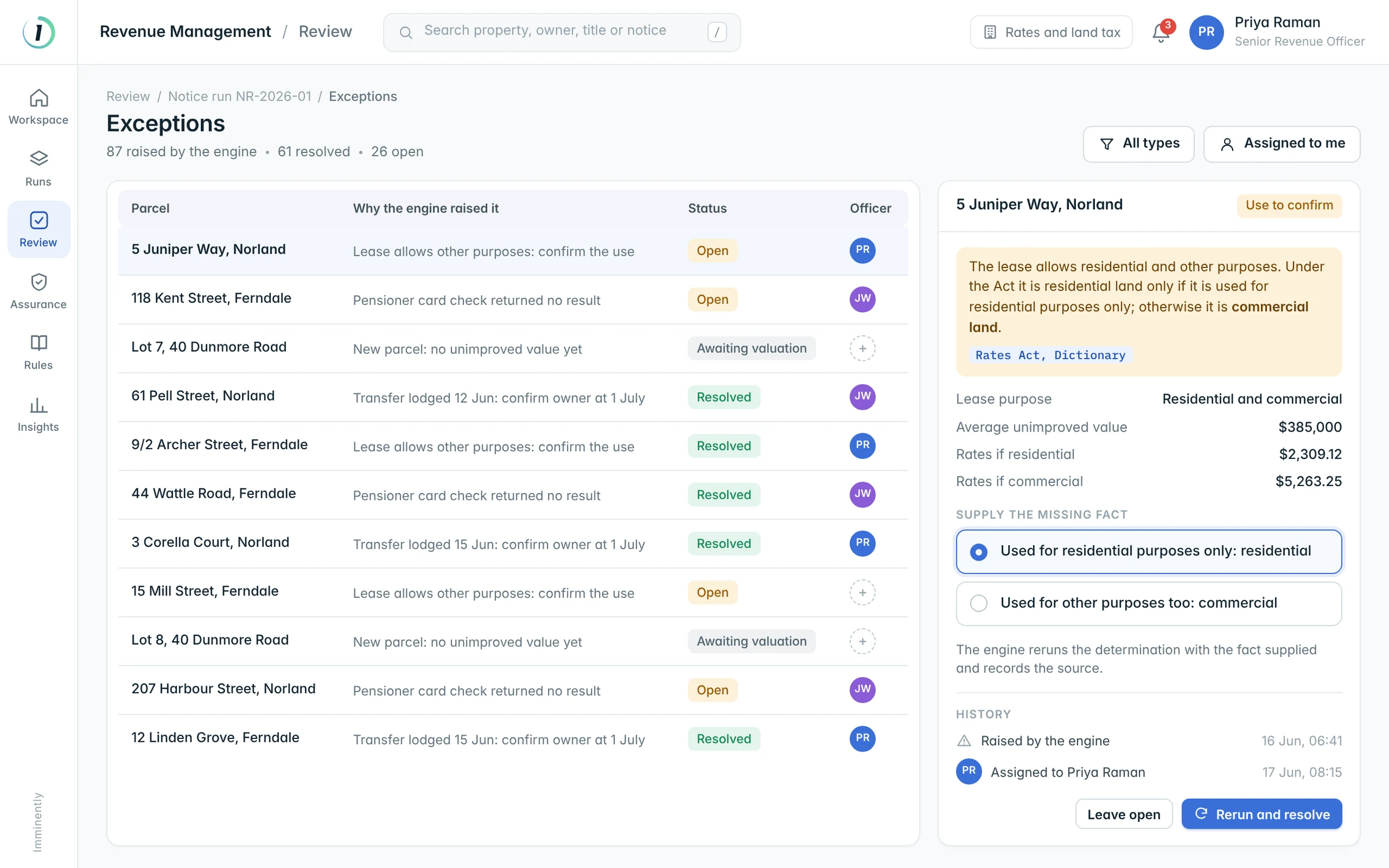
The engine determines every parcel and raises the cases that need a person. Officers resolve them, review a random sample against the law, then release the determinations to billing and correspondence, with every action in the audit trail.

01 / 05
Revenue Management · notice runRates notice run for the whole roll: the stages determine, exceptions, sample review and release, the engine’s determinations by outcome with their sections, exceptions by type and the controls on the run
Step 01 of 05

Every parcel determined, every stage controlled.

Determine, resolve the exceptions, review a sample and release. The run shows the engine’s determinations by outcome, with their sections, and the controls that must be met before release.

Revenue Management, on the Rates Act 2004 and the Land Tax Act 2004 (ACT). People, properties and amounts are an example.

04 · The taxpayer

The same explanation,
in plain language.

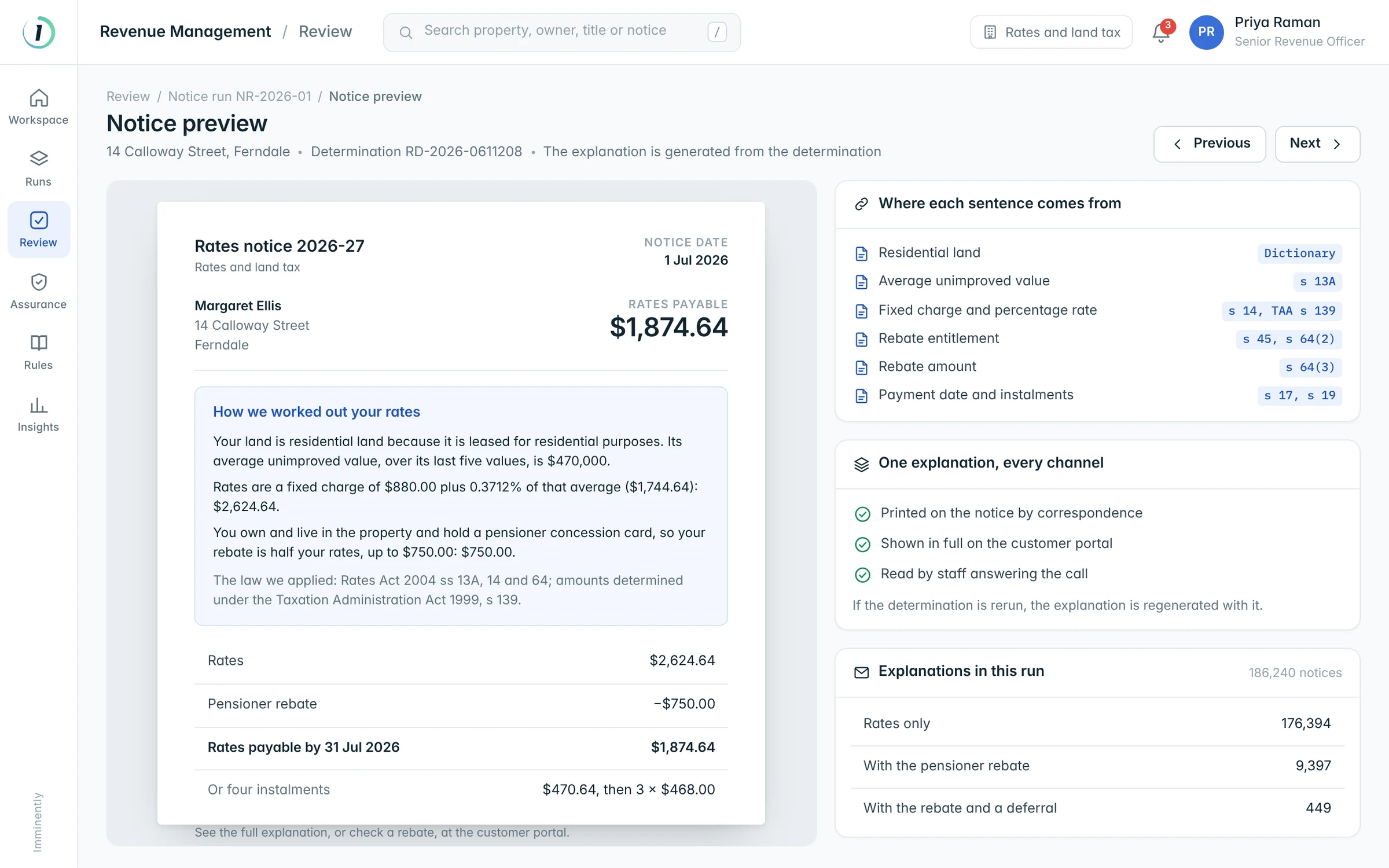
Ratepayers see why their assessment is what it is, and can check a rebate with a guided interview that asks only what applies to them.

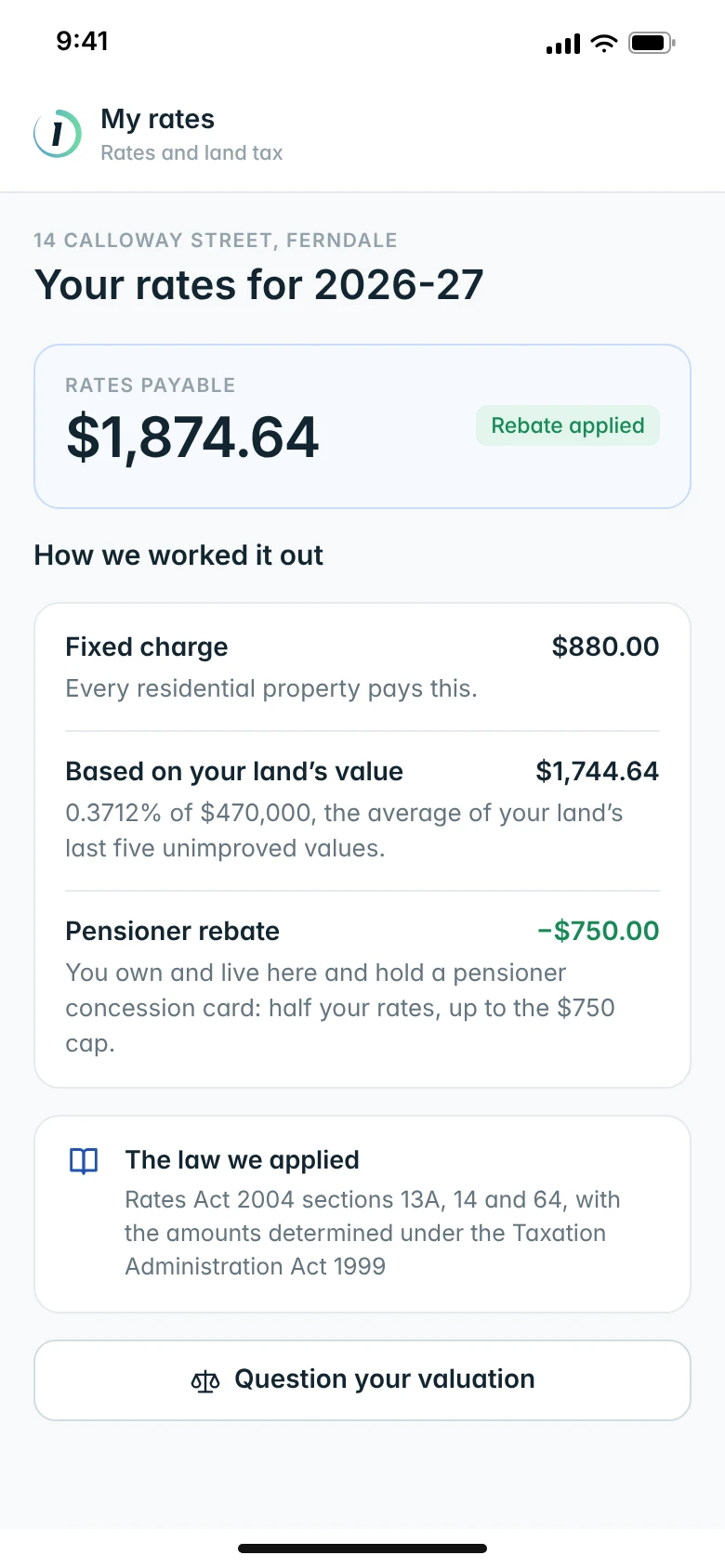
Ratepayer · on the phone

Why you pay what you pay.

The ratepayer reads the same explanation as the officer, in plain language, with the law that was applied. A guided check asks only the questions that apply and returns an answer with its reasons, from the same rules used for the formal assessment.

The taxpayer’s rates for 2026-27 on the phone: $1,874.64 payable, how it was worked out from the fixed charge, the value-based charge and the pensioner rebate, and the law applied
01NoticeThe notice, explainedThe fixed charge, the value-based charge and the rebate, with the law applied.
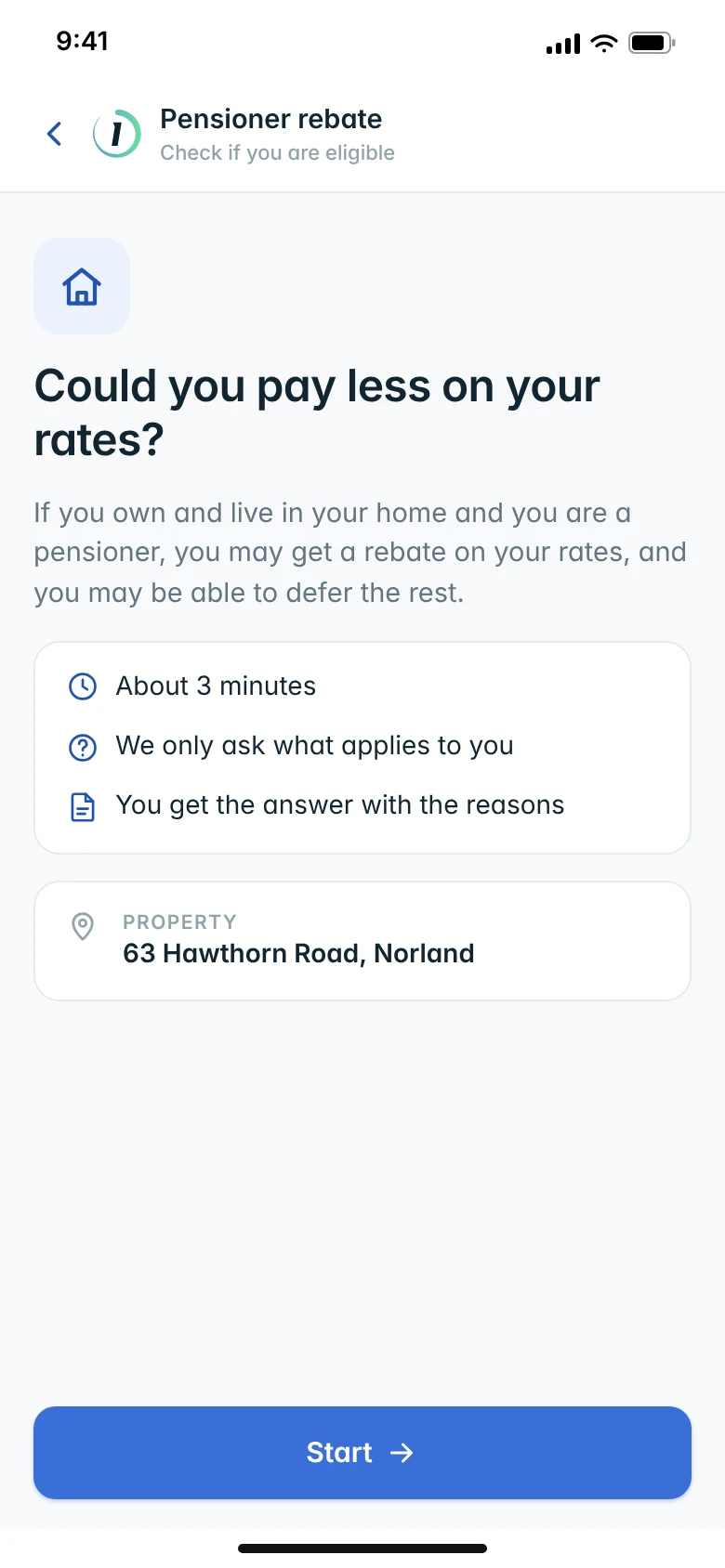
Pensioner rebate check: could you pay less on your rates, about three minutes, only the questions that apply, and the answer with its reasons
02CheckCould you pay less?A guided check for the pensioner rebate, and a deferral.
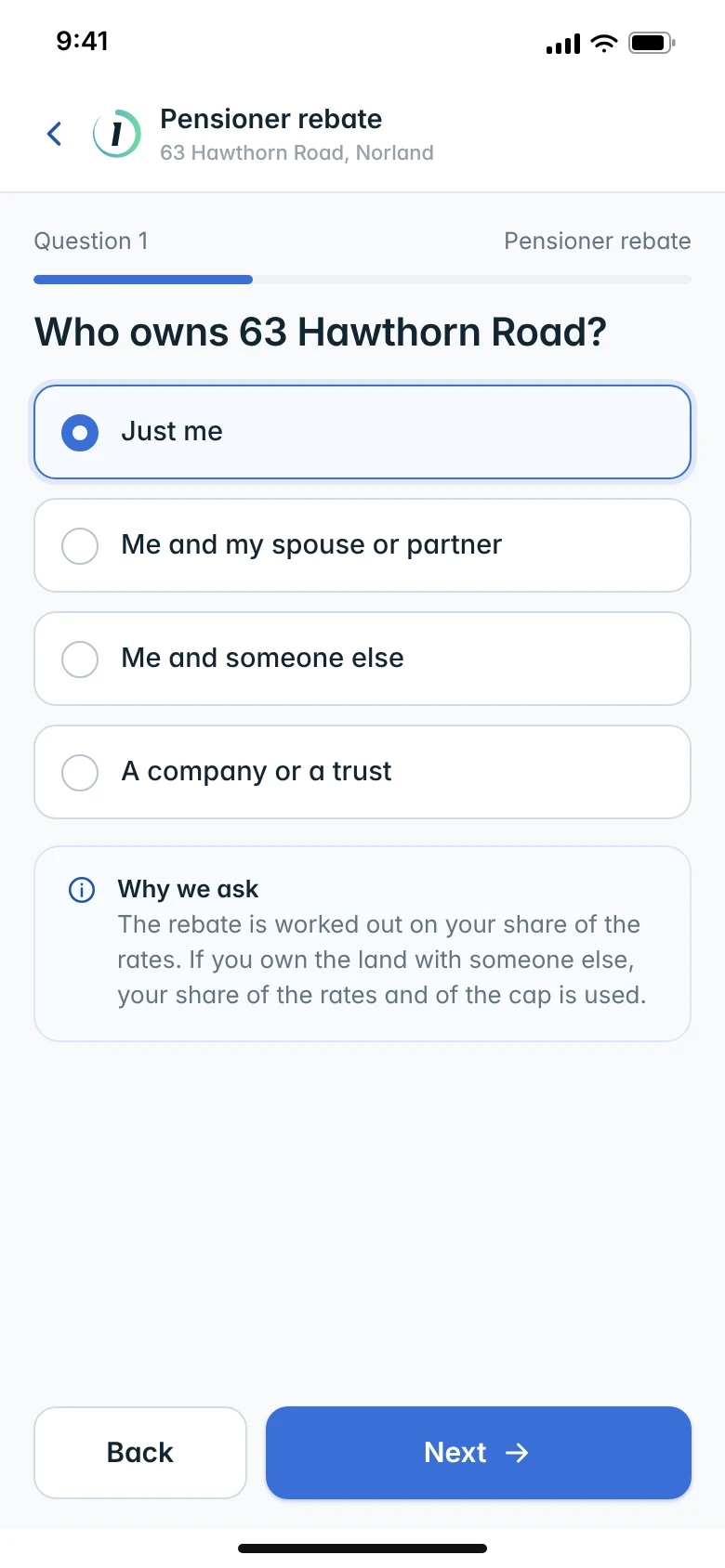
Question 1: who owns the property, with why the question is asked
03Who owns itEach question says why it is asked.
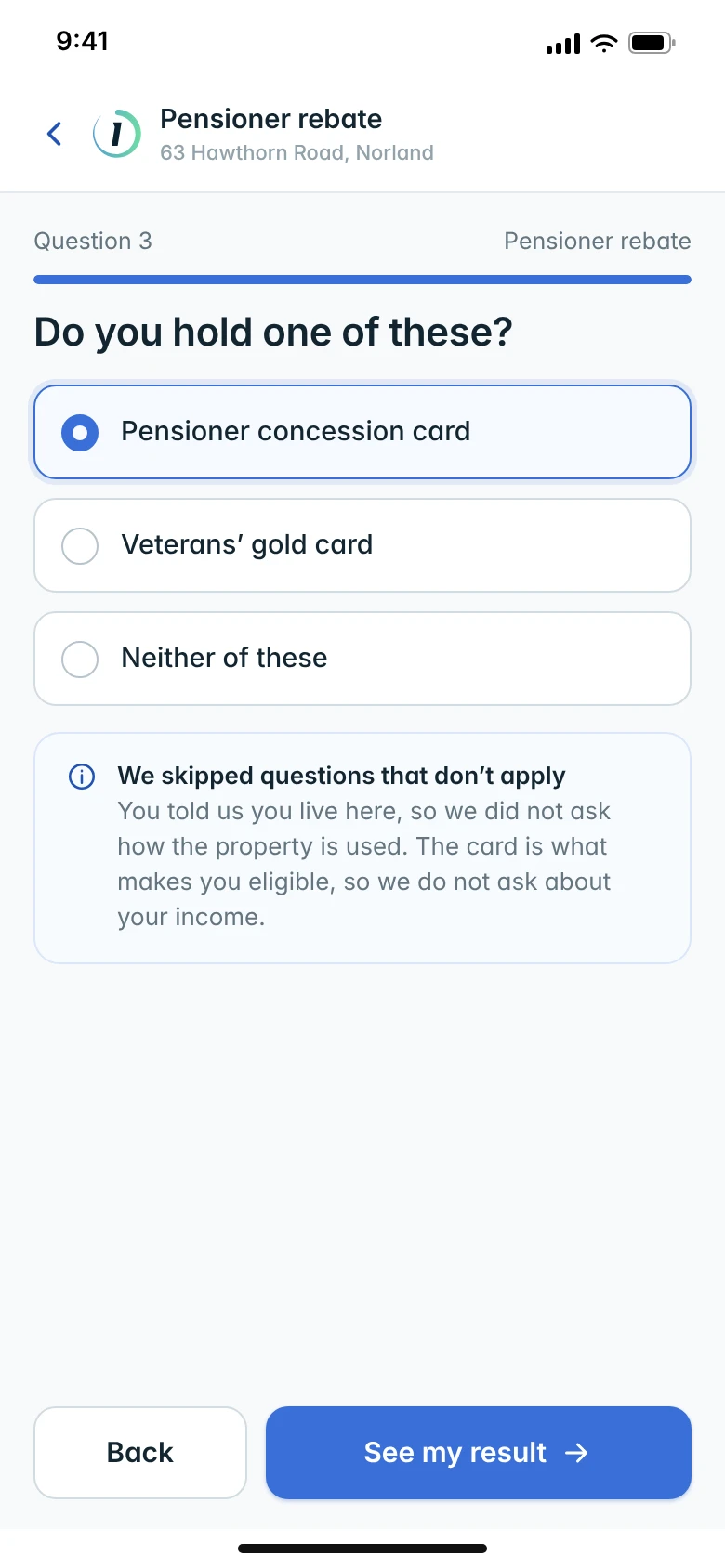
Question 3: which card is held, with the questions skipped because they do not apply
04Only what appliesQuestions that do not apply are skipped.
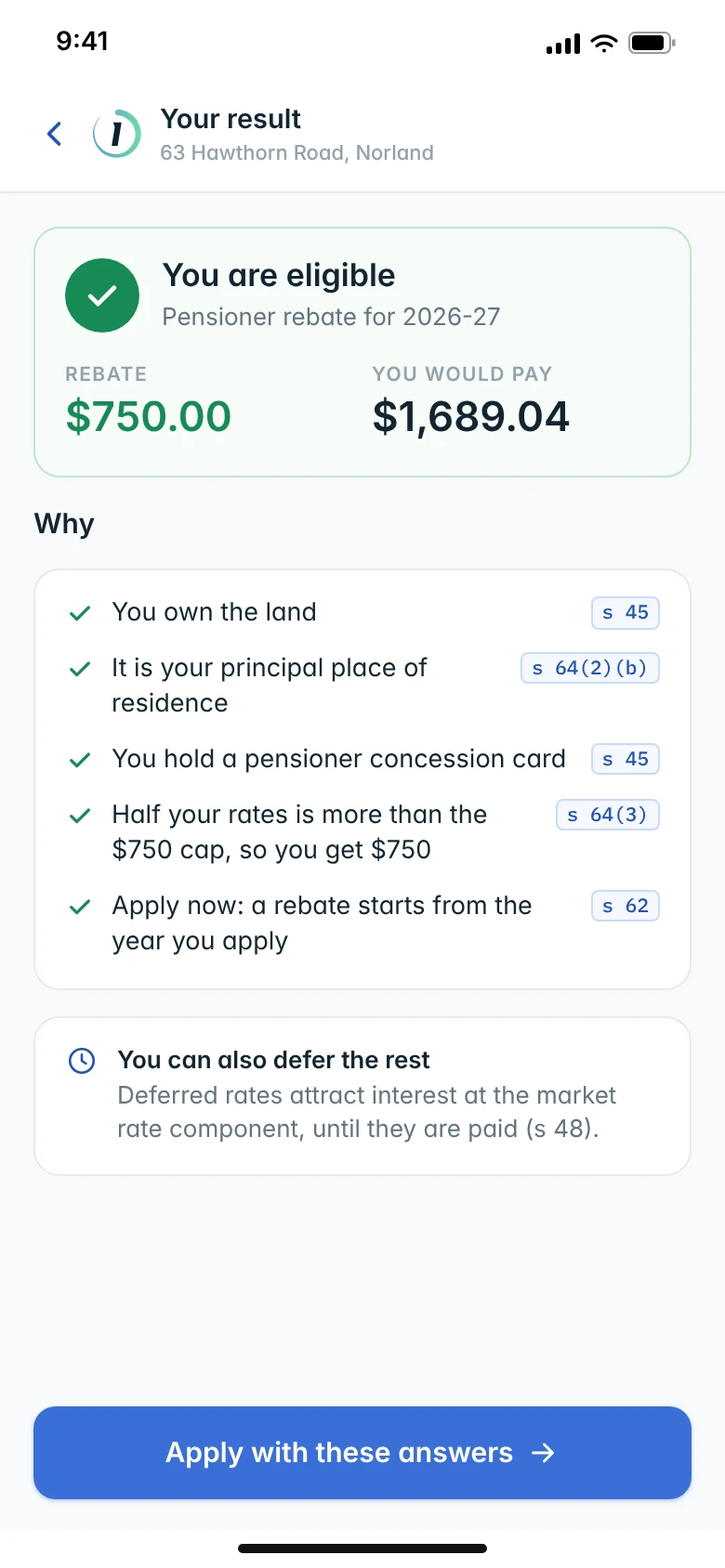
The answer: eligible for a $750.00 rebate, what the owner would pay, each reason tagged to its section, the option to defer and apply with these answers
05AnswerThe answer, with reasonsEach reason tagged to its section, ready to apply with the same answers.

Revenue Management, on the Rates Act 2004 and the Land Tax Act 2004 (ACT). People, properties and amounts are an example.

05 · Under the hood

The law, as rules
you can read and test.

Policy and legal specialists see exactly how the law has been captured, test the rules on their own before integration, run them in parallel beside the old system, and see a change across the roll before it commences.

Policy, legal and rules teams

Five views of the Legal Reasoning Platform.

Underneath every screen, the engine holds the legislation beside the rules written from it, every version of those rules with its effective date, the scenario tests that prove them, the parallel runs that compare them with the old system, and a decision report for every determination.

01 / 05
SourceRates Act 2004 (ACT) · republication 45

14 Imposition of rates

14(2)Rates are imposed for a parcel of rateable land in accordance with— … (b) in any other case—the following formula: FC + (AUV × P)

64 Rebate of rates—capped

64(2)The person is entitled, on application … to a rebate of the person’s liability for rates for a parcel of land for a year if— (a) this section applies to the person in the year; and (b) the parcel is the person’s principal place of residence for all or part of the year.

64(3)The amount of rebate is the lesser of— (a) the rebate cap; and (b) the amount worked out using the formula: RL ÷ 2 × D ÷ days in year

64(6)rebate cap means the rebate cap determined under the Taxation Administration Act, section 139.

RulesSide by side

Work out the rates for the parcel under 14(2):

the rates for the parcel = the fixed charge + (the average unimproved value × the percentage rate)

Note (14(3)): the fixed charge and the percentage rate are determined under the Taxation Administration Act 1999, s 139, and the average unimproved value is worked out under s 13A.

Work out whether the person is entitled to the rebate under 64(2):

the person is entitled to the rebate If
All
the person has applied for the rebate
All
the person is an eligible person
Any
section 63 does not apply to the person
the section 63 rebate ≤ the rebate cap
the parcel is the person’s principal place of residence for all or part of the year

Work out the amount of the rebate under 64(3):

the rebate = Minimum(the rebate cap, the person’s liability for rates ÷ 2 × the days as principal place of residence ÷ the days in the year)
the rebate cap = $750.00

Note (64(6)): the cap is determined under the Taxation Administration Act 1999, s 139. A new determination is a new rule version with its own effective date. The amount shown is an example.

Step 01 of 05

The section on the left, its rules on the right.

Each rule is written in plain English with All and Any groups and tagged to the paragraph it comes from, so policy and legal teams can see that the rules mirror the section and add nothing to it. Select a rule document to see the paragraph it came from.

The Legal Reasoning Platform’s views, on the Rates Act 2004 (ACT). People and amounts are an example.

The rules beside the clauses.With the rules side by side with the legislative clauses, business users can spot gaps or misinterpretations and make sure the digital rules mirror the intent of the law.

Time-variant reasoning

One determination can span a change in the law, applying each version to its own part of the period. Past periods are recomputed under the rules that applied at the time, and the engine can answer what a liability would have been under a previous law.

A data model from the law

Writing the rules from the Acts enumerates every input, output and entity the law speaks about, including multi-tiered trusts. Where a core system does not yet hold an attribute, the rules layer can hold it.

How legal reasoning works
Every revenue line

Use cases across
the revenue portfolio.

The same layer and the same review, for every line a revenue office administers.

Rates

Annual rates, concessions and objections

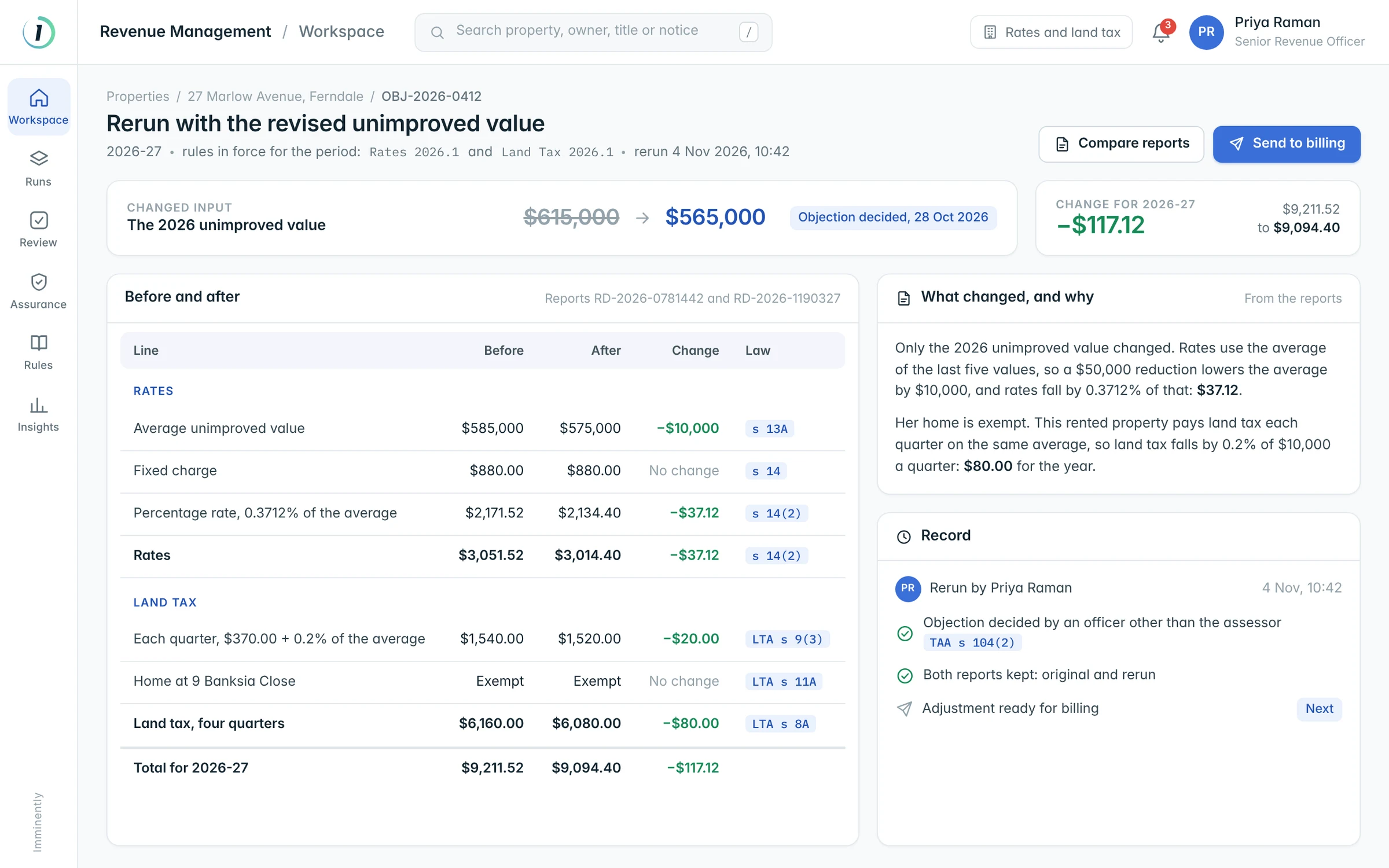
The engine takes valuation data, works out the type of land and the value the Act uses, applies the fixed charge and the rate, and returns each determination with an explanation that references the Act. Pensioner rebates and deferrals test ownership, occupancy, card status and the other conditions the Act sets, with interest calculated on deferrals. When a valuation objection succeeds, the assessment is rerun with before and after views.

Land tax

Trusts, absentee owners and short-stay use

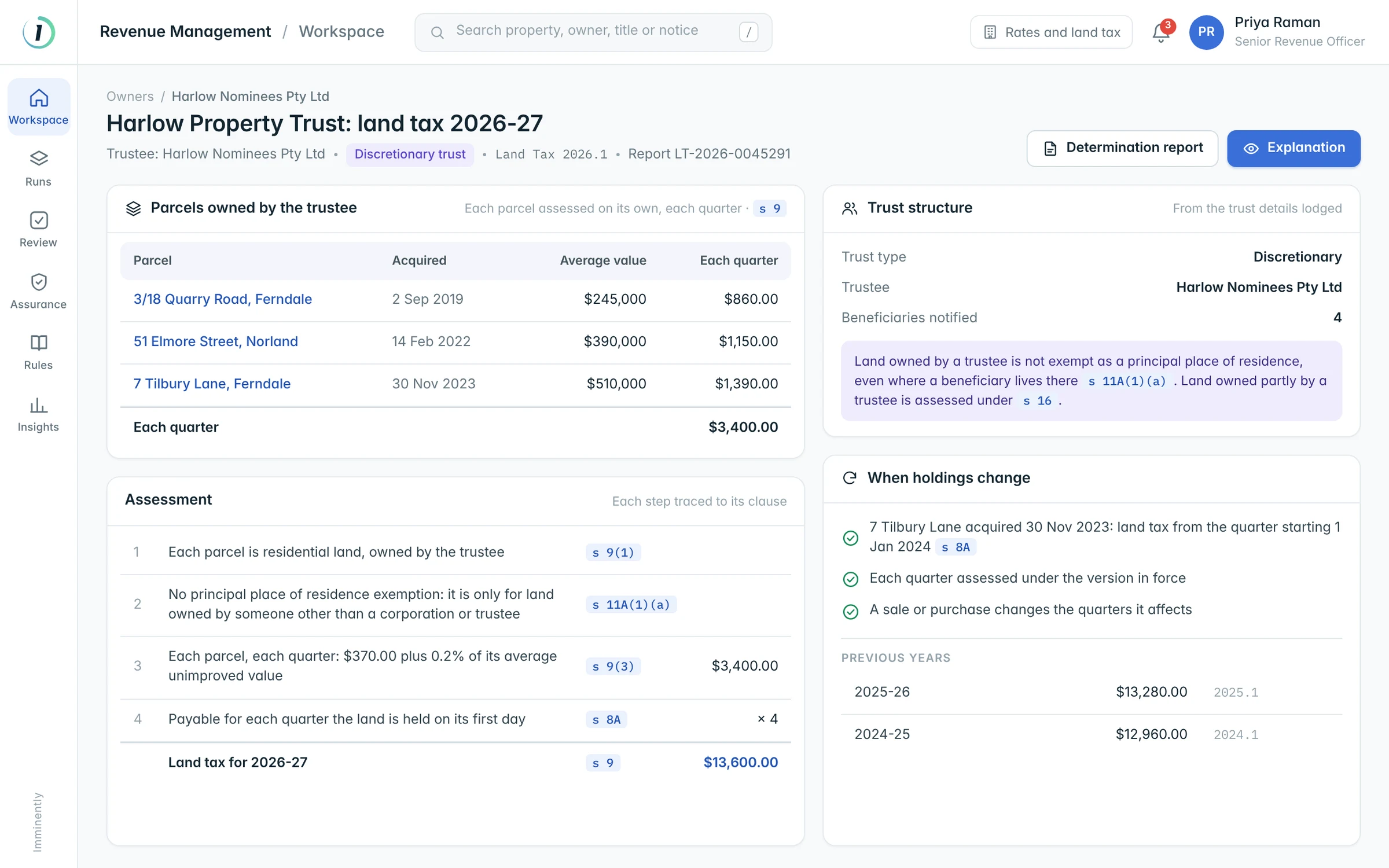
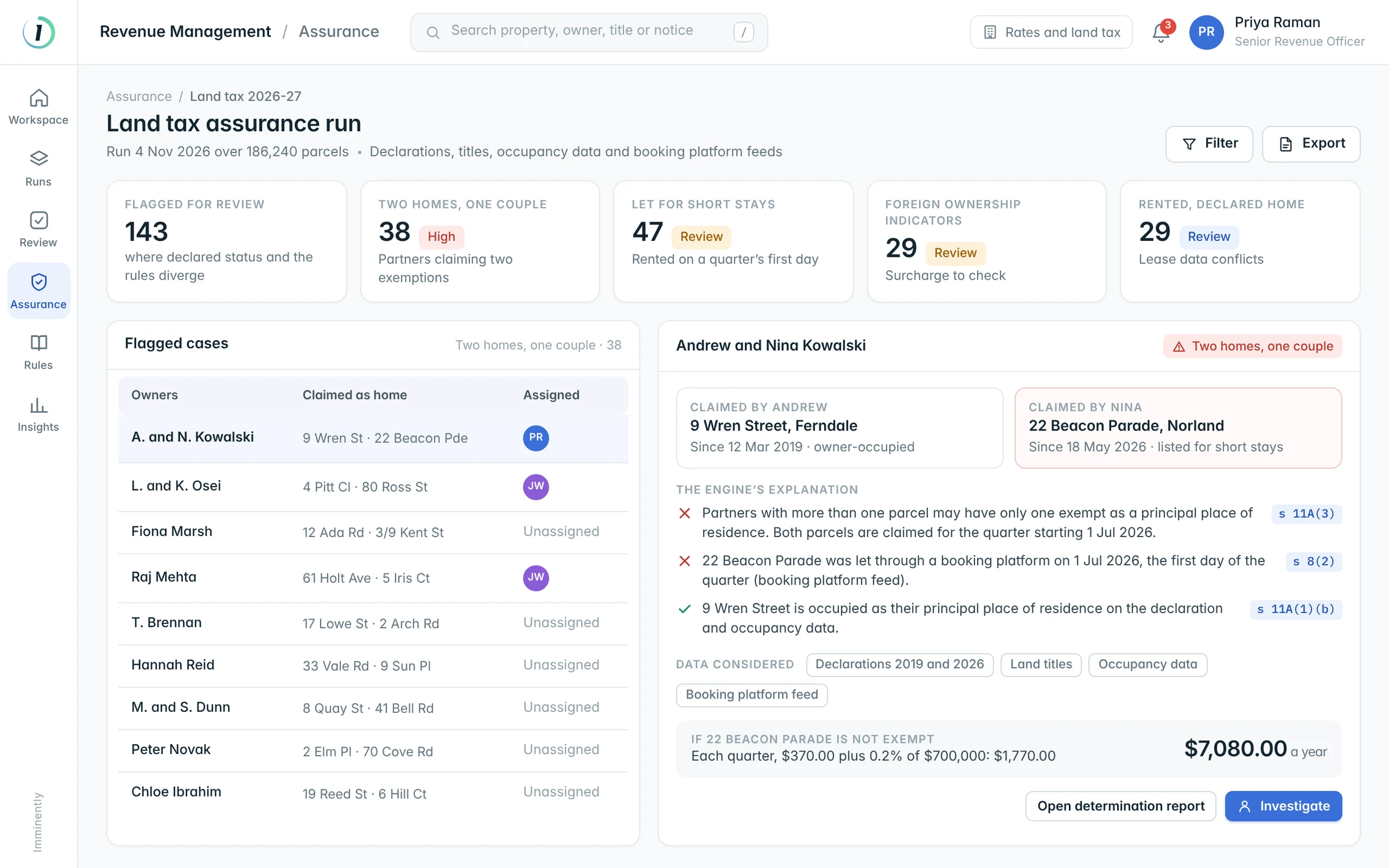
Trust structures are recognised and distinguished by type, the rules for land owned by trustees and corporations applied and principal place of residence claims handled, with liabilities recalculated when property is bought or sold. Occupancy data, declarations and booking platform feeds show whether absentee or short-stay criteria are met, and bulk assurance runs flag likely misclassification.

Duties and concessions

Eligibility at the moment of the transaction

First home buyer concessions are determined from citizenship, residency, income, property value, ownership history and occupancy intentions, with the concessional duty and its explanation returned during conveyancing. Temporary off-the-plan or precinct concessions carry their own start and end dates and can be simulated before legislation is final. Foreign buyer surcharges consider residency, corporate structure, transaction type and timing.

Payroll tax

Grouping and cross-border wages

Group membership is evaluated from ownership, control and common employees, wages aggregated, thresholds applied and liabilities recomputed when an entity joins or leaves a group during the year. Wages are apportioned across jurisdictions, including remote and multi-state work, and new levies can be configured in advance with earlier rules kept for past periods.

Relief measures

Concessions, remissions and cost-of-living support

Concession eligibility from income, household composition and residency is expressed once and called by revenue products, portals and other agencies. Emergency and cost-of-living measures are configured with start and end dates, tested against historical and projected data before activation, applied uniformly across channels and expire when intended.

Bulk reassessment

After an amendment or a court decision

When the law or its interpretation changes, the updated rules are loaded and determinations rerun for the affected periods, each period under its own rule version, with auditable before and after comparisons. Rule paths logged for every determination show which provisions are rarely used, confusing or generating disputes.
The outcomes

Change the law in one place.
Every channel follows.

Products become consumers of decisions rather than partial implementations of the law. When Parliament amends a provision, the rules change once and every system that uses them follows.

The digital regulatory layer between revenue law and the products that consume its determinations.

Legal fidelity

Each decision is anchored in statute and carries a clause-referenced report that staff, auditors and taxpayers can read.

Policy agility

Changes are made by editing rules, not rewriting code. Legislation is staged and switched on at commencement, so implementing a change takes days and weeks rather than months.

Fewer disputes

Decisions that are explained on the notice and online are understood, so fewer objections arise from confusion.

Less manual handling

Duplicated logic across systems is removed, and manual processing per case falls and in many circumstances is eliminated.

One source of truth

Every channel uses the same determination, and decision logs show concession uptake and compliance patterns for policy review.

Reuse across government

Once built for revenue, the same engine can serve concessions outside revenue, grants, licensing and shared calculators.

How it is delivered

Parallel run first.
Then the system of record.

A phased introduction that starts with rates and land tax, proves the rules in a parallel run beside existing calculations, and expands division by division in six-weekly releases. The programme below sets the order of the divisions, and each division follows the same six stages as every engagement: Mobilise, Plan, Deliver, Test, Deploy and Operate.

01

Mobilise

Priority use cases for each division, the integration pattern for legacy and new systems, our product in your managed cloud, governance and testing frameworks, and the source legislation prepared. Typically two to three months.

02

Property revenue first

Rates, land tax and their concessions digitised top down from the legislation, connected to valuation, titles and occupancy data.

03

Parallel run

The engine runs beside existing calculations. Outcomes are compared at scale and differences investigated before it becomes the determination service.

04

Six-weekly releases

Rule sets iterated, tested and released every six weeks, adding concessions, deferral logic, trusts, absentee use and multi-property holdings.

05

Division by division

Duties, payroll tax and concessions follow in parallel streams under one governance model.

06

Operate

Legislative-driven releases, a parallel run for every amendment, and policy simulation for future reform.

Governance

Policy and legal stay in control

A steering committee sets direction. A policy and rules governance board approves interpretations and scenario results. Every change is logged with its author, approver and date, and a data and privacy committee oversees data flows.

Deployment

Inside your environment

A private instance in your managed cloud, with your security controls, logging, identity integration and network boundaries. Rule authoring, versioning and execution all run under your governance.

Integration

Legacy and new, one interpretation

During the transition, legacy and new systems call the same determination service. Products keep accounts, payments, workflow and correspondence, and stay close to standard and upgradeable.

Questions

The practical detail.

Does it replace the revenue system?

No. Billing, case management, portals and correspondence keep accounts, payments, workflow and the customer experience. Revenue Management supplies each determination and its explanation, and those products call it.

Who produces the notices?

Your correspondence system produces and sends them. Revenue Management determines every parcel, carries the review and approval of the run, and supplies the plain-language explanation printed on each notice.

How is accuracy proven before go-live?

The rules are tested in isolation with scenario packs that the governance board reviews, then run in parallel beside existing calculations over the full roll. Every difference is investigated and explained before the layer becomes the determination service.

What happens when the law changes mid-year?

The change is released as a new rule version with its effective date. A liability that spans the change applies each version to its own part of the period, and past periods can be reassessed in bulk with before and after comparisons.

Where does it run?

In a private instance in your managed cloud, under your security controls, logging, identity integration and network boundaries, or as a dedicated instance we operate on your behalf.

Services as Software · Revenue Management

Parliament amends the Act.
The rules are ready on time.

We deploy one governed rules layer for your revenue lines, with your rating, land tax and duties law, concessions and approved interpretation loaded, and proved in a parallel run beside your current calculations. When rating factors change or the Act is amended, the rules are updated, tested and released on or before commencement, and every channel follows.

See it in your context

Bring a complex
revenue assessment.

Explore the legislation, ownership structures, concessions and system interfaces your service needs to handle.