Every payment,
checked against the law.

Integrity Management automates the audit of payments made through providers. It brings high-risk providers forward, collects complete evidence through guided steps, checks every child and every day against the legislation, the program’s policy and your audit practice, and explains each finding to the provision behind it.

It sits beside the payment, case and data systems an agency already runs, and turns audits that take weeks by email into audits that scale.

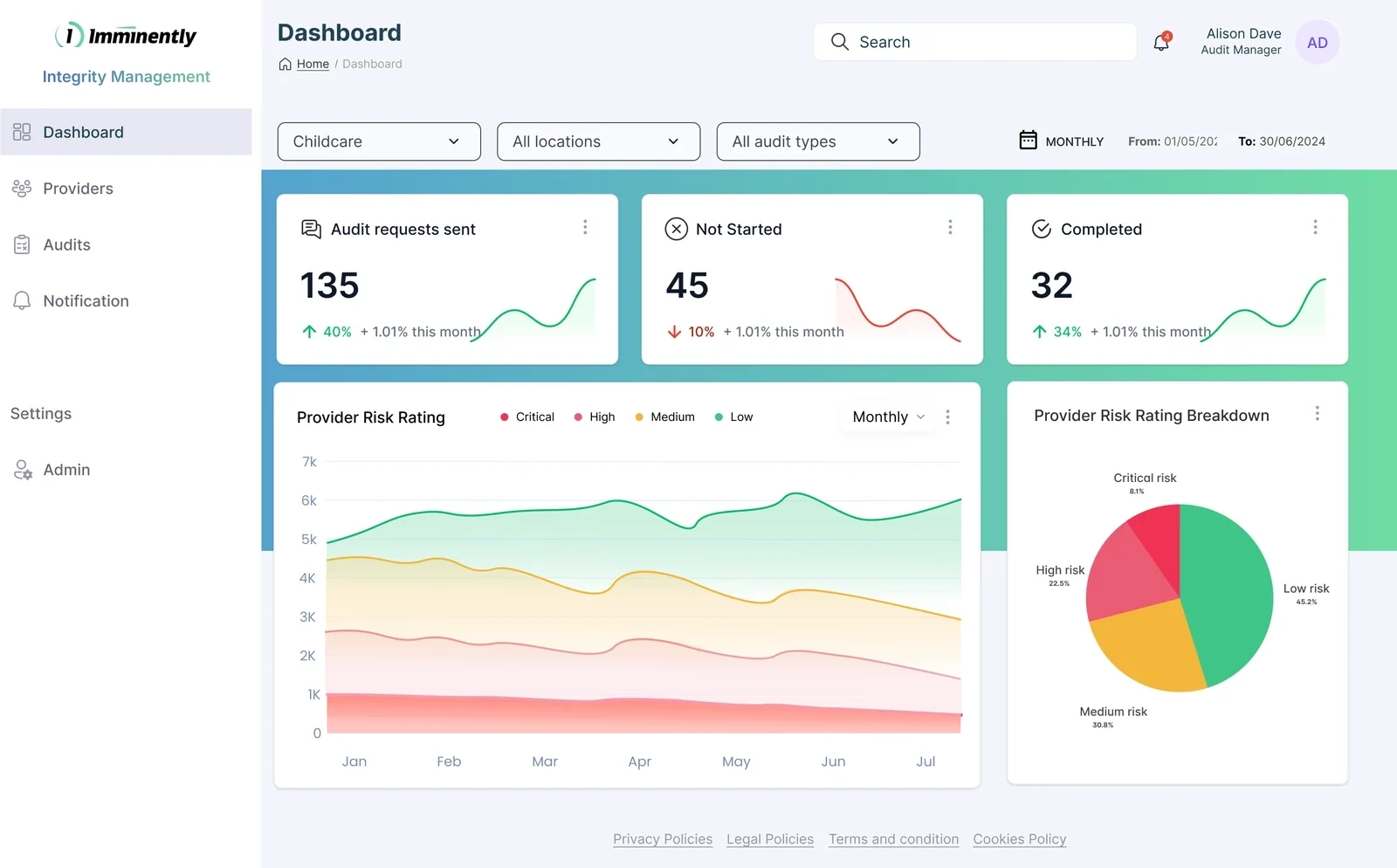
Integrity Management · agency dashboardThe analyst’s dashboard: 135 audit requests sent, 45 not started and 32 completed, the provider risk rating over seven months from critical to low, and the breakdown by rating
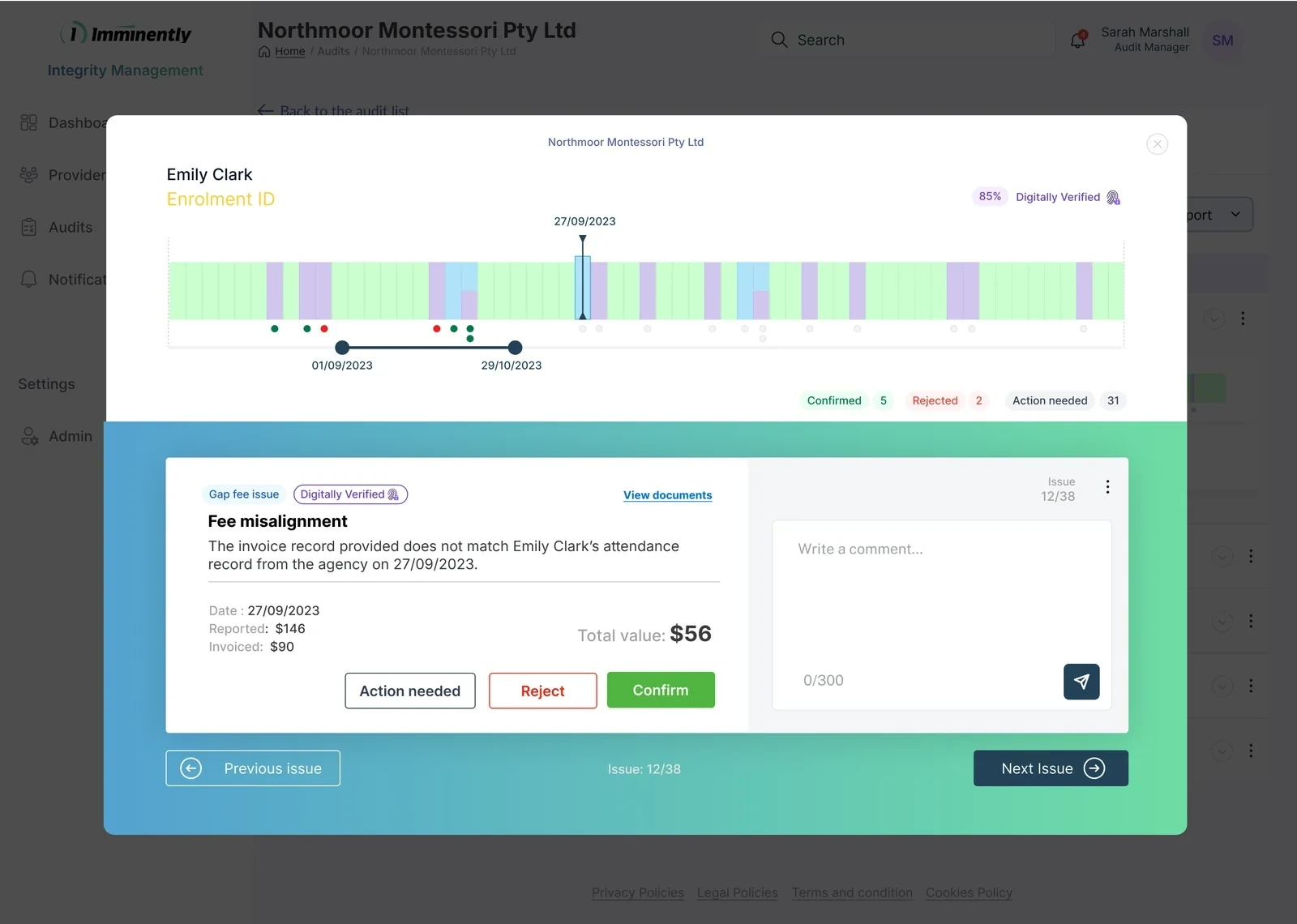
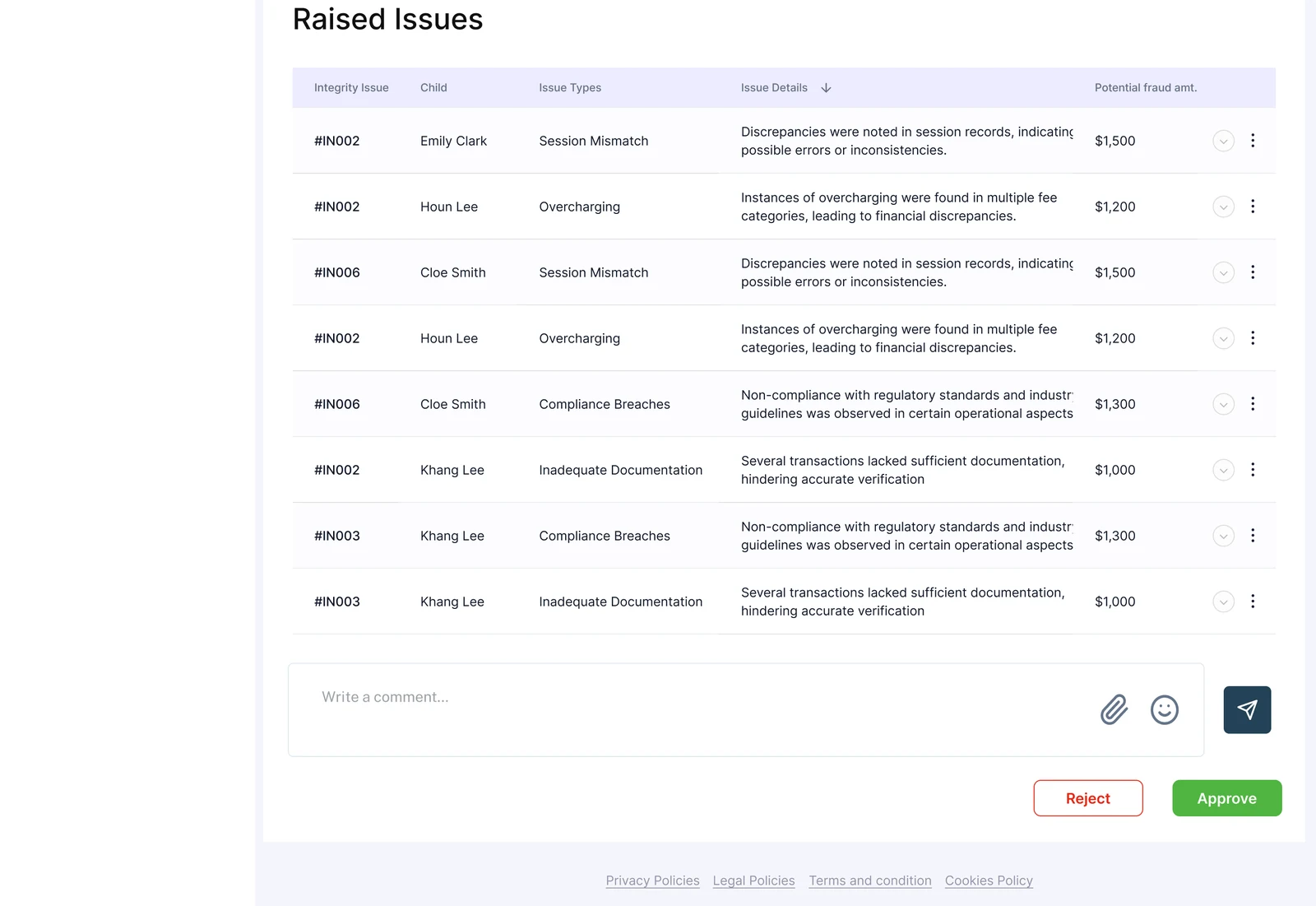
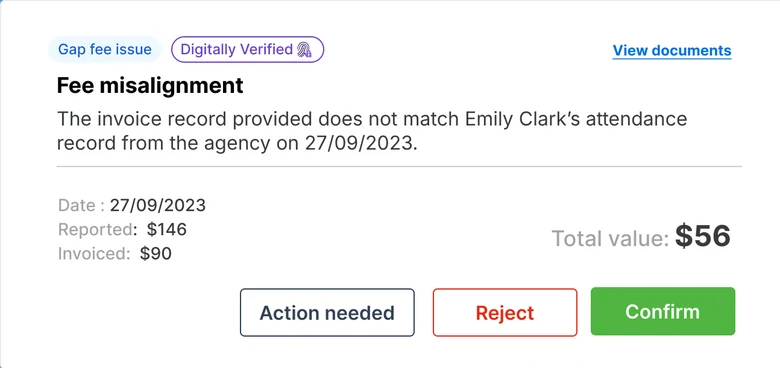
One finding: a fee misalignment for Emily Clark on 27 September 2023, reported $146 against invoiced $90, a value of $56, with Action needed, Reject and Confirm
Integrity Management, on an example subsidy program: the agency’s dashboard, and one finding with the amount reported and the amount invoiced.
The problem

Audits that take weeks,
one provider at a time.

Payments made through providers are checked by hand across systems that were never connected. Officers move documents and data between them; providers cross-check bank statements, payment reports and invoices before officers cross-check them again; and the exchange of information can take up to 28 days for a single provider.

For the agency
  • Risk reviewed by hand over days, and providers chosen on judgement or a tip-off
  • Notices drafted, documents chased and organised by email
  • Gap fees and payments recalculated by hand against invoices and statements
  • Different teams, different screens, inconsistent handling of cases
  • Hundreds of audits a year when tens of thousands are needed
For providers
  • Invoices, payment reports and statements kept in different tools and formats
  • Evidence requested, rejected and requested again
  • Rules that change, such as how gap fees must be paid
  • Educators and staff pulled from care into administration
Not a case management problem.Standard case management, low-code configuration and reporting cannot make the determinations an audit needs. The checks have to apply the law and the program’s rules to every record, day by day, and explain what they found.
Where to start

Start from where you are.
Two lanes, one approach.

Integrity Management meets an organisation at any point: checking what has already been paid, checking continuously from here on, or building the checks into a new system from its first release. The same rules serve two lanes: paying staff correctly, and paying citizens and providers correctly.

  1. 01 · Look back

    Audit what has been paid

    Retrospective analysis of the systems in place today: past payments checked against the law and the policy in force on each day, with every discrepancy found and traced to its provision.

  2. 02 · From here on

    Audit continuously

    The same checks run as payments are made, so a discrepancy is found in the cycle it occurs, not at the next audit, and providers and payroll fix it while it is small.

  3. 03 · From the start

    Build it in

    In a new transformation, the checks are part of the new system from its first release, so it pays correctly from day one and can show why each payment is right.

Start at any point. The rules written for one starting point are the rules used at the next.

Lane 1 · Payroll assurance

Paying your staff correctly

Every pay checked against the awards, agreements, contracts and legislation that apply to each employee, with underpayments and overpayments found before they compound and each correction explained to its clause.

  • Each pay cycle, or across past years for remediation
  • The same instruments that interpret pay in the first place
  • Evidence for payroll, audit and the people affected
Lane 2 · Payment integrity

Paying citizens and providers correctly

Entitlements, grants and subsidies paid under legislation and program guidelines, checked when they are decided and audited after they are paid, for accuracy, fraud and integrity.

  • Entitlements, such as pensions, decided and explained to the section
  • Grants, from application to every approving agency and payment
  • Subsidies paid through providers, audited child by child and day by day
01 · Find the risk

Start from the risk,
not from a tip-off.

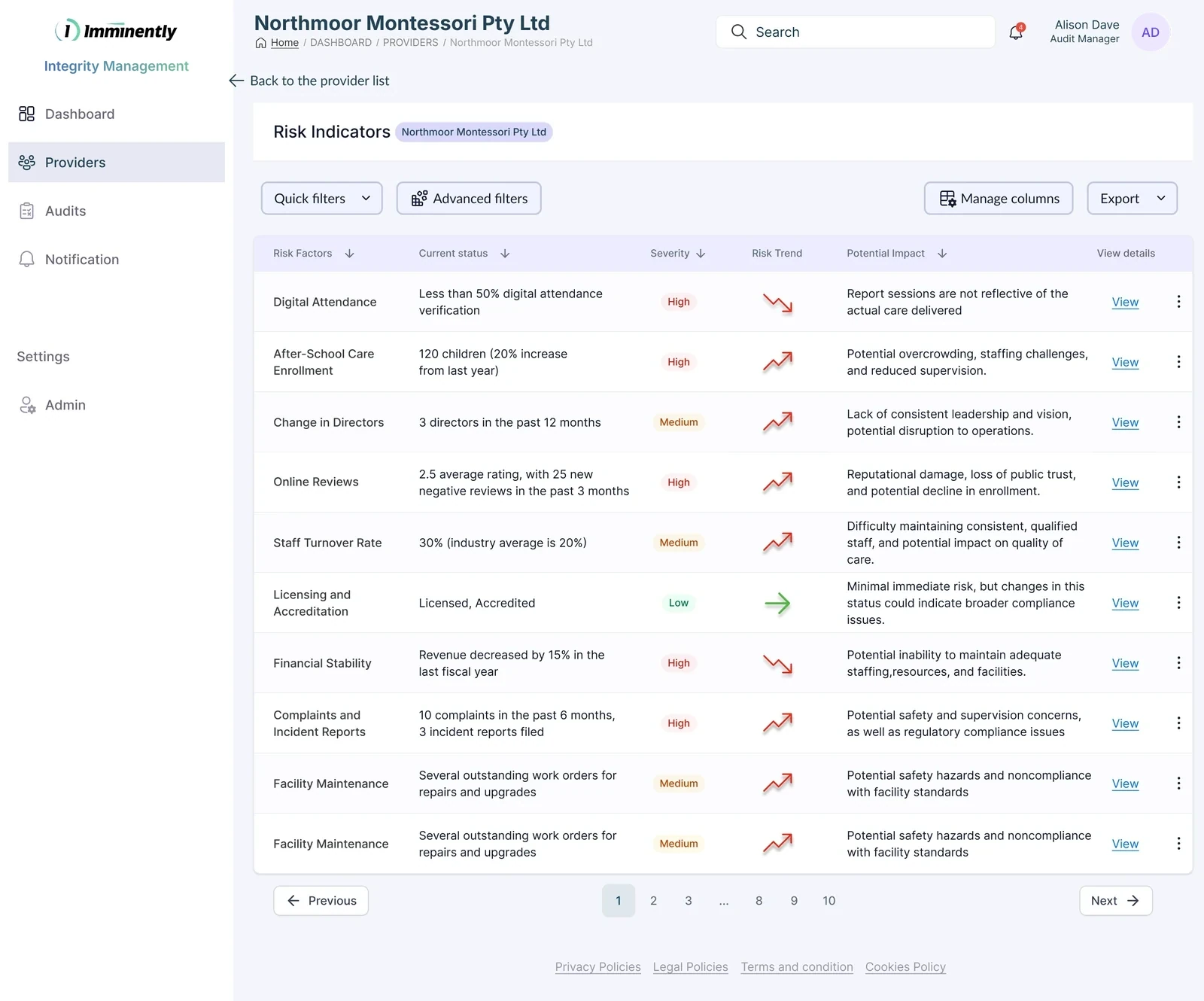
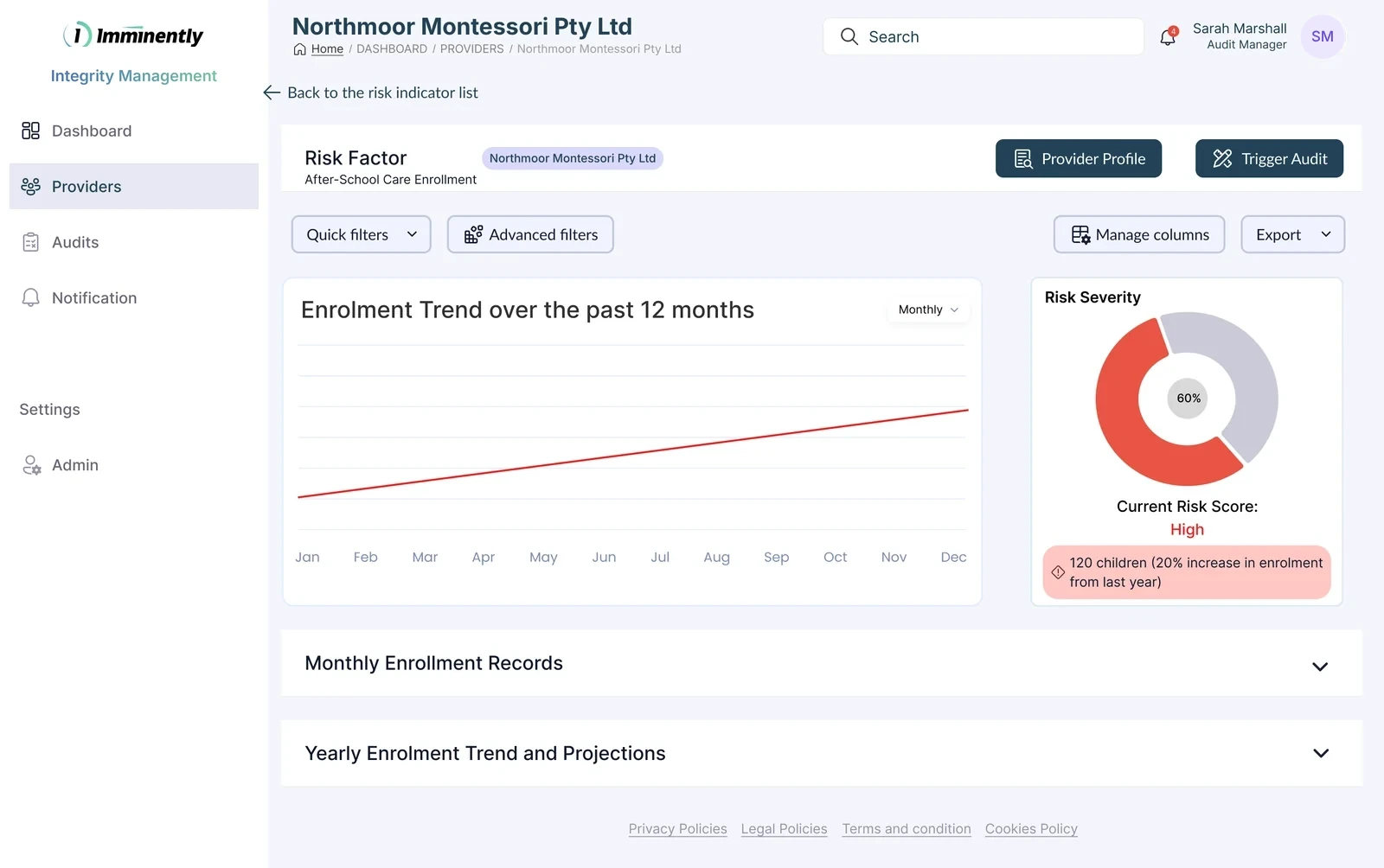
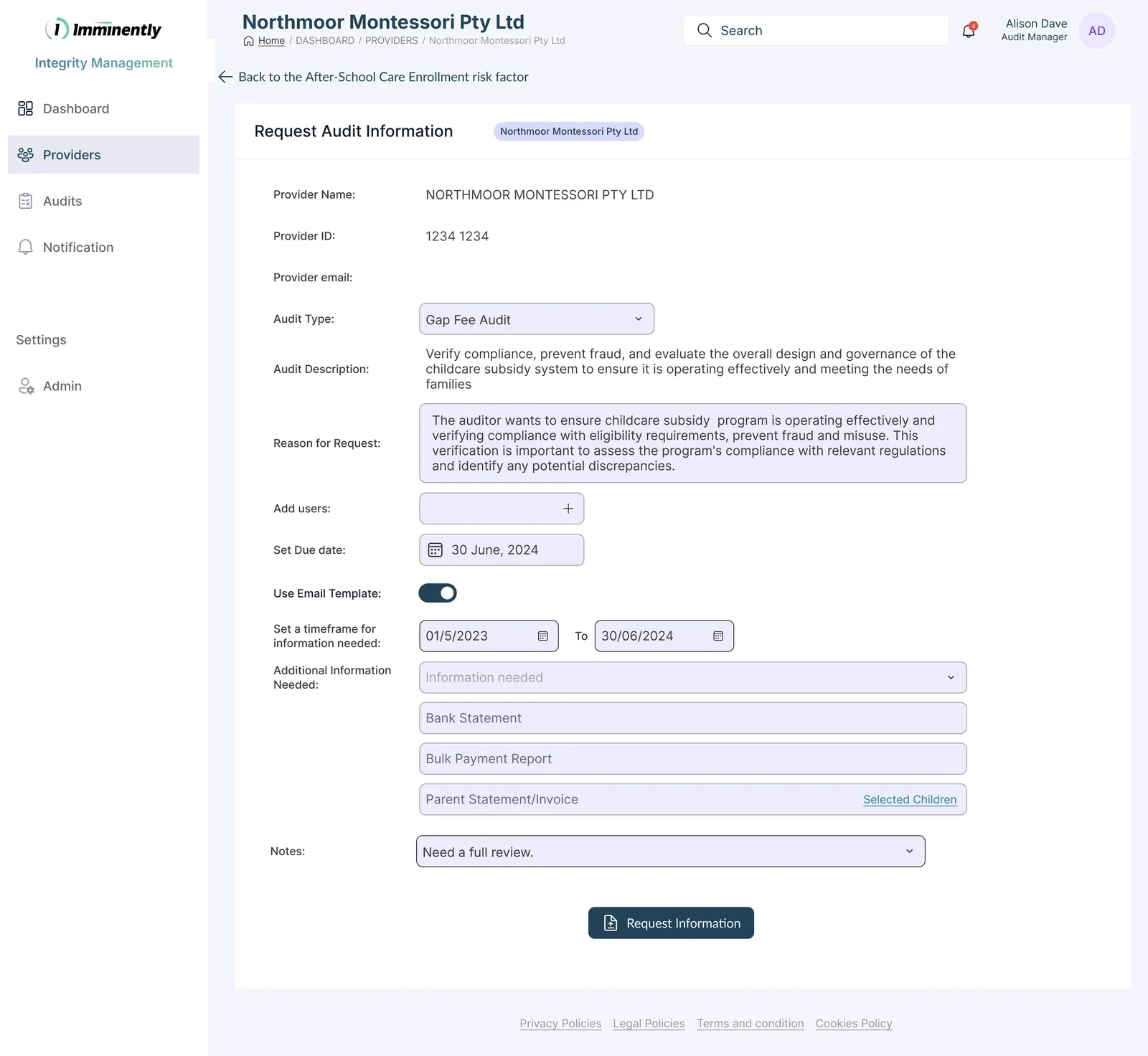
Risk indicators bring the providers that matter forward, and a request goes out with everything the provider needs to answer it.

Agency analyst

From a risk to a request in four screens.

The analyst starts from risk, not from a tip-off. Risk indicators the agency already produces sit beside each provider, and an audit request goes out pre-filled with the data the agency holds, so the provider is asked for exactly what the audit needs.

01 / 04
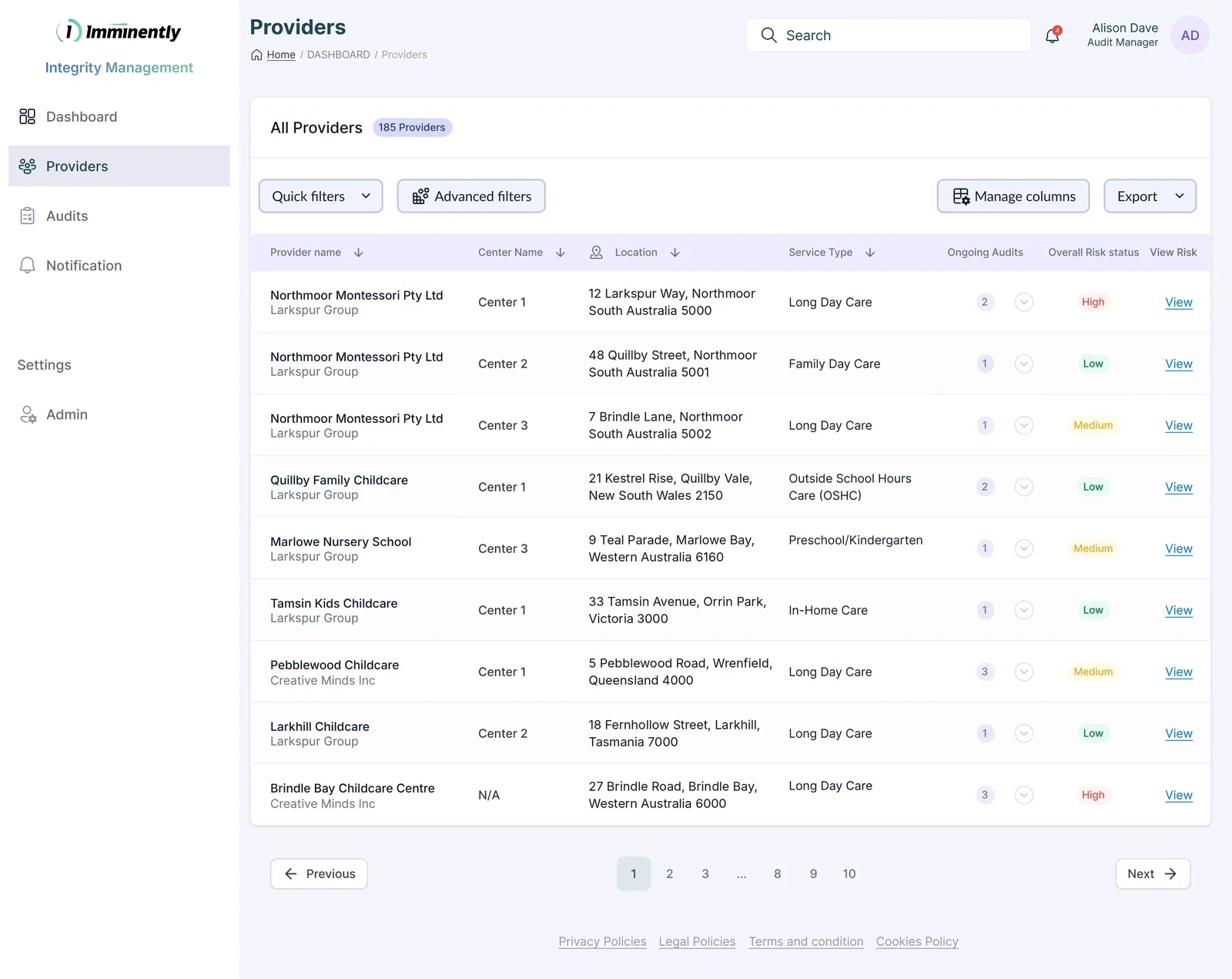
Integrity Management · providersAll 185 providers with each centre, its location and service type, the ongoing audits and the overall risk status, high, medium or low
Step 01 of 04

Providers, with their risk.

Each provider and centre with its location, service type, ongoing audits and overall risk status, ready to filter, sort and export.

Integrity Management, on an example subsidy program paid through providers. Providers, people and amounts are an example.

02 · The provider responds

Complete evidence,
the first time.

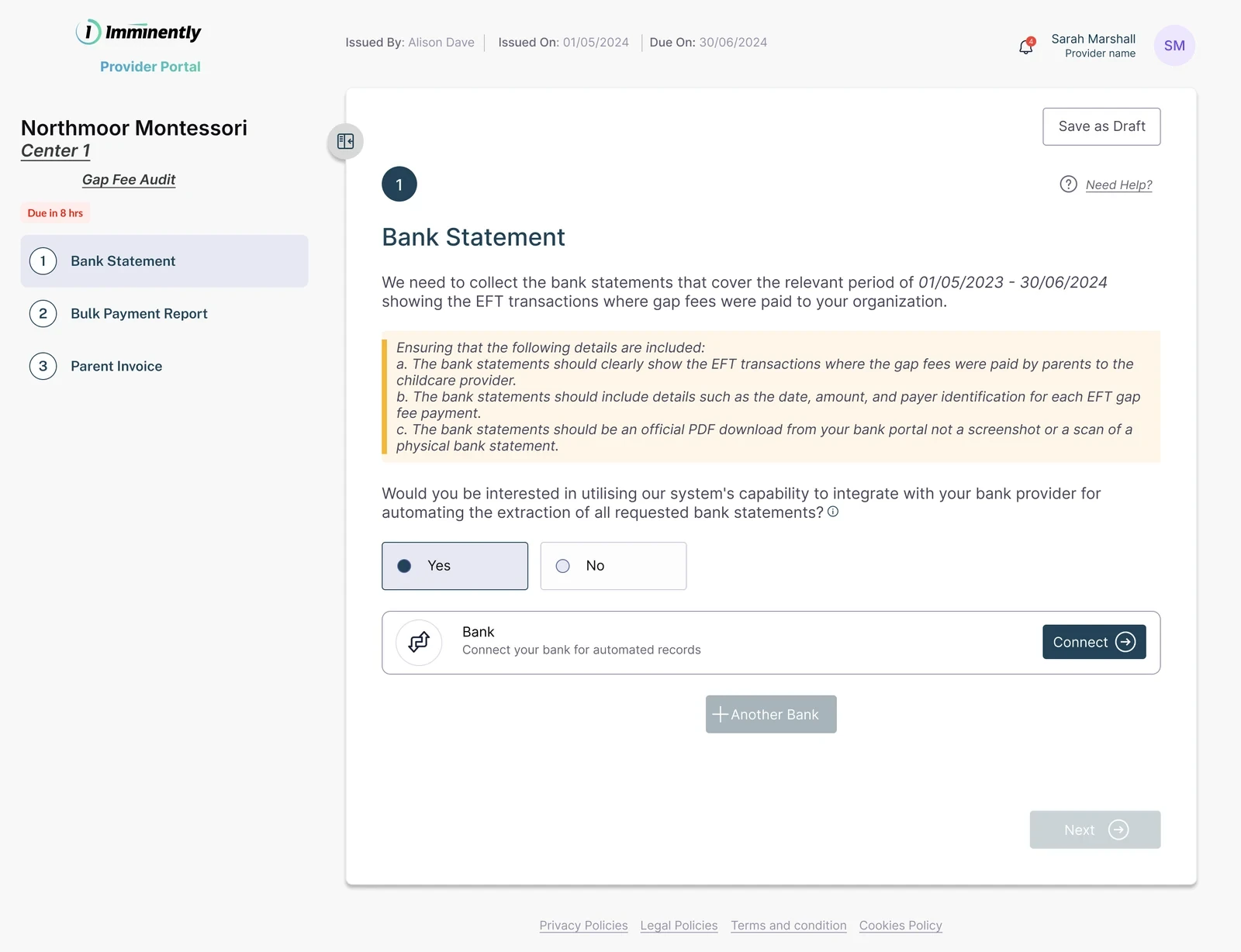
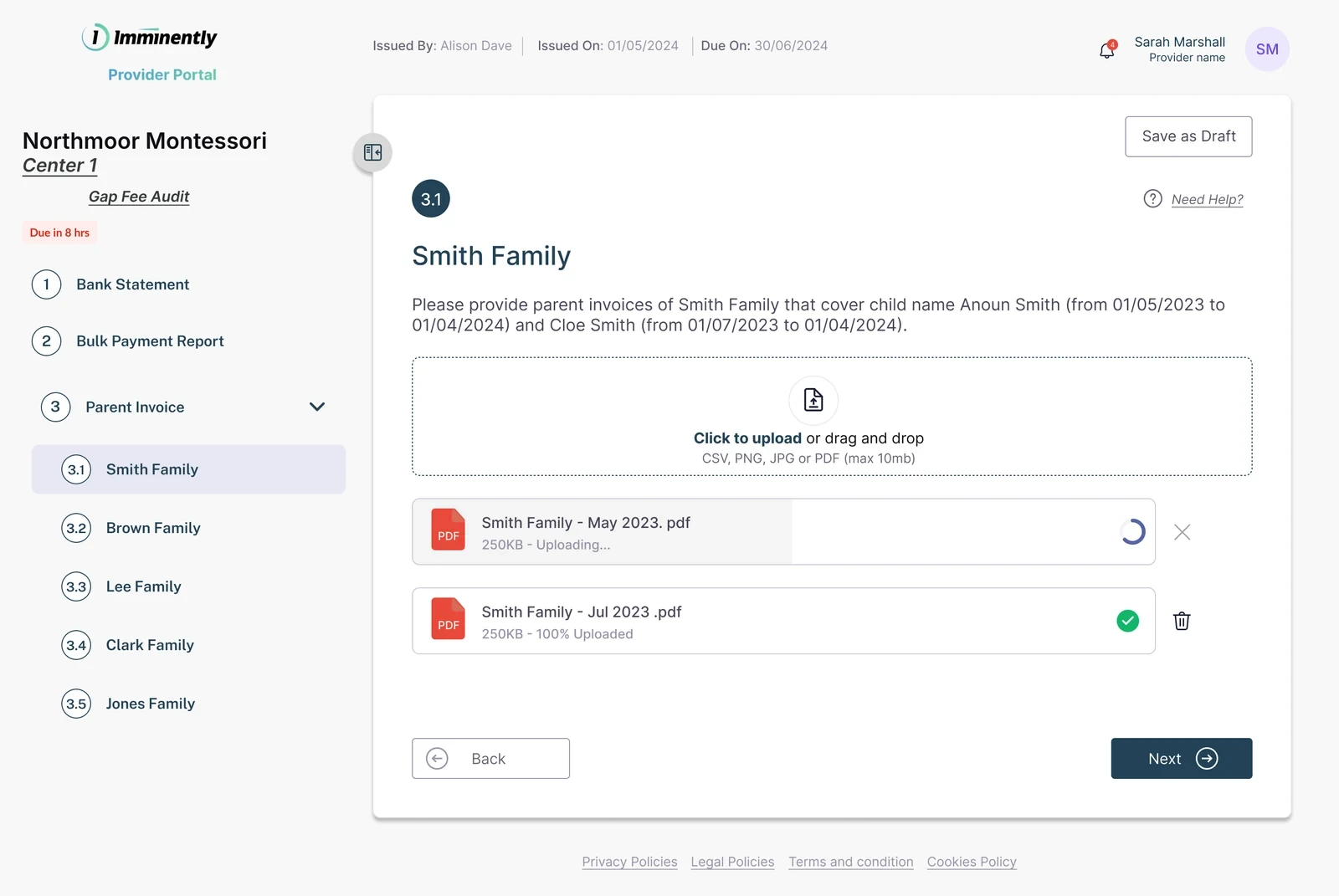
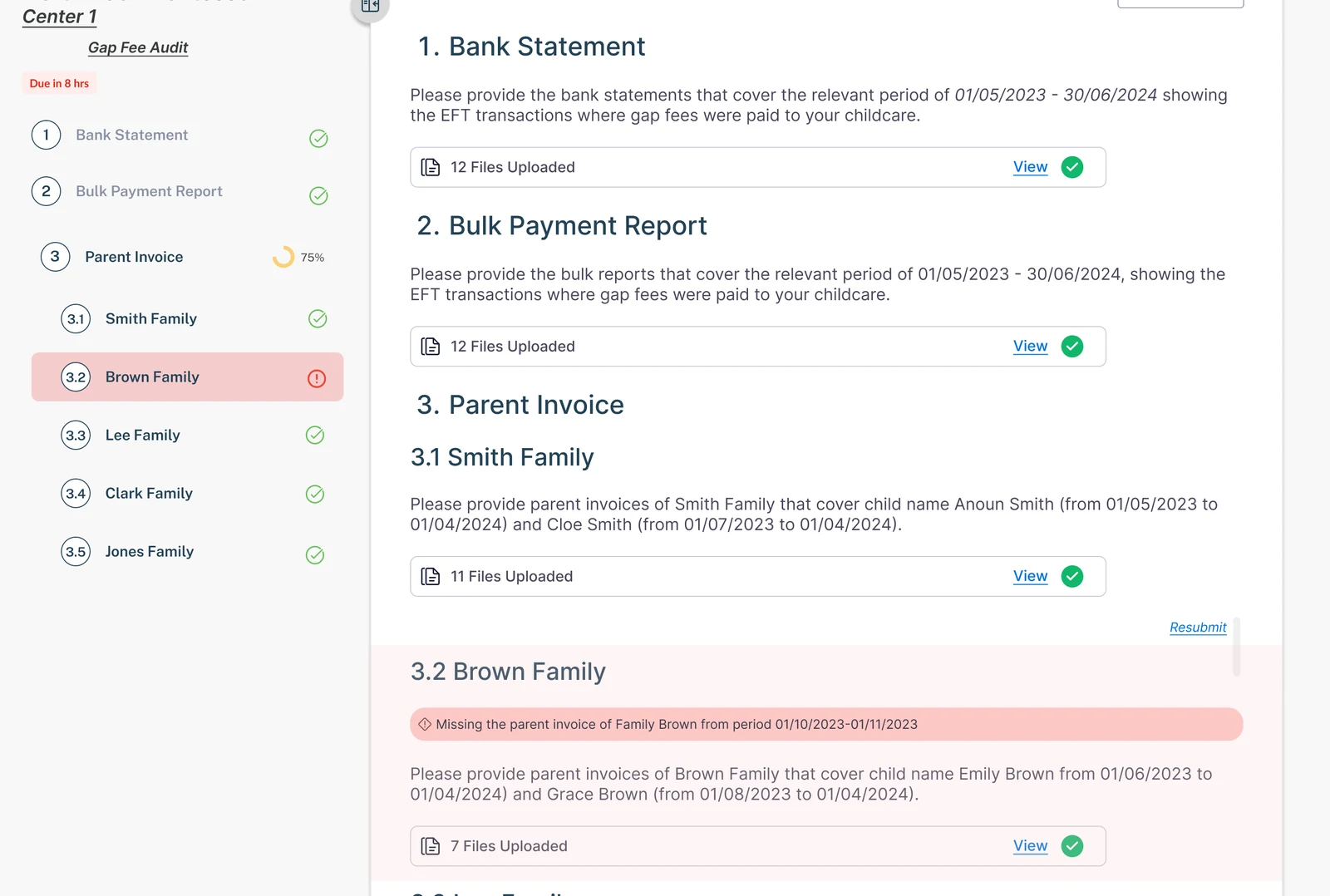
A guided portal asks for one thing at a time, connects to the provider’s bank, and checks that every child and every period is covered before the audit is submitted.

Provider

Guided steps. Nothing missing at the end.

The provider works through one set of evidence at a time, with what each must show beside it. The rules check every document for every child and period before the audit can be submitted, so the agency receives a complete audit and the provider is not chased for weeks.

01 / 06
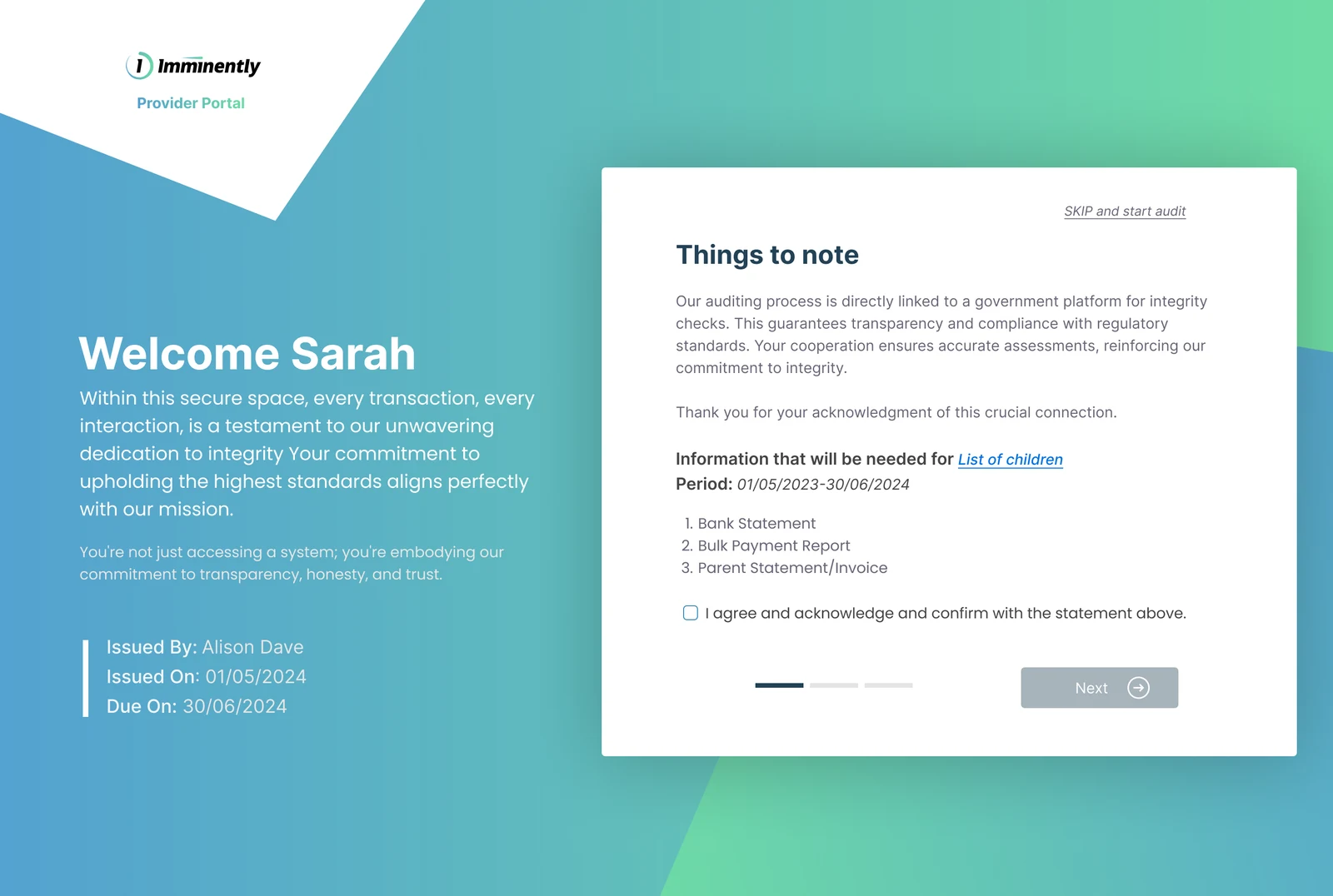
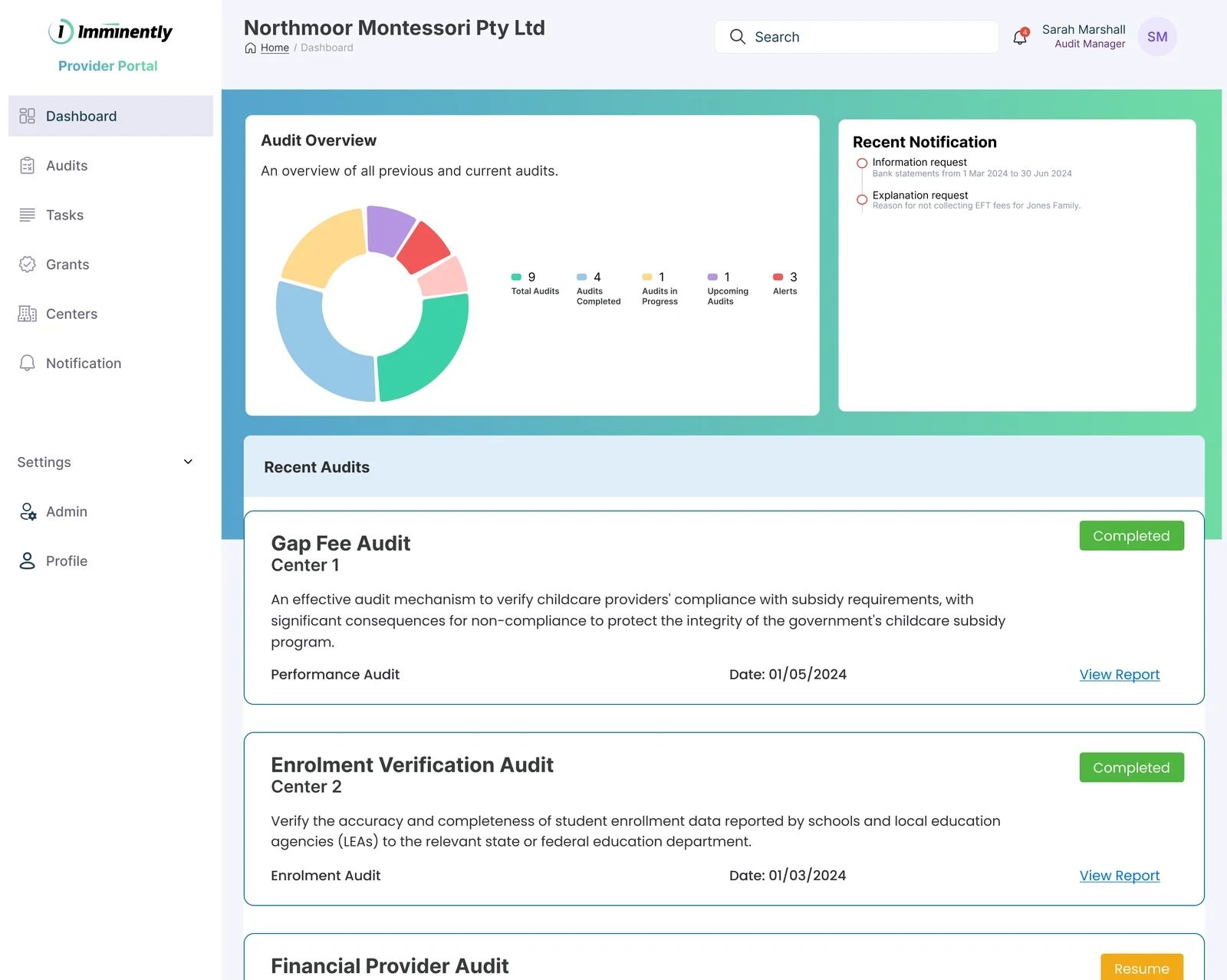
Integrity Management · provider portalThe provider’s start screen: Welcome Sarah, issued by Alison Dave on 1 May 2024 and due on 30 June 2024, things to note, the period 1 May 2023 to 30 June 2024 and the information needed, with an acknowledgement before starting
Step 01 of 06

The audit, explained before it starts.

Who issued the audit, when it is due, the period it covers and the information needed (bank statements, the bulk payment report and parent statements or invoices), acknowledged before the provider begins.

Integrity Management, on an example subsidy program paid through providers. Providers, people and amounts are an example.

03 · Review the findings

Every discrepancy,
with its evidence.

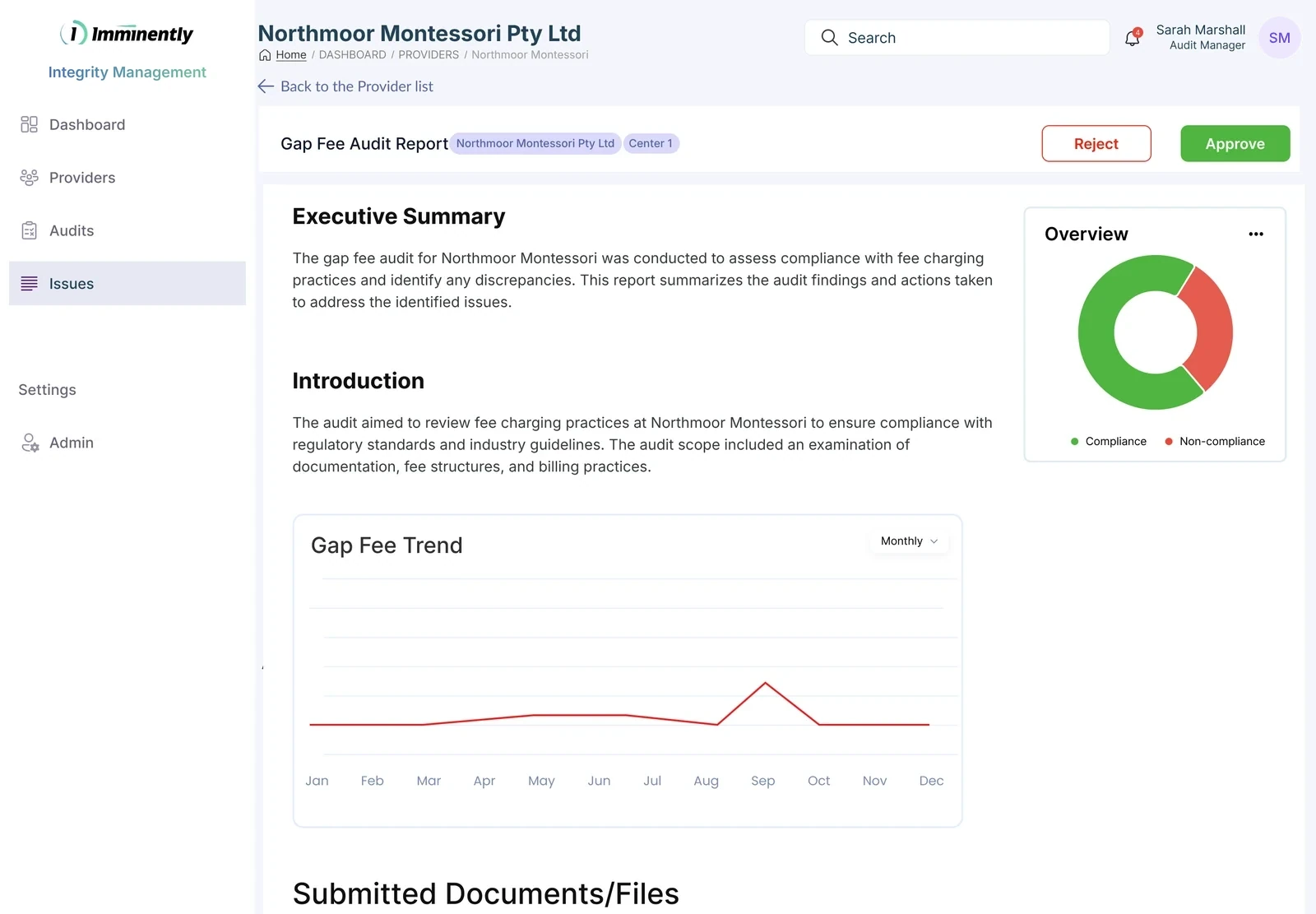
The checks run over every day and every child. The analyst sees each finding with the records behind it, decides it, and approves the report.

Agency analyst

Findings by family, by child, by day.

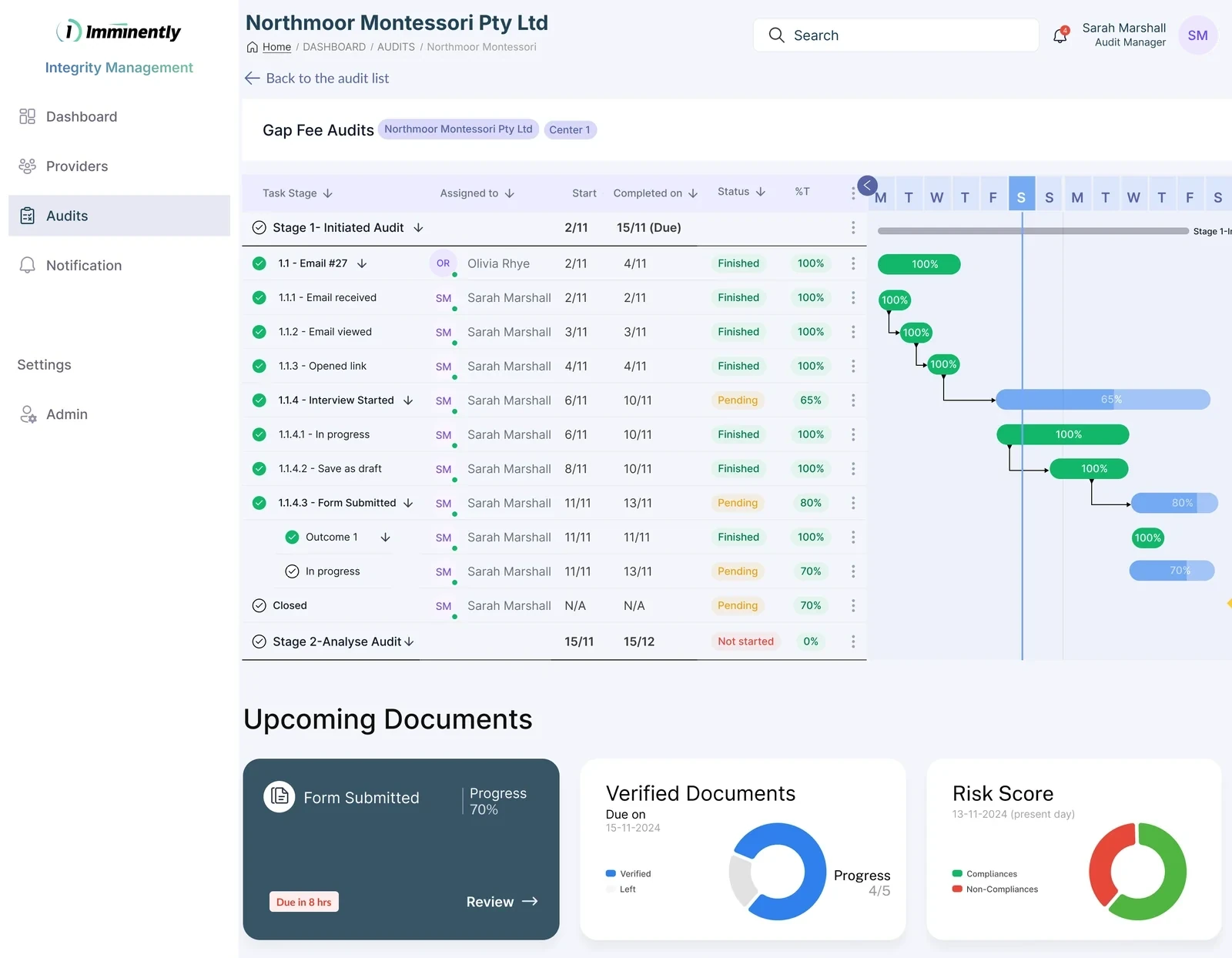
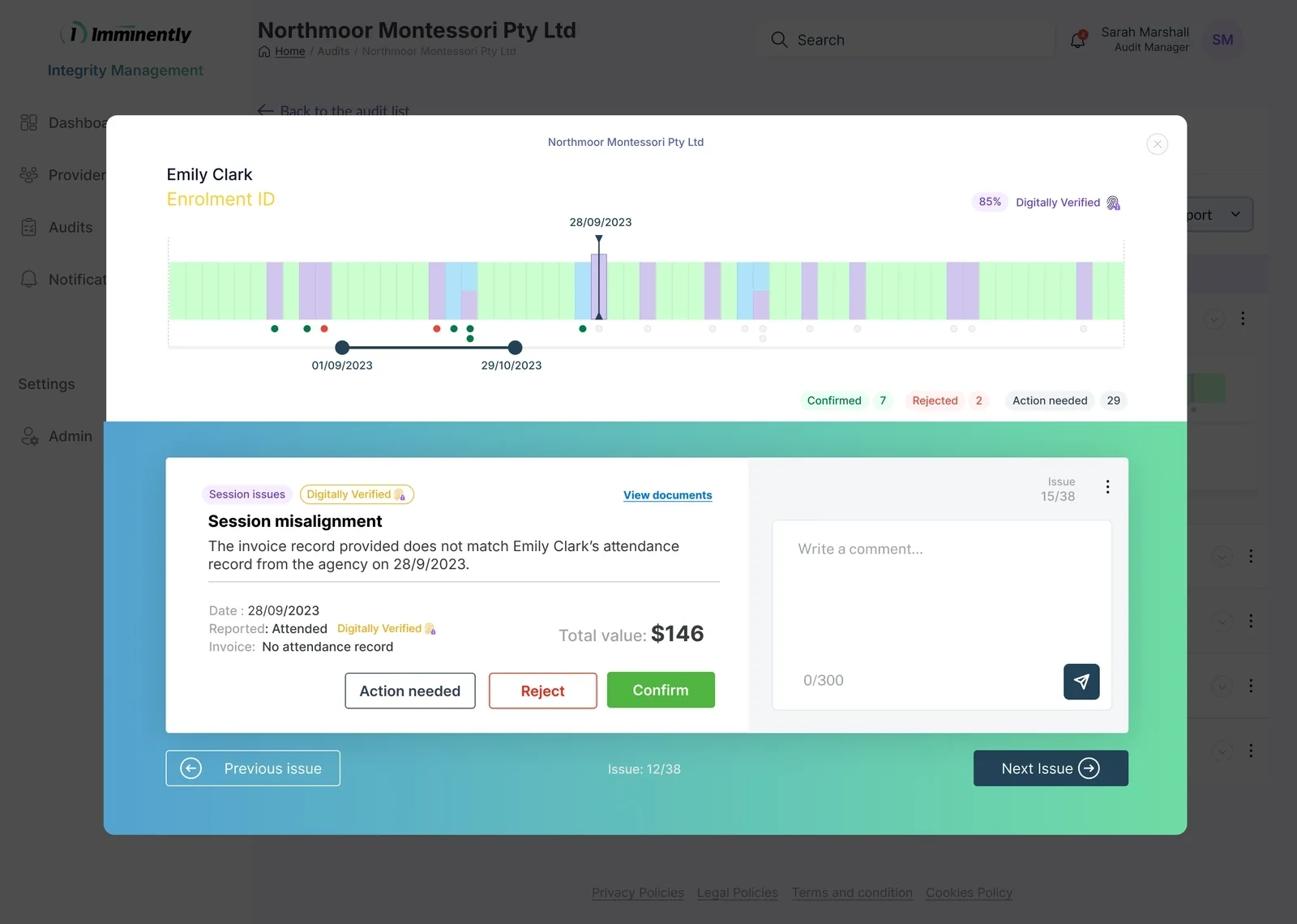
The checks run over every day of the period and every child, and set out what they found. The analyst reviews each finding with the records behind it, and nothing is put to the provider until a person has confirmed it.

01 / 07
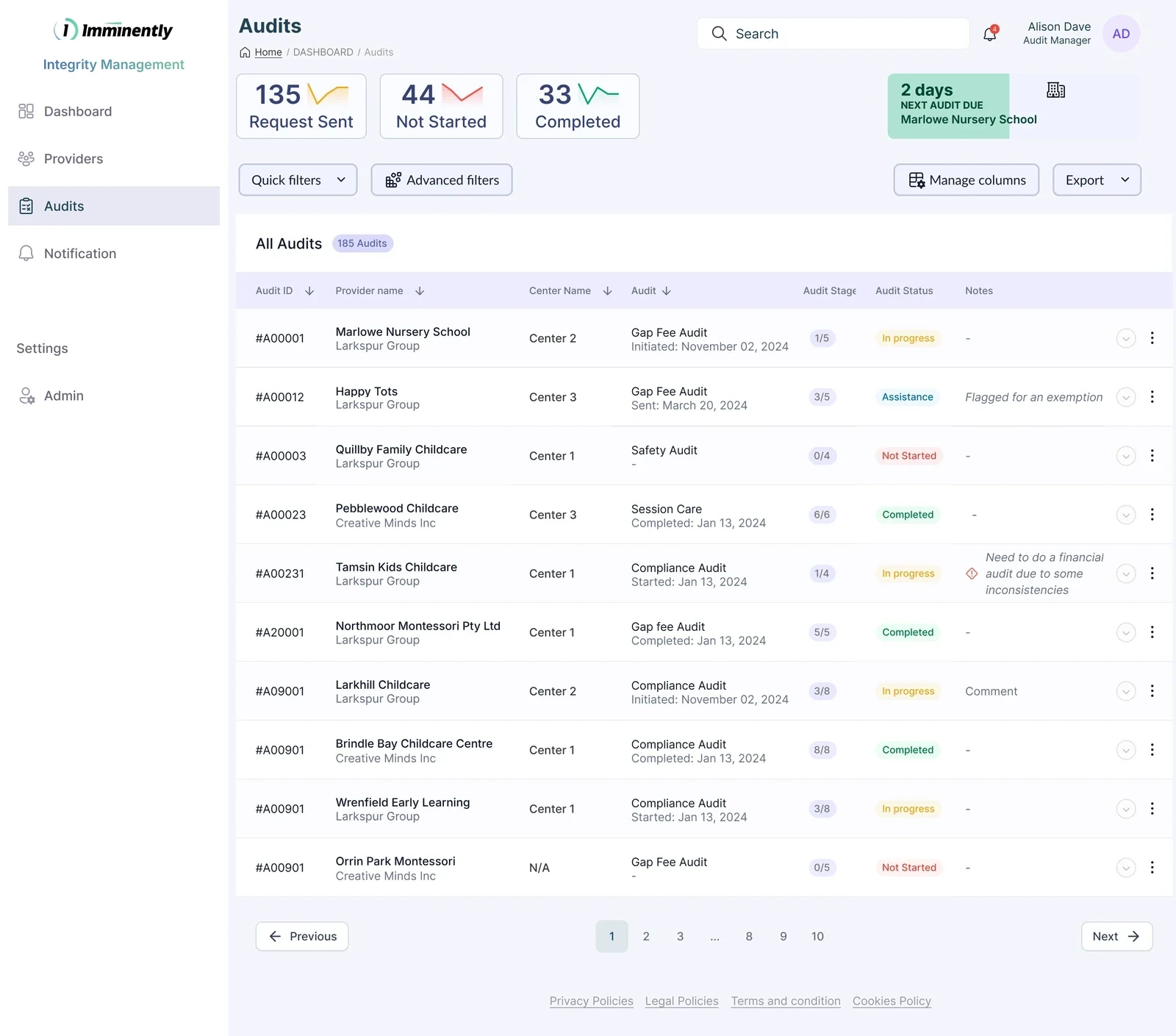
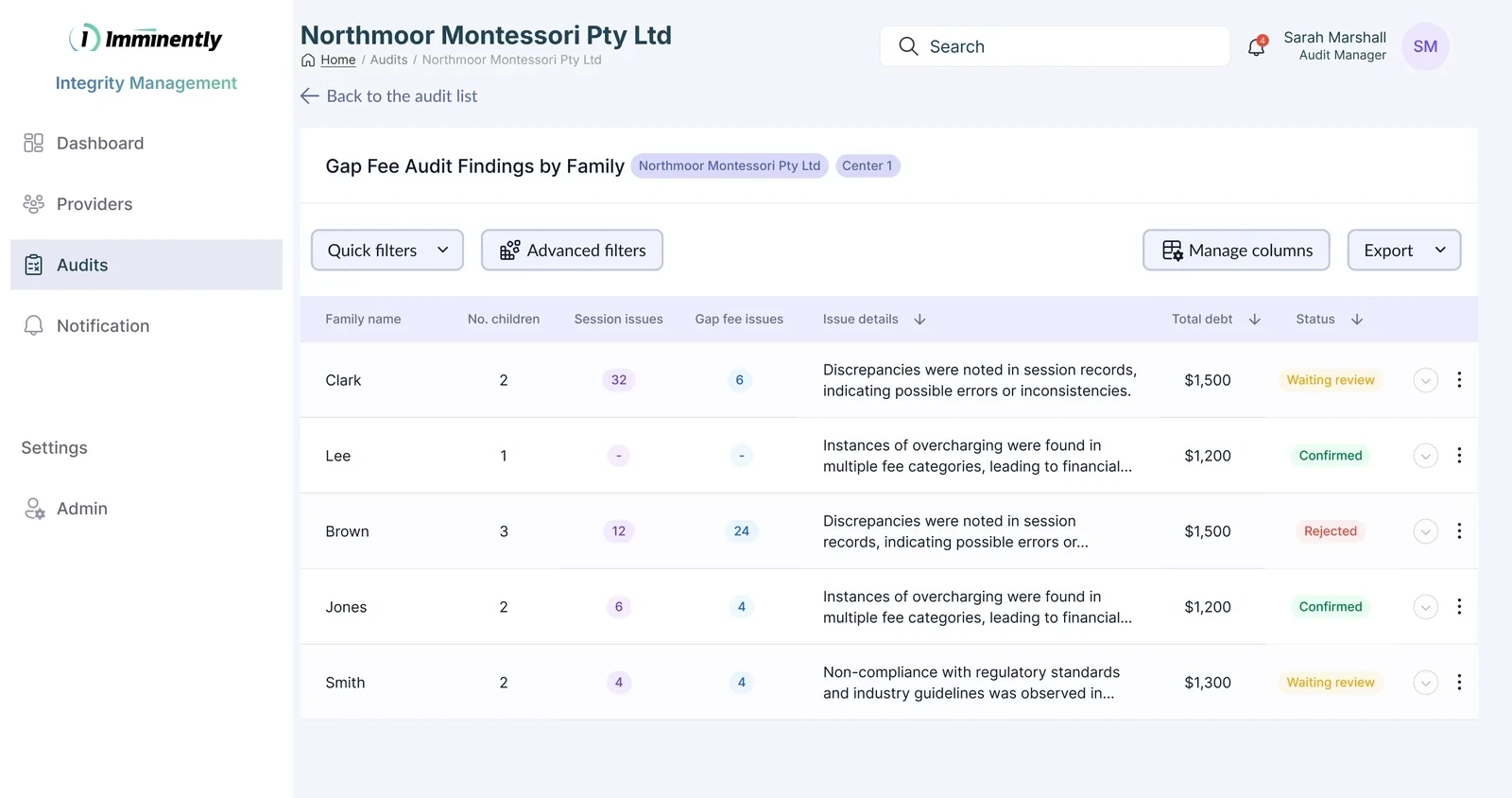
Integrity Management · all auditsAll audits: each provider and centre with its audit, stage and status (in progress, assistance, not started or completed), notes such as flagged for an exemption, and the next audit due in two days
Step 01 of 07

Every audit and its stage.

Every audit with its provider, centre, type, stage and status, including one where the provider has asked for an exemption, and the next audit due.

Integrity Management, on an example subsidy program paid through providers. Providers, people and amounts are an example.

04 · What it determines

The checks, per child
and per day.

Integrity Management starts with the checks your auditors already make by hand, written as rules from the legislation, the program’s policy and your audit practice, and runs them over every record.

Gap fees

Expected, day by day

The gap fee expected on each day from the agency’s own data, and the total expected over the period of each session report.

Session fees

Each day and in total

The session fees expected on each day and over the period, compared with what the provider reported.

Session days

Recorded against expected

The session days expected for each child, compared day by day with the days recorded in the session report.

Closing balance

What it should be

The closing balance each session report should show, and whether the reported balance is correct.

Payments received

Invoiced, paid and banked

Payments received each day against the enrolment, whether the payments on parent invoices were received, and whether what the provider charged was deposited into its bank account.

Attendance

Care that was delivered

Whether a parent was digitally identified at pick-up or drop-off at least once in the period, and, where digital attendance is available, the session reported against the session attended.

100% accuracy against your law and interpretations

The checks are deterministic rules written from the legislation, the program’s policy and your audit practice, with the interpretations you agree. The same records and rule version always produce the same finding, and totals are matched to within one cent.

Every finding traced to its provision

Each finding carries a plain-English decision report: the records it used, the rules it applied and the section of the law or policy behind them, for the analyst, the provider and any later review.

Day by day, over any period

The engine reasons over time natively, so every day of the audit period is checked under the rules in force on that day, across session reports, invoices, bank statements and attendance.

A person decides

When the checks find an anomaly, an analyst reviews it before anything is put to the provider, and the review is part of the record.

Test an audit strategy first

New checks, thresholds and risk indicators can be run over past audits as scenarios, so the agency sees their effect before it adopts them.

Changed in plain English

Audit and policy staff read the rules in plain English beside their source, and approved changes flow into the provider’s guided steps without rebuilding them.

Built for volume

Determinations run in under a second, each carrying a whole history of circumstances.

The legislation itself becomes the source code.Business users can see that every check makes the decision the law and the policy require, with full transparency from the finding back to the source.
Integrity Management · grants

Grants, assessed
on the same platform.

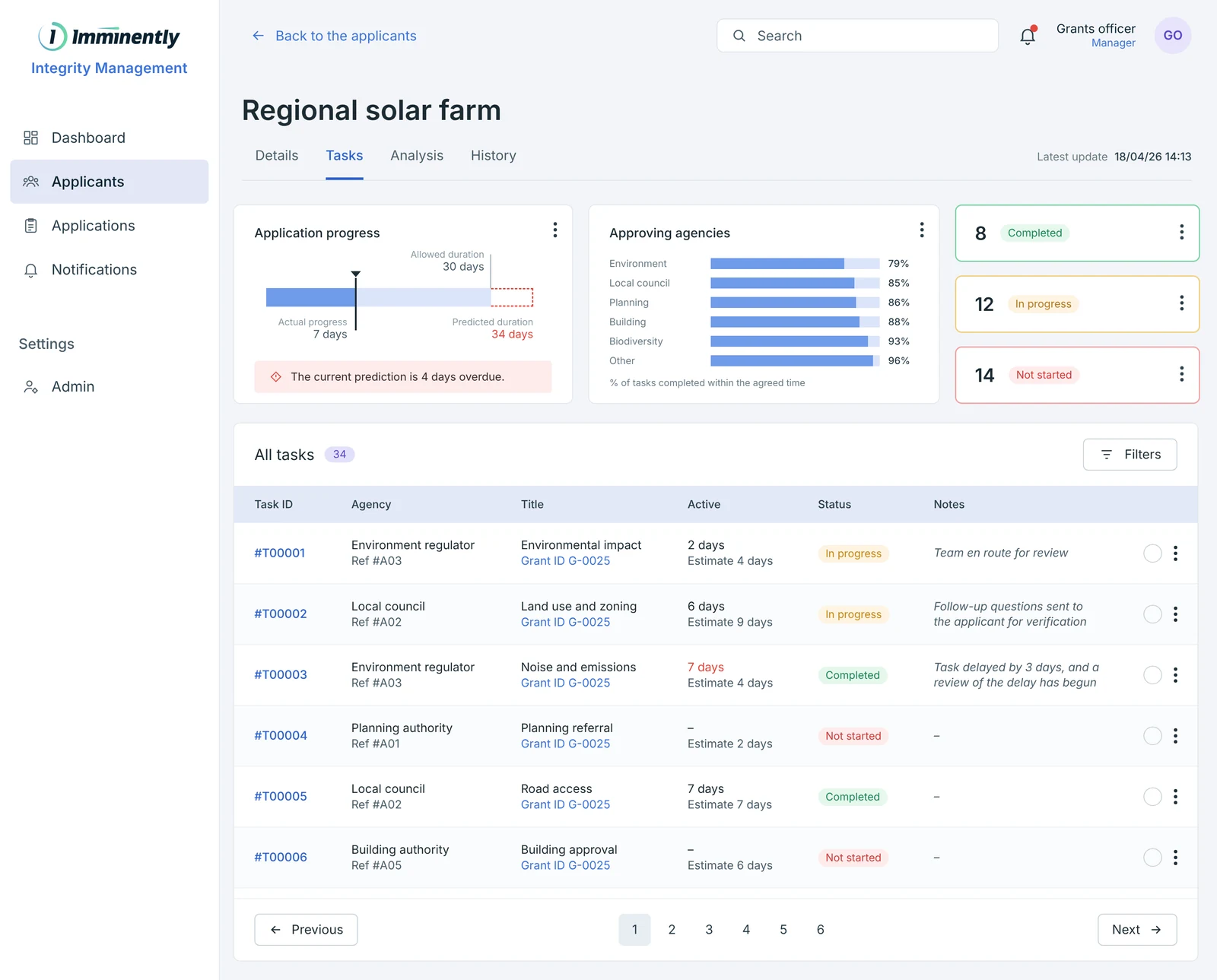
The same portal, rules and review extend to grants paid under legislation and program guidelines. The applicant lodges once; each approving agency’s task is tracked against its expected time; and the decision comes with its reasons, for the payment system to pay.

Applicant and approving agencies

One application, every approval in view.

The applicant lodges once, guided one section at a time with the guidelines beside them. Each approving agency’s task is then tracked against its expected time, so the program sees progress, delays and who is waiting on whom.

01 / 02
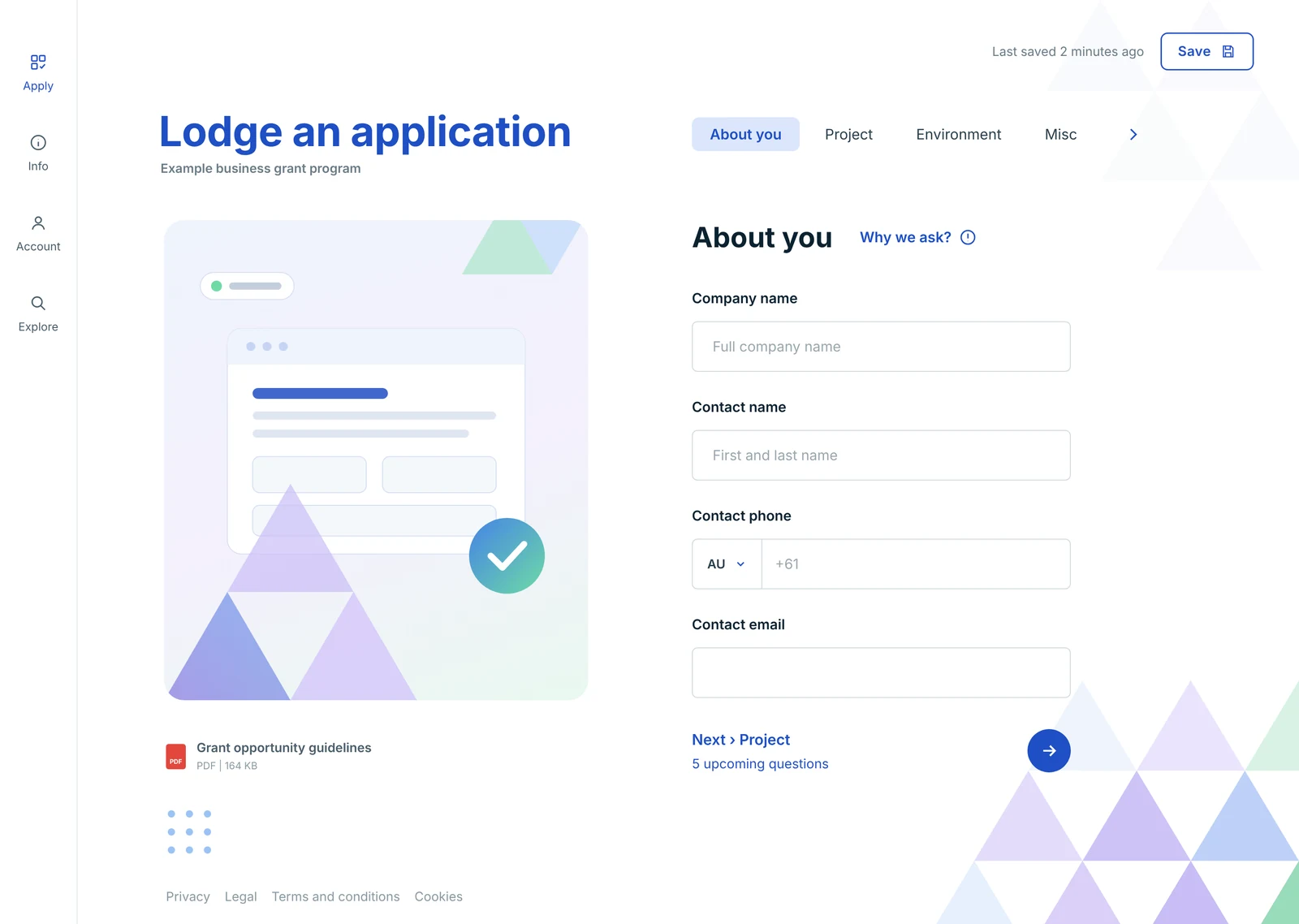
Integrity Management · grant applicationA grant application under an example business grant program: the applicant’s About you step, with company name, contact name, phone and email, tabs for the project, environment and other details, the program guidelines attached, and five questions to come in the next step
Step 01 of 02

The applicant lodges once.

A guided application, one section at a time: about the applicant, the project, its environmental detail and the rest, with the program guidelines attached and only the questions that apply. Progress is saved as the applicant goes.

An example program and an example application. The names, agencies and figures are examples.

Then the decision, with its reasons.

the applicant is eligible for the grantSatisfied

Value:trueGuidelines 4 · eligibility

the applicant is a business with an active ABNSatisfied

Value:trueInput · 4.1(a)

the business employs fewer than 20 peopleSatisfied

Value:trueInput · 4.1(b)

the project is located in an eligible regionSatisfied

Value:trueInterpretation · 4.2

the applicant has not received this grant in the previous two yearsSatisfied

Value:trueInput · 4.3

the grant amount

Value:$25,000.00Guidelines 6 · amount

the eligible project costs

Value:$50,000.00Interpretation · 6.1

the grant is half of the eligible costs, up to the cap of $25,000Satisfied

Value:trueGuidelines 6.2

The finance system pays the amount; the report shows why it is right.Legal Reasoning Platform · example program
The Legal Reasoning Platform’s decision report, on example program guidelines.
05 · Where it sits

Beside the systems
the agency runs.

Our product augments the agency’s systems; it does not compete with them. It adds the determinations they cannot make and reuses what the agency already has.

Integrity Management between the law and the systems an agency runs. The payment system keeps paying; our product makes and explains each finding.

Augment, never compete

The payment and subsidy system, case management and the data platform stay the systems of record. Integrity Management adds the legal determinations they were never built to make, and returns each finding with its reasons.

Reuse what the agency has

The risk indicators the agency already produces appear beside each provider; documents are stored in the agency’s document management system; staff sign in with the agency’s identity provider and providers with government digital identity.

API first

Every function is available through APIs as well as the portals, in JSON, XML or CSV, so provider software can submit records directly and other systems can call the checks.

Toward continuous assurance

As digital attendance and e-invoicing reach providers, records can stream in as they are made, and the same checks run continuously rather than audit by audit.

ERP Augmentation: the bridge between the law and the systems you run
The outcomes

What it is designed
to change.

The benefits we anticipate when audits of payments made through providers move onto Integrity Management.

Anticipated

Audits at a new scale

Designed to take an agency from hundreds of audits a year to tens of thousands, and toward continuous auditing of every provider.

Anticipated

No back-and-forth

Only complete audits can be submitted, so the weeks of email between officers and providers (up to 28 days for a single provider) give way to evidence checked at the source.

Anticipated

Risk-led, objective selection

High-risk providers brought forward from the data within hours, in place of days of manual review and subjective selection.

Anticipated

Less burden on providers

One portal and guided steps, with the bank connected instead of statements downloaded and uploaded, so educators and staff spend their time on care.

Anticipated

Findings that stand up

Every finding traced to the law, the policy and the records, so outcome letters, compliance actions and reviews rest on the same explanation.

Anticipated

One platform, many programs

The same portal, checks and case management extend to other programs paid through providers, such as schools, vocational training and grants.

How it is delivered

Co-designed, piloted,
then proved at scale.

A business-led transformation, not a software installation: designed with the people who audit and the providers who answer, and proved in stages.

01

Co-design and validate

Workshops with your auditors, analysts and provider representatives map the audit as it is done today, and the screens are tested with them before full build.

02

Production pilot

A targeted pilot on real audits, typically within about three months depending on its objectives, so change management starts early.

03

Prove it in stages

Volume first, then the accuracy of extraction and checks, then value in a live parallel run beside current audits, then scale.

04

Incremental releases

Two-week sprints, each phase with its own deliverables and success criteria, adding audit types, checks and integrations.

05

Full deployment

Roll-out with training, train-the-trainer programs, documentation and help inside the screens, then support integrated with your help desk.

06

Optimise

New fraud and error patterns are made into checks, and more programs and audit types are brought onto the same platform.

Deployment

Australian data centres or your cloud

Our managed service in Australian data centres, a dedicated environment, or a private deployment in your managed cloud under your security controls, identity integration and network boundaries.

Support

Supported in operation

Support integrated with your existing help desk, a dedicated support function or a co-managed service, with regular releases that keep the checks current.

Assurance

Secure by design

Zero-trust architecture, encryption in transit and at rest, role-based access and full audit trails, with Imminently’s ISO 27001 certification and SOC 2 Type 2 report.

Questions

The practical detail.

Does it replace our payment or case management systems?

No. They stay the systems of record. Integrity Management makes the checks, explains each finding and manages the audit, and works with the payment, case, data and document systems you already run.

Who decides that a payment was wrong?

A person. The checks find and explain each discrepancy; an analyst confirms, rejects or marks it for action before anything is put to the provider, and outcome letters and compliance actions follow from the confirmed findings.

What if a provider cannot supply a document?

The provider asks for an exemption in the portal with the reason, and the analyst decides it. Where a gap has a common cause, such as a payment made late, the provider is asked for the further evidence that resolves it.

How are bank statements and invoices read?

Document intelligence extracts the data as each document is uploaded, reusing your existing service where you have one, and every figure stays traceable to its page. Where the provider connects their bank, or provider software sends records directly, no extraction is needed at all.

Can it use the risk models we already have?

Yes. The indicators your data platform produces sit beside each provider in the analyst’s view, and the checks can add their own findings to them.

Is it only for early learning subsidies?

No. The example shows a subsidy paid through early learning services. The same approach applies wherever payments are made through providers under legislation and program rules: schools funding, vocational training, grants and other programs.

Where does it run?

In Australian data centres, in a dedicated environment, or in your managed cloud. Imminently holds ISO 27001 certification and a SOC 2 Type 2 report.

Services as Software · Integrity Management

The rules change.
Every audit keeps up.

We deploy Integrity Management with your program’s legislation, program and grant guidelines, provider obligations and audit practice loaded as source-linked rules, and the checks your auditors run today digitised. When the law, a guideline, a provider obligation or your audit approach changes, the affected checks are updated, tested and released as part of the service, and each audit period is checked under the rules in force for it.

See it in your context

Bring an audit
you do by hand today.

Bring the program’s rules, a recent audit and the evidence it needed. We will show you the checks, the findings and their reasons on your own example.