Councils run more kinds of work than almost any employer: road and parks crews on early starts and call-outs, educators held to ratios, lifeguards on supervision plans, libraries open into the evening and an office on flexitime. Our product applies your award and agreements to all of it, as the roster is built, the time is entered and the pay is calculated.
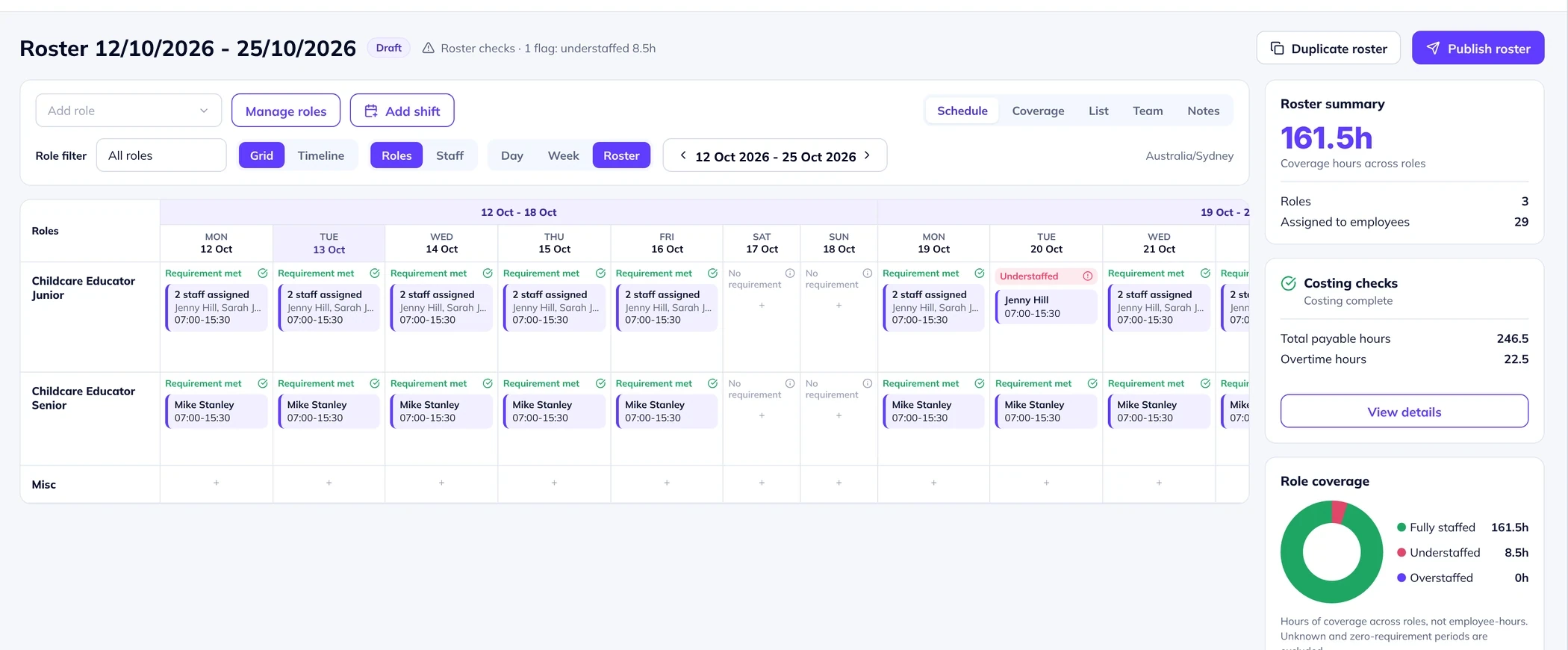
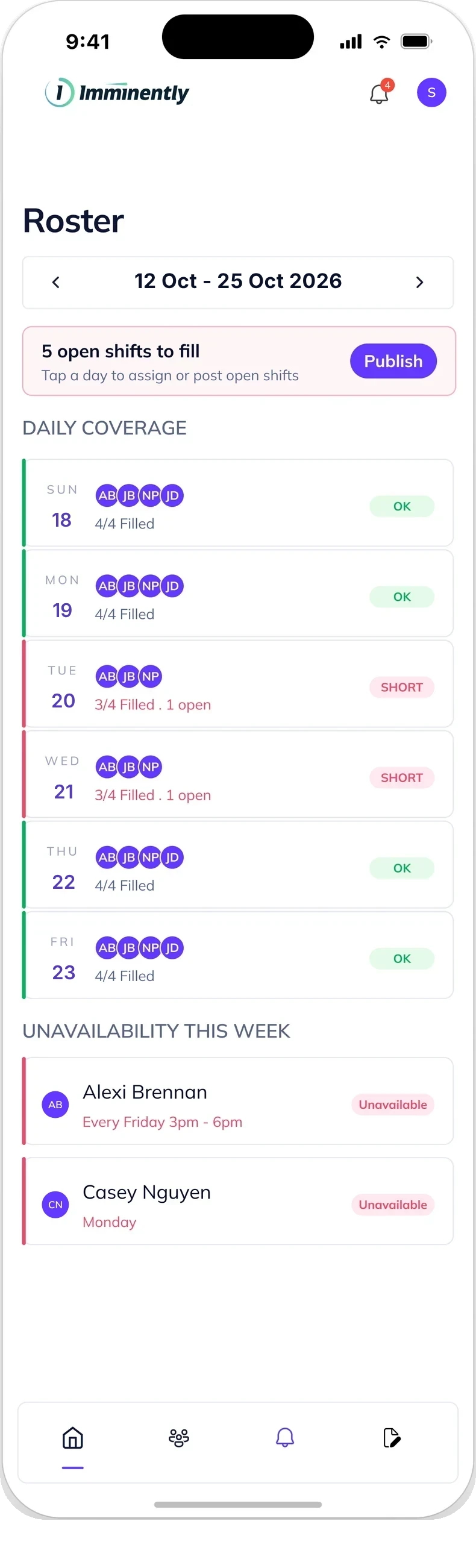
A two-week roster by role for children’s services, and the manager’s roster on the phone with open shifts, daily coverage and publish.
2 state awardsin the NSW base: the Local Government (State) Award 2026 and the Local Government (Electricians) (State) Award
20 cohortsof council rostering in our library, from children’s services to water and sewerage
16 scenariosof council exceptions built against the award and used as acceptance tests
8,500+timesheets a fortnight processed with real-time determinations
THE COUNCIL WORKFORCE
Many workforces. One employer.
A council is a collection of very different operations under the same awards and agreements. Each cohort brings its own hours, spans and penalties, and the credentials a roster must hold before anyone is put on a shift.
Outdoor crews
Civil works, roads and parks
Early starts, summer and winter hours, nine-day fortnights, job-and-finish arrangements, and crews travelling or camping out on remote works. Call-outs after storms and on-call weeks are routine.
Traffic control tickets
Plant and high-risk licences
Chainsaw and arborist competencies
Seven days
Waste and resource recovery
Transfer stations and landfills open every day, with higher weekend penalties, a responsible person on site during operating hours and weighbridge operators where trade weighings occur.
Plant tickets
Responsible person on site
Weekend penalties
Around the clock
Water and sewerage
Treatment plants that run continuously, on-call rosters, call-backs and remote response, and arrangements that replace variable penalties with an operational allowance.
On call and call-back
Remote response
Rest after overtime
Ratios
Children’s services
Long day care, preschool, out of school hours and family day care. Every roster slice must hold the educator-to-child ratio, the qualification mix and a responsible person, with first aid on every shift.
Ratios by age band
Working with Children Check
First aid, CPR and anaphylaxis
Supervision plans
Aquatic and leisure centres
Lifeguard numbers set by each pool’s supervision plan, a competent plant operator at opening, and a large casual learn-to-swim workforce that peaks after school, at weekends and in the holidays.
Pool lifeguard currency
Swim teaching qualification
Casual engagements
Evenings and weekends
Libraries, venues and community centres
Multi-branch rosters open into the evening and at weekends, mobile libraries, festivals and civic events planned alongside normal service, and casual staff across them.
Function-specific spans
Weekend penalties
Event rosters
Authorised officers
Rangers, compliance and animal care
Seven-day enforcement and animal care, with authorised-officer appointments deciding who can be rostered to which work, and after-hours on-call.
Authorised officer status
After-hours on call
Flexible hours
Corporate and professional staff
A shorter ordinary week for listed professional and administrative functions, flexitime and time in lieu, acting and higher duties, and staff who hold more than one position.
Flexitime
Higher duties
Multiple positions
THE INSTRUMENTS
An award, an agreement and the arrangements in between.
Councils sit in a state or the federal industrial system depending on where they are, and each layers its instruments differently. Every implementation starts by mapping, condition by condition, which instrument governs, which defers to another, and which local arrangement overrides it for which cohort.
Pattern oneAn award with local agreementsThe award is the baseline. Agreements made at council level under it replace specific provisions, such as hours, overtime or travelling allowances, for a named cohort and period.
Pattern twoAn agreement that defers to the awardThe enterprise agreement sets some conditions and points to the award for the rest, so each rule must know which instrument governs it and where its rate comes from.
Pattern threeA self-contained agreementThe agreement replaces the award for the employees it covers, carrying its own rates, hours and allowances.
Clause typeWhat it providesWhat makes it hardWhat our product does
What it providesOrdinary hours per week by function, arranged over a cycle of one to four weeks, with a daily maximum and minimum days off.
What makes it hardWhether a nine-hour day is overtime depends on the whole cycle, not the day.
What our product doesDetermines ordinary hours and overtime against the averaging cycle and the daily maximum; a roster check for them is configured in the deployment.
What it providesA span of ordinary hours set by function, such as later evenings for libraries or earlier starts for pools, with a penalty for ordinary hours outside it.
What makes it hardThe same shift is penalty-free in one service and penalised in another.
What our product doesSpans are set by function on each shift template, so out-of-span hours are flagged on the timesheet.
What it providesHigher weekend penalties for listed outdoor and operational functions, such as parks, waste, water and road maintenance.
What makes it hardThe function of the position, not the location, decides the rate.
What our product doesApplies the penalty for the function worked, including for staff who work across functions.
What it providesOvertime before or after agreed hours, escalating after the first hours and at weekends, work on a rostered day off treated as overtime, and a rest break required before work resumes.
What makes it hardMissing the rest break changes the rate of the next day’s work.
What our product doesBuilds the overtime period and applies the escalation. A roster check for the rest break is configured in the deployment.
What it providesAllowances for being on call, a minimum payment for a call-back, and the treatment of work done remotely.
What makes it hardEach kind of call has its own minimum or rounding, such as the four-hour minimum for a call-back in the NSW award (cl. 21D(ii)).
What our product doesRecords each on-call period and each call, and applies the allowance and minimum payment from those facts.
What it providesAn unpaid meal break after a set number of hours, a paid break after further continuous work, and the limited cases in which a break may be delayed, such as by agreement or in unforeseen circumstances.
What makes it hardCrews in the field cannot always stop on time.
What our product doesPlans the unpaid meal break into each rostered shift, and flags on the timesheet a meal break that does not meet the instrument; a roster check for break timing is configured in the deployment.
What it providesAdverse working conditions, travelling and camping, tools, first aid and community language allowances, some of which a local agreement may consolidate into one site allowance.
What makes it hardSome allowances can be varied locally and others cannot.
What our product doesHolds each allowance with its source, so a consolidated allowance replaces only what it is permitted to replace.
What it providesAdverse conditions allowances, inclement weather provisions or stand-downs, depending on the instrument.
What makes it hardA wet day is handled differently in each instrument.
What our product doesThe timesheet asks the question the instrument needs, only when it applies.
What it providesAnnualised salaries, excess hours agreements for senior bands, employee-requested weekend or out-of-span work, and requests for flexible working.
What makes it hardEach carries its own test: an annual salary is compared with the award over the year, an excess hours agreement is tested when it is made, and an employee-requested weekend or out-of-span arrangement removes the penalty.
What our product doesApplies the arrangement for its effective period and keeps the hours the comparison requires.
What it providesActing in a higher role, or holding two positions under different conditions.
What makes it hardHours and fatigue run across positions while pay is calculated per position.
What our product doesInterprets pay for the position worked, and shows each person’s other shifts when they are rostered; a roster check for hours across positions is configured in the deployment.
SYSTEMS AND INTEGRATION
Your HR and payroll stay. The interpretation sits in between.
Councils keep their HR, leave and payroll. Our product adds rostering, time capture and award interpretation, and returns payroll-ready pay lines.
From your HR system
The authoritative facts
Employees, positions and the reporting hierarchy
Contracted hours and work patterns
Pending and approved leave
Credentials and qualifications with expiry dates
Delegations, acting and higher duties
Cost centres and project codes
Imminently Attendance Management
Rosters, Timesheets and Awards
Rosters checked as each shift is placed
Timesheets pre-filled from the roster
The award and agreements applied in real time
A legal determination report for every work period
From reconciling after payday to getting it right on the roster.
Where it hurtsTodayWith our product
Building the roster
TodaySpreadsheets service by service, with the award applied from memory and the cost unknown until payroll.
With our productOne roster for every service, with coverage and each person’s credentials checked as each shift is placed, and gaps and issues flagged before publication.
Short-notice cover
TodayCalls down a list, without knowing who holds the ticket or is close to a fatigue limit.
With our productThe available staff are shown with their credentials and availability, and an assignment that lacks a required credential is flagged as invalid.
Credentials
TodayAn expired ticket found after the shift was worked.
With our productCredentials held with their expiry dates, and an assignment flagged as invalid where a mandatory credential is not recorded; reminders before expiry can be configured with you.
Interpretation
TodayPay codes chosen by the employee or keyed by payroll.
With our productSimple facts entered once; the award determines the pay codes, with the clause behind each.
Corrections
TodayManual recall and recalculation whenever a record changes.
With our productEach approval creates a version, and only the line-by-line difference goes to payroll, under the rules in force at the time.
Audit and disputes
TodayLogs showing who changed a figure.
With our productA legal determination report for every work period, linking each outcome to its facts and clauses.
A COUNCIL WEEK
A week across the council, screen by screen.
Rostering the depot, covering a children’s service, filling a short day from the phone, and every timesheet reviewed with its hours and status in view.
Manager and staff
From the depot roster to approved time.
01 / 07
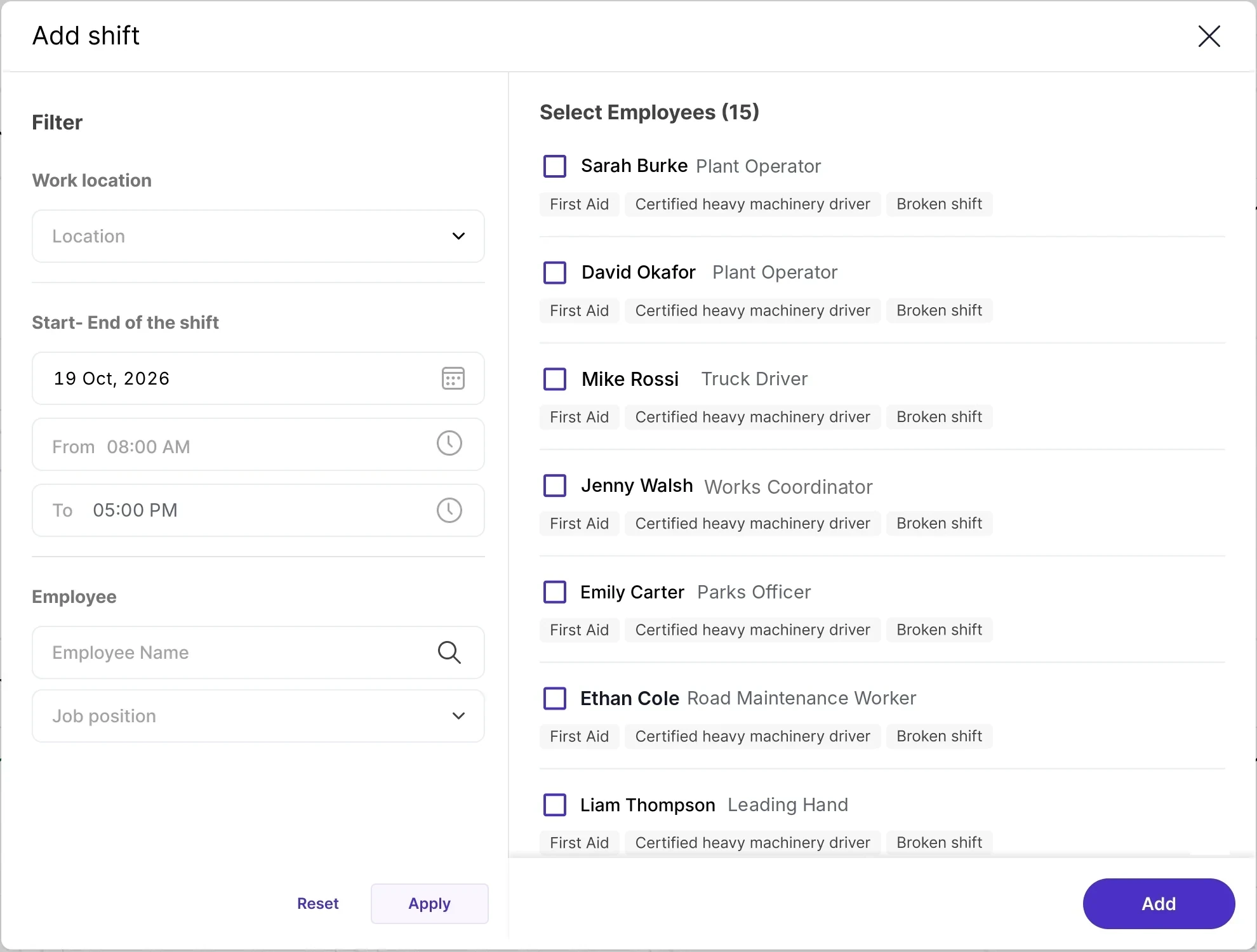
Imminently Rosters · add a shift
Step 01 of 07 · Manager
Find the crew with the right tickets.
The roster manager adds a shift for the depot, filtered by location, date and position. Each person is listed with their skills and tickets, such as first aid or heavy machinery.
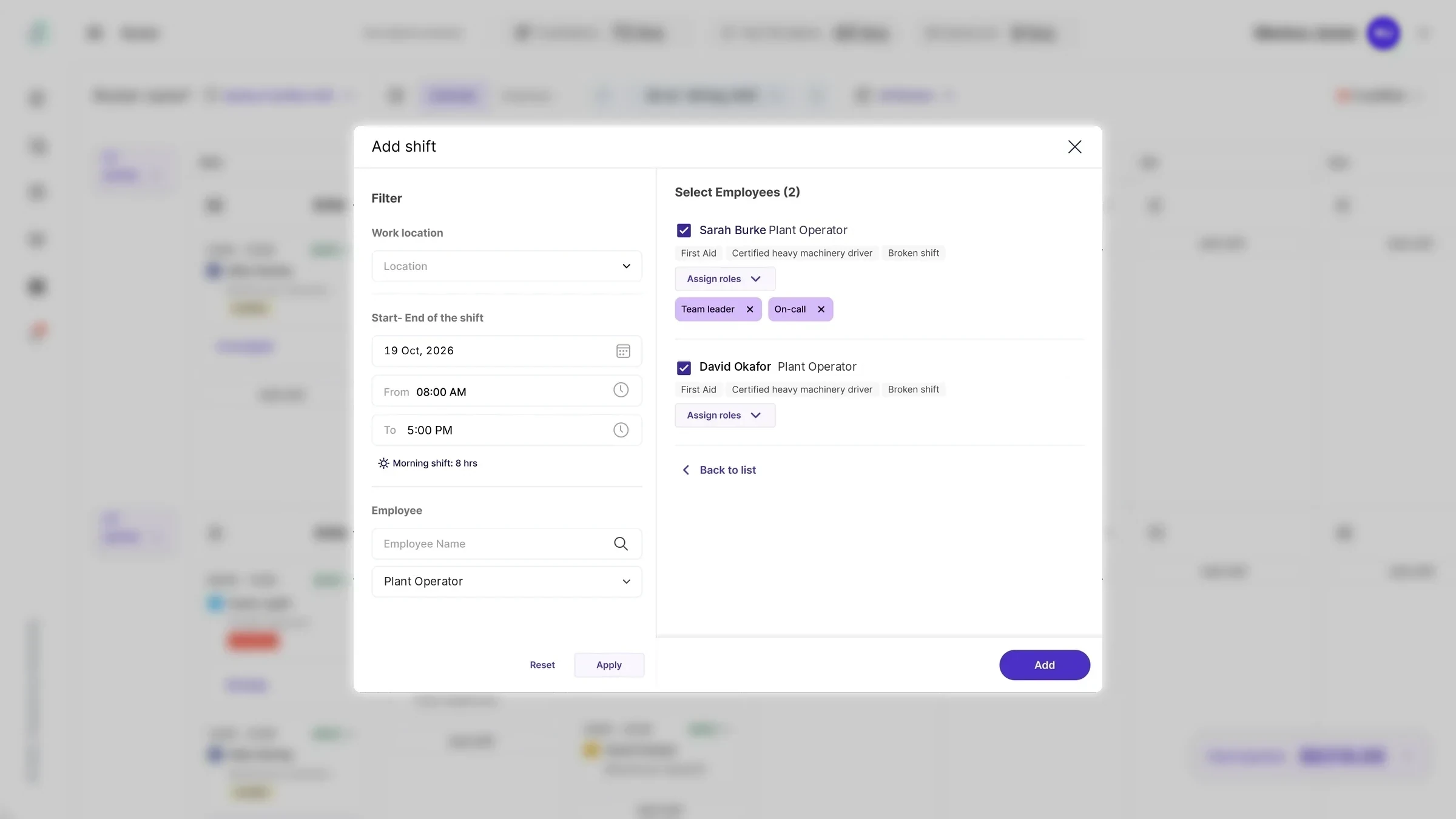
Imminently Rosters · roles on the shift
Step 02 of 07 · Manager
Name who is on call.
A person can carry a role on the shift, such as team leader or on call, before it is added. The on-call period then drives the allowance and any call-back payments.
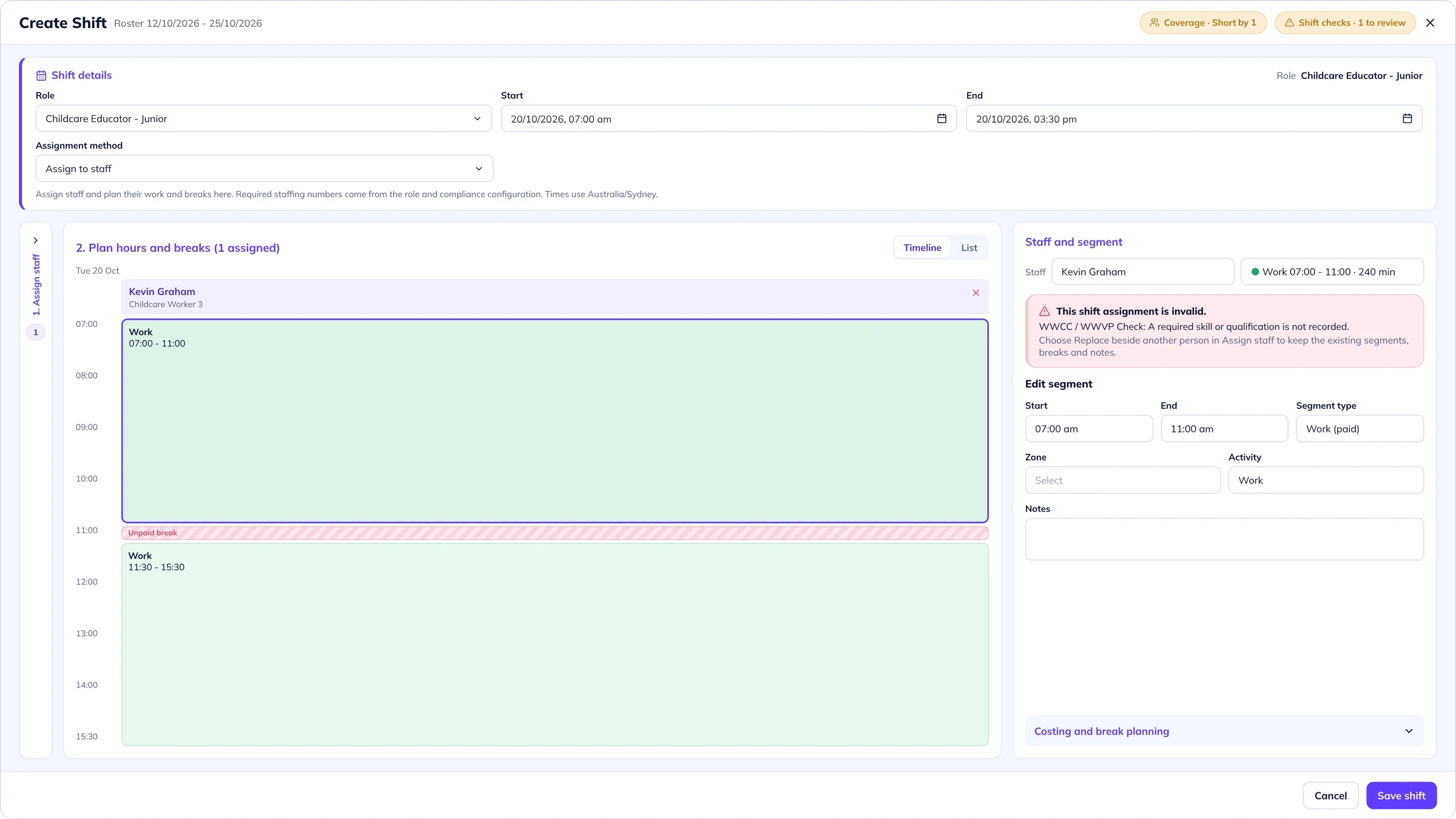
Imminently Rosters · invalid assignment
Step 03 of 07 · Manager
An educator without a recorded check is flagged.
At the council’s early learning centre, assigning someone without a recorded Working with Children Check is flagged as invalid before the shift is saved, with the way to fix it.
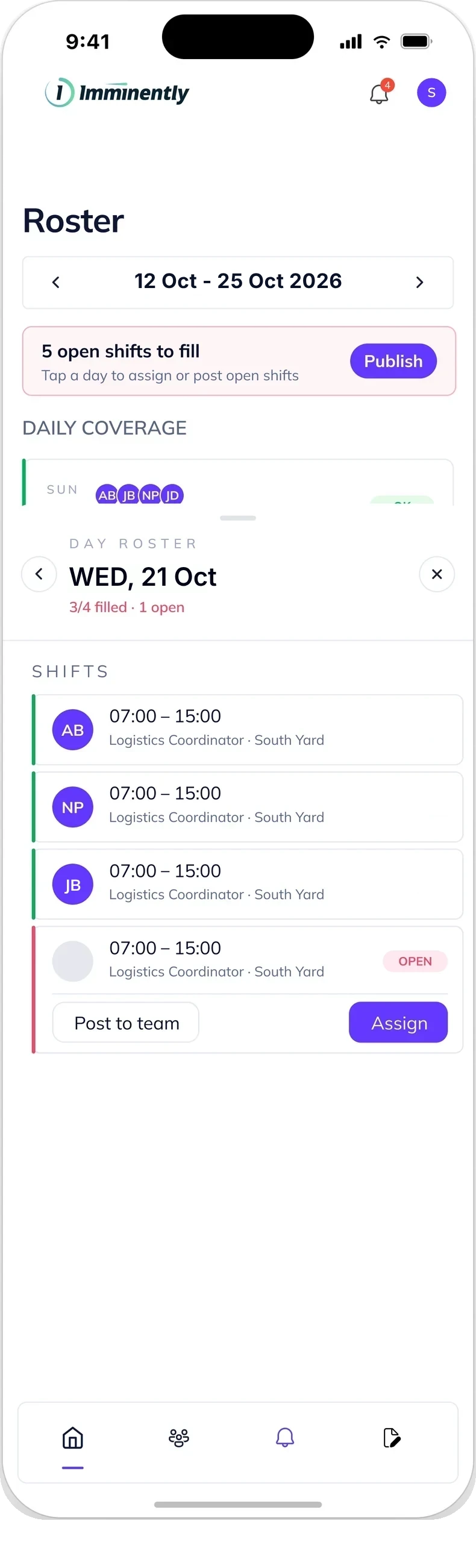
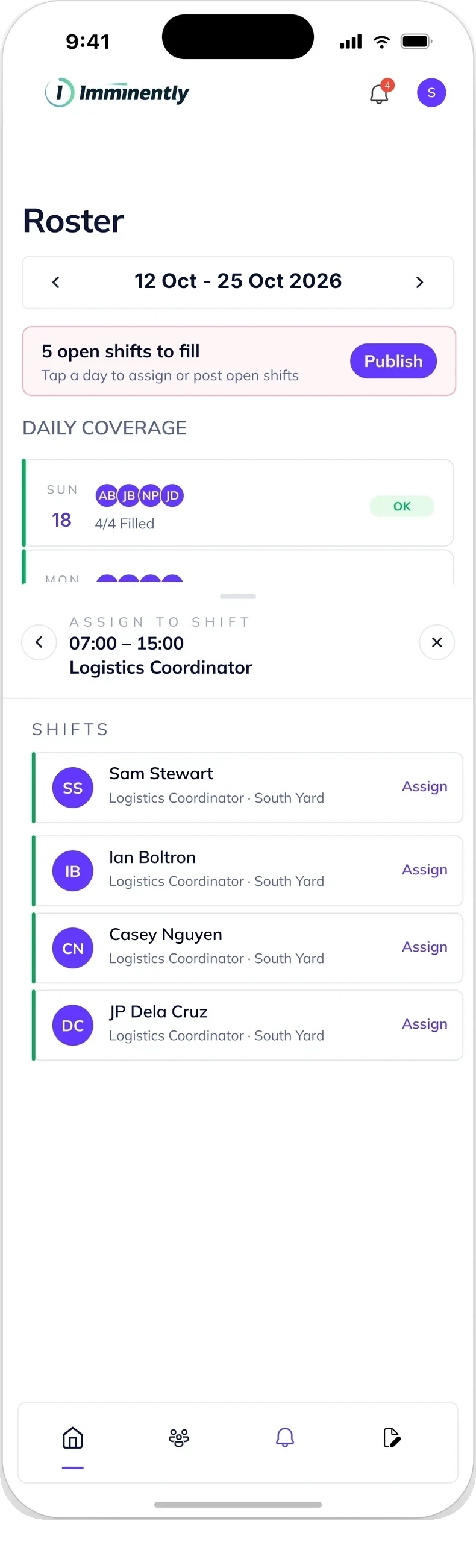
Step 04 of 07 · Manager
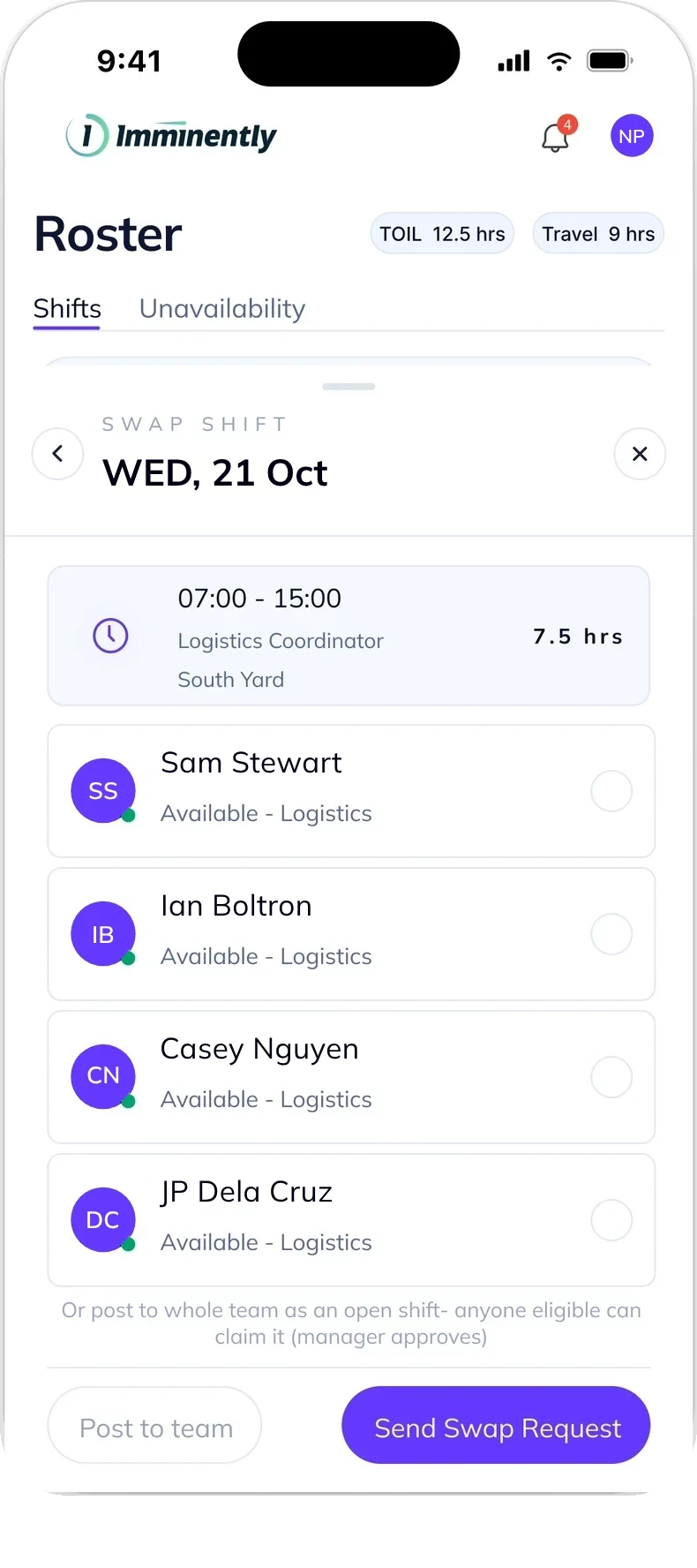
Fill a short day from the phone.
The manager opens a day that is one short, then assigns from a list that offers only eligible staff, or posts the open shift to the team.
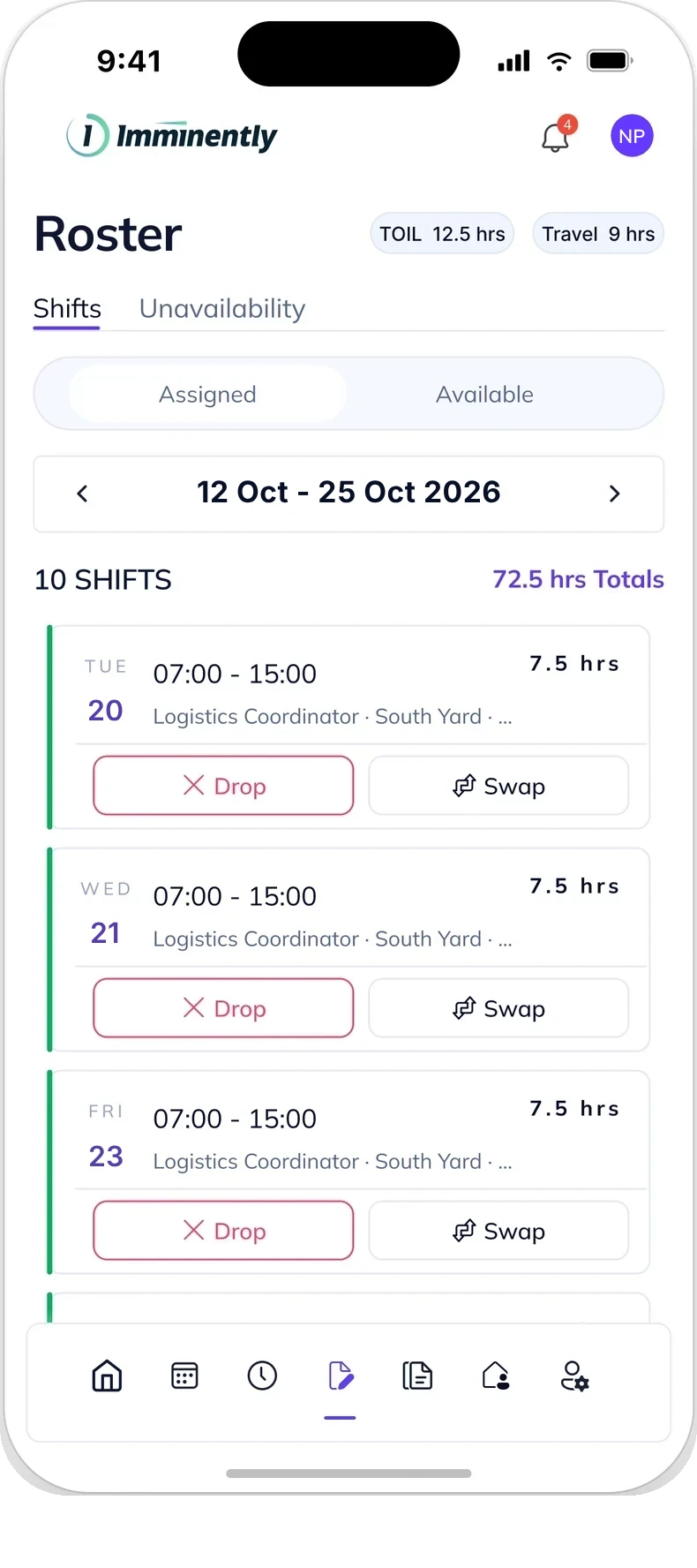
Step 05 of 07 · Employee
Staff swap with someone who can do the work.
An employee sees their own shifts, with swap and drop on each, and offers a shift to colleagues with matching skills or posts it to the team. Nothing changes until the manager approves.
Step 06 of 07 · Employee
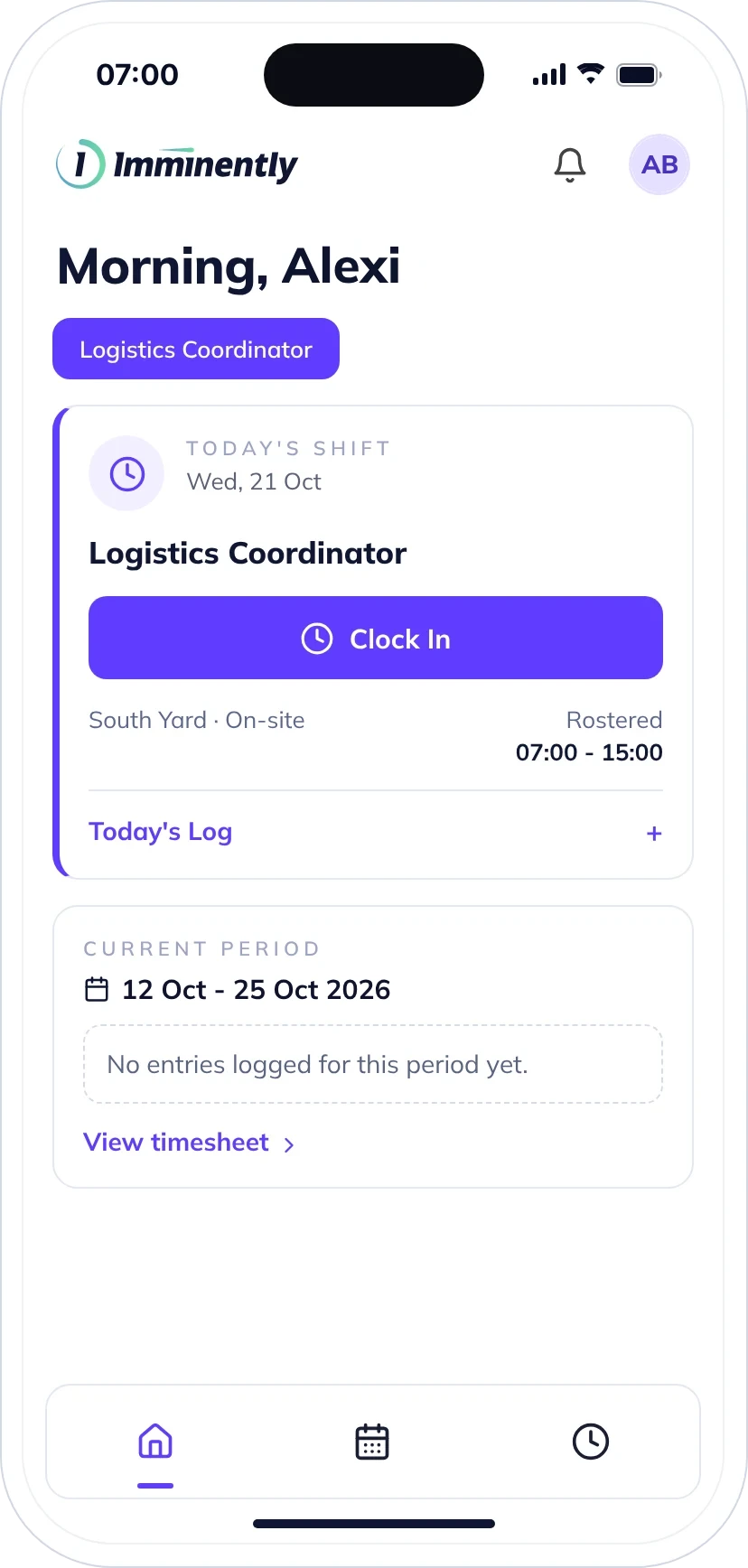
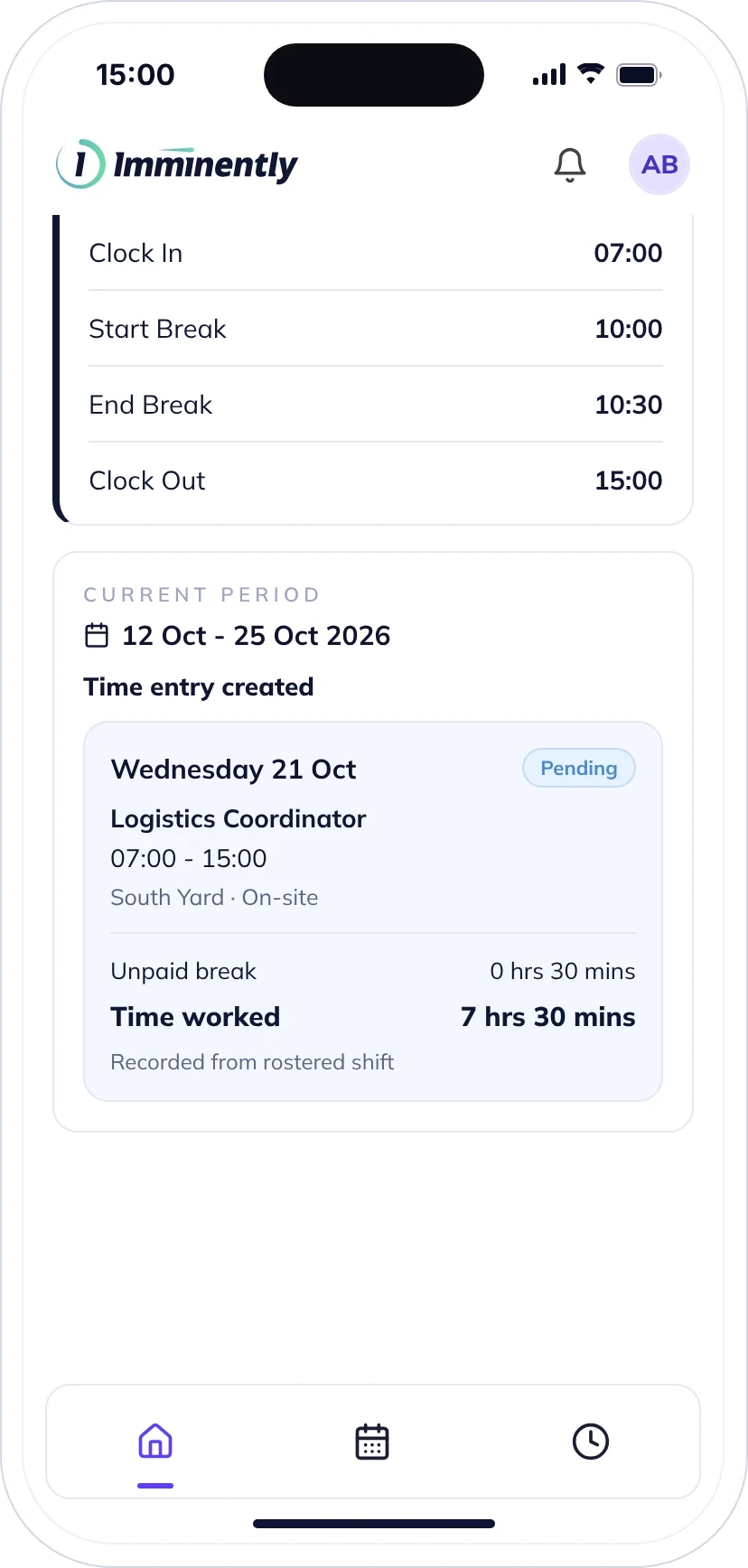
Clock in against the rostered shift.
The rostered shift is waiting in the app with one Clock In button, the site and the rostered hours beneath. At the end of the day the clock events, the break included, become a time entry against that shift, ready for approval.
Step 07 of 07 · Manager
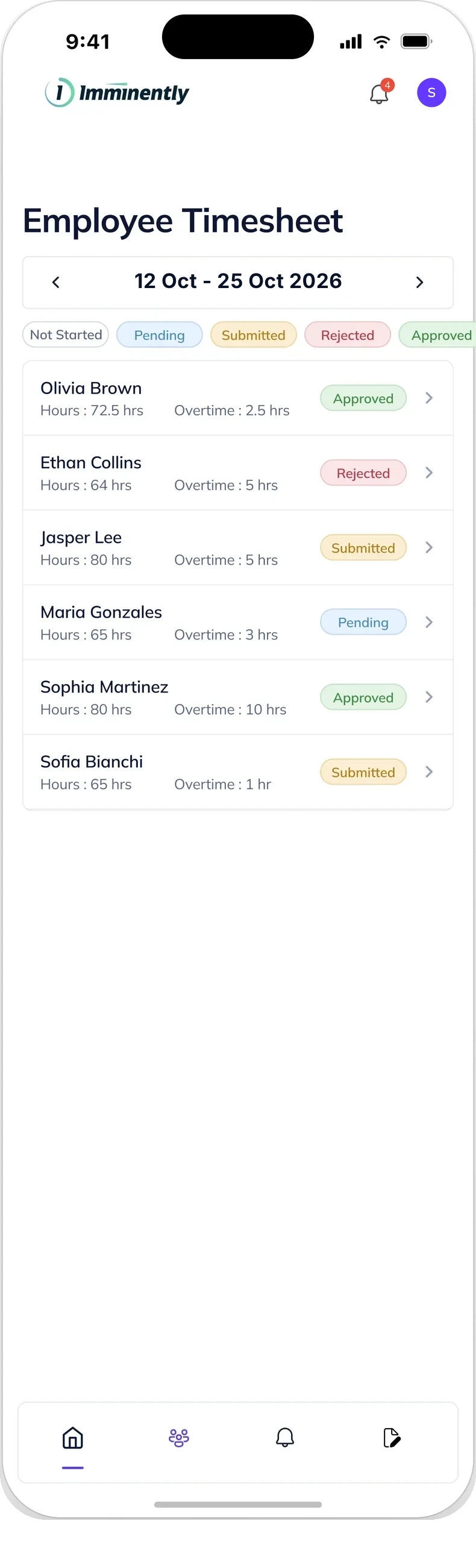
Every timesheet’s status, on the phone.
The manager sees the team’s timesheets for the period, each with its hours, overtime and status, from not started to approved, and opens any one to review it. Approved time is then interpreted against the award and agreements and goes to payroll as pay codes, hours and units.
People, locations, hours and amounts shown are examples.
THE LOCAL GOVERNMENT TEMPLATE
We do not start from a blank page.
Every council implementation starts from our local government template: the instruments, cohorts, rules and tests that are the same from council to council. Delivery then concentrates on what is genuinely yours.
What the template brings
For NSW councils, the Local Government (State) Award 2026 and the Local Government (Electricians) (State) Award, digitised and maintained as a shared base, with each council’s agreements and policies scoped as its own layer.
A rostering baseline for every council service, from children’s services and aquatic centres to water, waste and civil works, with the credentials and ratios each one needs; fatigue and rest rules are configured in the deployment.
A library of council rostering cohorts and exception scenarios built against the award, such as leave approved after publication, a sick-call refill, a start-time change inside the notice period, a public holiday on a rostered day off and a credential expiring mid-cycle.
Best-practice timesheet and approval configuration, ledgers for time in lieu, flexitime and travel time, and pay code mapping to your payroll.
A deferral map for your instruments: for every condition, which instrument governs, which defers, and which local arrangement overrides it.
Integration through the certified adapter for TechnologyOne, or open integration for other systems.
How it goes live
01Mobilise
Agree the boundaries, owners, governance and the delivery plan.
02Plan
Map your enterprise agreement, council agreements and individual arrangements against the template, and record each assumption for your confirmation.
03Deliver
Load your local arrangements as overlays on the award, map pay codes and cost codes, and set a roster model for each service.
04Test
Entitlement scenarios, system and integration testing, user acceptance and a parallel pay run, with the clause recorded against each test.
05Deploy
Go live in waves: start with Awards and add Timesheets and Rosters, or go service by service. Every wave runs on the same tenancy, with no re-implementation.
06Operate
Award and agreement changes are applied, regression tested and released as part of the service.
PROOF
Chosen by councils. Built with them.
CouncilsChosen in three states
The City of Karratha in Western Australia, the City of Salisbury in South Australia, and Central Coast Council and the City of Ryde in New South Wales have chosen our product, each under the awards and agreements that apply to it.
Co-designedWith NSW councils
The council rostering use cases were co-designed with NSW councils, and the template carries twenty rostering cohorts and sixteen exception scenarios built against the award.
AssuranceISO 27001 and SOC 2 Type 2
Data processed and stored in Australian data centres, each customer in its own tenancy with separate environments.
In use at
City of KarrathaLocal government
City of SalisburyLocal government
Central Coast CouncilLocal government
City of RydeLocal government
SERVICES AS SOFTWARE
The award is part of the service.
We provide, digitise and maintain the in-scope instruments as part of the software outcome. Your council confirms its local arrangements, its data and its acceptance decisions.
Can our enterprise agreement and council agreements be kept?
Yes. They are configured as overlays on the award for the cohorts and periods they cover. Each override replaces only the provisions it is allowed to replace, and savings provisions continue to apply when an agreement ends where the instrument requires it.
Do we have to replace our HR or payroll system?
No. Your HR system remains the source of employees, positions, leave and credentials, and your payroll keeps paying. Our product adds rostering, time capture and interpretation between them.
Can we start with award interpretation only?
Yes. Imminently Awards is available on its own where your existing timesheets can supply the facts it needs. Imminently Timesheets and Imminently Rosters each include Awards and can be added later on the same tenancy.
How do outdoor crews without a desk use it?
On the Imminently app on their phones: clocking in by geofence, QR code or photo where the site allows it, viewing rosters, swapping shifts and recording time.
What about children’s services and pools?
Their roster models hold the ratios, qualifications, supervision plans and credentials each service needs, configured in the deployment, with each shortfall flagged on the roster.
Who keeps the award current?
We do. Changes to the award and your in-scope agreements are applied, regression tested against your scenarios and released as part of the service.
Where is our data held?
In Australian data centres on Microsoft Azure, in your own dedicated tenancy with separate development, test and production environments. We hold ISO 27001 certification and a SOC 2 Type 2 report.
Where does NSW Council Cloud fit?
NSW Council Cloud is our product pre-built for New South Wales councils: a shared base on the Local Government (State) Award 2026 and the Local Government (Electricians) (State) Award, maintained once, with each council’s agreements and policies as its own layer. See the NSW Council Cloud page.
See it in your context
Bring a real council fortnight.
Bring a depot roster, a children’s service and your hardest pay period. We will run them through our product against your award and agreements.