A pension, from
claim to explanation.
Pensions are among the hardest entitlements to automate: qualification, residence, income and assets tests, rate calculators, supplements, payability and constant change of circumstances, all interacting over time. We have taken an age pension and a disability pension through the method for a national welfare system, connected to its system of record.
Qualification
Pension age, the conditions of the payment and any exemptions, each tested against the provision that sets it.
Residence
Periods of residence counted and combined, continuous and in total, with portability rules when the person is overseas.
Means tests
The income test and the assets test applied in full, with deeming and the partner’s income and assets, and the test that gives the lower rate applied.
Rates
The maximum basic rate, supplements and allowances built up through the rate calculator, step by step, with each figure drawn from the rate tables in force.
Payability
Whether the rate is payable: nil rates, multiple entitlements and the other exclusions the law sets out.
Reviews and change of circumstances
When income, assets, relationships or address change, the entitlement is recalculated for each period under the law in force at the time.
The decision report
Every conclusion, its value over time and the provision relied on, in plain English, for the officer, the person and the auditor.
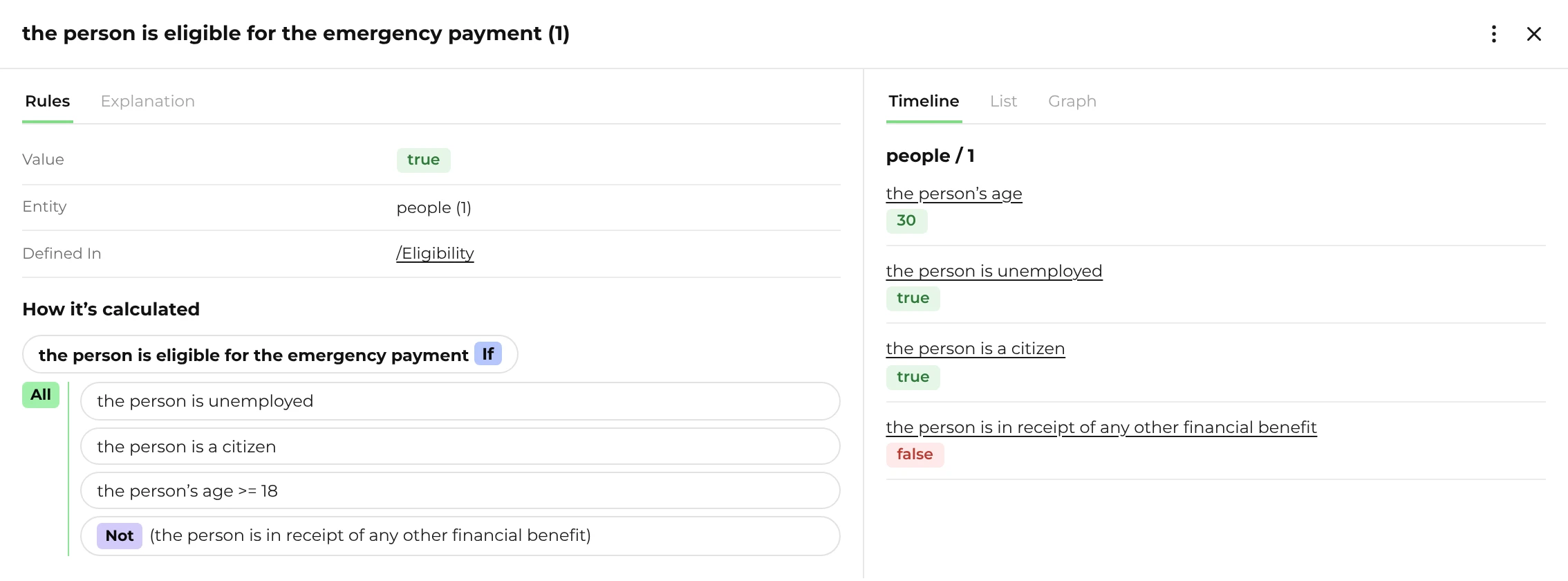
The person claiming or checking
Guided interviews for a new claim and for a change of circumstances run on the same rules. They ask only the questions the rules need and can show the outcome with its reasons.
The officer assessing
The determination reaches the officer’s system through the Decision API with its report beside it, so a review starts from the reasons rather than a recalculation.
The reviewer and auditor
Each determination is kept with its facts, rule version and provisions, so it can be explained, reviewed or run again for any past date.
A pension service that explains itself.
The rules that decide the pension also guide the person through the claim, give the outcome and explain it, in the person’s words and the law’s. Step through it: apply, read the report, then see what the person can do next.


Start your claim
One guided application checks whether you qualify and makes your claim. We only ask what the law needs for your situation, and we tell you why we ask.
Before you start, have ready
- The dates you have lived in the country, and overseas
- What income you receive, and how much
- What you own: bank accounts, shares and property
Your answers save as you go, so you can stop and come back to your claim at any time.
A warm start, and nothing asked that the law does not need.
The service opens on the person, not on a form: what to have ready, a guide to claiming, and answers that save as they go so the claim can be finished later.
Claim the age pension
Step 1 of 5It changes how your income and assets are counted. The law treats a couple as pooling their income and assets and sharing them equally.
Members of a coupleAbout you
Why we ask?It sets your pension age, which is 67, so you reached it on 14 March 2025.
Pension ageEvery question says why it is asked.
The date of birth sets pension age. Joan was born on 14 March 1958, so her pension age is 67 and she reached it on 14 March 2025. She is single, and that decides how her income and assets are counted: a couple’s are pooled and shared equally.
- Pension agesets when the pension can be claimed
- Qualificationpension age and residence
- Members of a couplehow a couple’s income is counted
Claim the age pension
Step 2 of 510 years qualifying residence
MetYou have lived in the country for a continuous period of at least 10 years: 32 years 3 months from birth, and 32 years 9 months since 1994.
Qualifying residenceQualificationUnless the law gives you another way to qualify, you need 10 years qualifying residence: one continuous period of at least 10 years, or periods adding up to more than 10 years with one of at least 5 years.
QualificationQualifying residenceResidence
Why we ask?Residence, counted as the person answers.
Joan enters the periods she has lived in the country and overseas, and the rules count them as she goes: one continuous period of 32 years meets 10 years qualifying residence.
- Residencewho counts as a resident
- Qualifying residence10 years
- Qualificationage and residence met
Claim the age pension
Step 3 of 5
Rent you receive is income. Income above the income free area reduces your rate under the income test.
IncomeIncome testIncome
Why we ask?Only the income questions that apply.
Joan chooses the kinds of income she receives and answers only for those. Rent is income, and income above the free area reduces the rate.
- Incomewhat counts as income
- Income testincome above the free area
Welcome to your age pension report
This report shows whether the age pension is payable to you, and why. Each answer is explained in plain English, beside the part of the law that decides it.
You qualify for the age pension, but your income makes your rate nil, so it is not payable to you at this time.
How your decision follows from the law
- Pension age reached67, reached 14 March 2025Pension age
- 10 years residence32 years without a breakQualifying residence
- Qualifiedage and residence both metQualification
- Income test: rate nilsingle, rent of $96,000 a yearIncome test
- Lower of the two ratesso your rate is nilRate
- Not payableat a nil ratePayability
The outcome first, and how it follows from the law.
After the assets questions and a final check, which are not shown here, Joan submits her claim. She qualifies on age and residence, but as a single person with rent of $96,000 a year her rate is reduced to nil, so the age pension is not payable to her. The report shows the decision as a chain, each link tied to its provision.
- Qualificationqualified
- Ratethe lower rate applies
- Payabilitynot payable at a nil rate
Assessment results
Submitted 10 Nov 2026, 9:12 amAssessment categories
Choose an answer to see how the law applies to it.
3.2 Rent from a property
Reasoning In plain English, beside the rule that applies
Rent you receive from your property is income.
IncomeIncome includes any amount a person earns, derives or receives for their own use or benefit, such as rent.
You are single, so your own income is counted in full. Only for a member of a couple are the two incomes added together and halved.
Members of a coupleFor a member of a couple, the two incomes are added together and divided by two to work out each person’s income for the income test.
Income above the income free area reduces your rate. At $96,000 a year the reduction is more than your maximum rate, so your income test rate is nil.
Income testIncome above the income free area is the income excess.
Your rate is the lower of your income test rate and your assets test rate, so it is nil.
RateThe lower of the income test rate and the assets test rate is the rate that applies.
At a nil rate, the age pension is not payable to you.
PayabilityThe pension is not payable to a person whose rate would be nil.
1 Pension age
Reasoning In plain English, beside the rule that applies
Pension age is 67. You were born on 14 March 1958, so you reached it on 14 March 2025.
Pension agePension age is set by the date of birth. For a person born in 1958 it is 67 years.
Reaching pension age is the first condition for the age pension.
QualificationA person qualifies once they have reached pension age and meet one of the other conditions, such as qualifying residence.
2 Residence
Reasoning In plain English, beside the rule that applies
You are a citizen who lives in the country, so you are a resident.
ResidenceA resident is a person who lives in the country and is a citizen, or has a permanent right to stay.
You lived here for 32 years without a break, which is more than the 10 years needed.
Qualifying residenceOne continuous period of residence of at least 10 years meets the residence condition.
With pension age reached, this means you qualify for the age pension.
QualificationPension age together with qualifying residence meets the conditions for the pension.
3.1 Pay from work
Reasoning In plain English, beside the rule that applies
You told us you do not work, so no pay from work is counted.
IncomeIncome includes any amount a person earns, derives or receives for their own use or benefit, such as rent.
3.3 Pension from overseas
Reasoning In plain English, beside the rule that applies
You told us you receive no pension from overseas, so none is counted.
IncomeIncome includes any amount a person earns, derives or receives for their own use or benefit, such as rent.
4 Assets
Reasoning In plain English, beside the rule that applies
Your assets are tested as well as your income.
Assets testThe assets test works out a reduction for assets, separately from the income test.
The lower of the two rates applies. With an income test rate of nil, the lower rate is nil.
RateThe lower of the income test rate and the assets test rate is the rate that applies.
Results by category, and the reasoning for every answer.
Each category shows met, nil or assessed. Choose any answer to see its reasoning in plain English, beside the rule it comes from. Guides, chat and a call back sit alongside.
- Incomewhat counts as income
- Members of a couplea couple’s income
- Income testincome above the free area
- Payabilitynot payable
What you can do next
Upload evidence
If the rent we used is not right, upload your rental statement and we will look at your claim again.
Ask for a review
If you think the decision is wrong, ask for it to be looked at again by a review officer.
If things change
If your income or assets change, for example the rent stops, you can claim again. The same rules work it out.
Resources for your situation
How rent counts as income.pdfHow the income test worksHow a review worksNotifications 3
What the person can do now, in one place.
Upload evidence, ask for a review, or claim again if things change, with notifications, resources for the person’s own situation, and help by chat or phone.
Show us the rent you receive
Why we ask
Rent is income, so we need to know how much you receive.
IncomeIncome includes any amount a person earns, derives or receives for their own use or benefit, such as rent.
What happens next
- We check the documentagainst the answer you gave
- We review the decision if there is reason toWith the same rules, we can confirm it, change it, or replace it with a new one.Review of a decision
- You get the outcomewith the reasons for every answer
Evidence, tied to the answer it supports.
Joan uploads her rental statement against the rent answer. If it gives reason to, the decision is reviewed with the same rules, and a new report follows.
- Incomewhat counts as income
- Review of a decisionnew evidence
Ask us to look at the decision again
How a review works
Under the pension law- You ask for a reviewA person affected by the decision can ask.Application for review
- A review officer looks at it againThey confirm the decision, change it, or replace it with a new one.Review of the decision
- You get the outcome in writingA written notice of the review decision.Notice of the decision
- If you still disagreeYou can ask for an independent review.Independent review
A review, explained step by step.
If Joan thinks the decision is wrong she can ask for a review. The screen sets out who reviews it, what they can decide, how she hears and where she can go next, each step with its provision.
- Application for reviewwho can ask
- Review of the decisionwhat a reviewer can decide
- Notice of the decisionhow the person hears
- Independent reviewwhere to go next
Tell us about a change
Ray Morgan · receives the age pension

Pay from work is covered by an earnings concession. Each fortnight the first $300 is not counted, and your concession balance covers more before any of it counts as income.
Earnings concessionYour new job
Why we ask?A change of circumstances, in the person’s own terms.
Ray Morgan, who receives the age pension, reports a new job from 9 November 2026 paying $1,400 a fortnight. Only the questions for that change are asked.
- Earnings concessionpay from work
Your new job and your age pension
| Fortnight | Pay | Concession | From balance | Counted as income | Balance after |
|---|---|---|---|---|---|
| 1 | $1,400 | $300 | $1,100 | $0 | $10,700 |
| 2 | $1,400 | $300 | $1,100 | $0 | $9,600 |
| Fortnights 3 to 9: the same, $1,100 a fortnight from the balance | |||||
| 10 | $1,400 | $300 | $1,100 | $0 | $800 |
| 11 | $1,400 | $300 | $800 | $300 | $0 |
| 12 on | $1,400 | $300 | $0 | $1,100 | $0 |
Why
The first $300 of pay each fortnight is not counted.
Earnings concessionA set amount of each fortnight’s pay from work is not counted as income.
Your concession balance covers the rest while it lasts, and goes down by the amount it covers.
Earnings concessionAn unused concession balance can cover pay above that amount, and it reduces by the amount it covers.
In fortnight 11 the last $800 is used, so $300 counts. After that, $1,100 counts under the income test.
Income testOnce the balance is used up, the pay above the set amount counts as income under the income test.
The balance cannot hold more than $11,800.
Earnings concessionThe balance has an upper limit, and it cannot hold more than that limit.
The effect, fortnight by fortnight, before it happens.
Of $1,400 a fortnight, $300 is not counted and his $11,800 concession balance covers the rest for 10 fortnights. In the 11th, $300 counts; from the 12th, $1,100 counts under the income test. He is told before it starts.
- Earnings concession$300 a fortnight not counted
- Income testthe rest counts once the balance is used
- Balance limit$11,800
Welcome to your age pension report
This report shows whether the age pension is payable to you, and why. Each answer is explained in plain English, beside the part of the law that decides it.
You qualify for the age pension, but your income makes your rate nil, so it is not payable to you at this time.
How your decision follows from the law
- Pension age reached67, reached 14 March 2025Pension age
- 10 years residence32 years without a breakQualifying residence
- Qualifiedage and residence both metQualification
- Income test: rate nilsingle, rent of $96,000 a yearIncome test
- Lower of the two ratesso your rate is nilRate
- Not payableat a nil ratePayability
Assessment results
Submitted 10 Nov 2026, 9:12 amAssessment categories
Choose an answer to see how the law applies to it.
3.2 Rent from a property
Reasoning In plain English, beside the rule that applies
Rent you receive from your property is income.
IncomeIncome includes any amount a person earns, derives or receives for their own use or benefit, such as rent.
You are single, so your own income is counted in full. Only for a member of a couple are the two incomes added together and halved.
Members of a coupleFor a member of a couple, the two incomes are added together and divided by two to work out each person’s income for the income test.
Income above the income free area reduces your rate. At $96,000 a year the reduction is more than your maximum rate, so your income test rate is nil.
Income testIncome above the income free area is the income excess.
Your rate is the lower of your income test rate and your assets test rate, so it is nil.
RateThe lower of the income test rate and the assets test rate is the rate that applies.
At a nil rate, the age pension is not payable to you.
PayabilityThe pension is not payable to a person whose rate would be nil.
1 Pension age
Reasoning In plain English, beside the rule that applies
Pension age is 67. You were born on 14 March 1958, so you reached it on 14 March 2025.
Pension agePension age is set by the date of birth. For a person born in 1958 it is 67 years.
Reaching pension age is the first condition for the age pension.
QualificationA person qualifies once they have reached pension age and meet one of the other conditions, such as qualifying residence.
2 Residence
Reasoning In plain English, beside the rule that applies
You are a citizen who lives in the country, so you are a resident.
ResidenceA resident is a person who lives in the country and is a citizen, or has a permanent right to stay.
You lived here for 32 years without a break, which is more than the 10 years needed.
Qualifying residenceOne continuous period of residence of at least 10 years meets the residence condition.
With pension age reached, this means you qualify for the age pension.
QualificationPension age together with qualifying residence meets the conditions for the pension.
3.1 Pay from work
Reasoning In plain English, beside the rule that applies
You told us you do not work, so no pay from work is counted.
IncomeIncome includes any amount a person earns, derives or receives for their own use or benefit, such as rent.
3.3 Pension from overseas
Reasoning In plain English, beside the rule that applies
You told us you receive no pension from overseas, so none is counted.
IncomeIncome includes any amount a person earns, derives or receives for their own use or benefit, such as rent.
4 Assets
Reasoning In plain English, beside the rule that applies
Your assets are tested as well as your income.
Assets testThe assets test works out a reduction for assets, separately from the income test.
The lower of the two rates applies. With an income test rate of nil, the lower rate is nil.
RateThe lower of the income test rate and the assets test rate is the rate that applies.
What you can do next
Upload evidence
If the rent we used is not right, upload your rental statement and we will look at your claim again.
Ask for a review
If you think the decision is wrong, ask for it to be looked at again by a review officer.
If things change
If your income or assets change, for example the rent stops, you can claim again. The same rules work it out.
Resources for your situation
How rent counts as income.pdfHow the income test worksHow a review worksNotifications 3
The same service on a phone.
The same screens, laid out for a phone: the outcome, the reasons and what to do next. Choose an answer on the phone to see its reasoning.
Joan Avery and Ray Morgan, and their amounts, are an example.
One set of rules. The same answer in every channel.
The guided application, the decision and the explanation are not three systems to keep in step. They are one set of rules, written from the law, with every rule linked to the provision it comes from. Online, in the app, on the phone or at the counter, the person and the officer get the same answer from the same facts, with the same reasons. When the law changes, the rules change once and every channel follows.
The provisions this example relies on, each labelled by what it decides.
ResidenceIncomePension ageQualificationPayabilityRateEarnings concessionThe rules for claims and reviewsReview of a decisionApplication for reviewNotice of the decisionIndependent reviewEach rule keeps the words it came from, with tests generated from them. The person’s questions, the decision and the reasons all come from here.
Bring an entitlement
that is hard to explain.
We will take one provision from the law to rules, tests, a decision report and an interface your systems can call.